

*Reviews implementation of IRS
Excelsior Correspondent
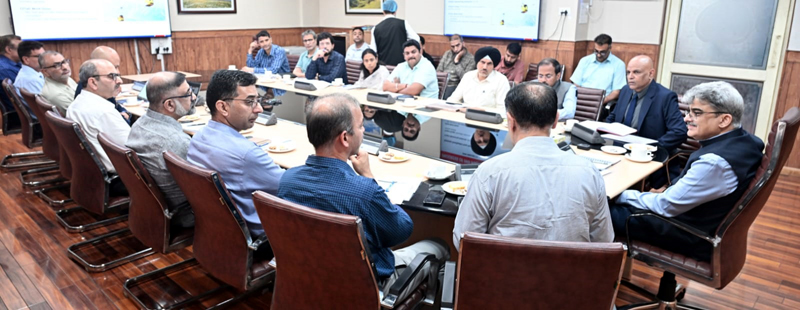
SRINAGAR, Aug 14: Chief Secretary, Atal Dulloo, today chaired a high-level meeting to review the preliminary roadmap of the Centre for Innovation and Transformation in Governance (CITaG), aimed at accelerating the economic growth, improving governance and reforming the planning process in Jammu & Kashmir.
The presentation, made during the meeting, highlighted significant strides in Public-Private Partnerships (PPP), governance transformation and institutional capacity building across the UT.
Besides the ACS, Planning and Tourism Departments the meeting was attended by Principal Secretary, PWD; Principal Secretary, Culture; Principal Secretary, Finance; Director, IIM Jammu; Commissioner Secretary, I&C; Commissioner Secretary, GAD; Secretary, S&T; Secretary, L&E; MD, J&K Cable Car Corporation; Representative from NHLML and other concerned officers.
The Chief Secretary underscored the significance of CITaG in framing a futuristic roadmap for all-round development of J&K. He highlighted its role in conception, identification and implementation of high impact projects in PPP mode for giving boost to key sectors like Industries, Tourism, Agriculture, Urban Planning, Handicrafts and others here.
The Chief Secretary also advised the Planning Development & Monitoring Development to take steps to acquaint all the departments with the role of CITaG. He called for holding brainstorming sessions with these departments to have acquaintance and awareness about their collaboration with CITaG in implementation of their projects and plans.
He impressed upon the CITaG team to come up with implementation strategy for the best practices and focus on few at a time for their effective grounding. He pointed out several of the important projects that could be focussed upon initially including development of an Industrial estate in a PPP mode as there is a vast land bank created across the districts of the UT.
CEO, CITaG, Dr Sandeep, in his presentation listed out a total of 63 PPP projects representing a tentative investment of over Rs 21,988 cr. Currently, 21 of these projects are active, with 42 others on a development shelf.
The key projects under active consideration included the adaptive reuse of the historic Mubarak Mandi Heritage Complex in Jammu for developing a heritage hotel, enhancing tourism infrastructure at scenic tourist destinations, establishment of a new ropeway projects and solar parks here.
The CEO confirmed that preliminary site assessment reports and stakeholder consultations are underway for these and other projects, laying the groundwork for future investment and development.
In addition to PPPs, it was divulged that CITaG’s broader mandate includes 65 deliverables spanning several key areas of governance and economic development. The meeting reviewed progress on various initiatives, including the preparation of new PPP policy for Jammu & Kashmir, measures for increasing revenue generation, and strategies for promoting entrepreneurship and export promotion.
Meanwhile, in a decisive step towards strengthening the disaster preparedness and response, Chief Secretary, chaired a high-level meeting to review the implementation of Incident Response System (IRS) in Jammu and Kashmir.
Speaking on the occasion, the Chief Secretary underscored the critical importance of resource mapping at the district level. He directed the Disaster Management Department to provide necessary formats and guidelines to facilitate the process.
Highlighting the UT’s vulnerability to natural and anthropogenic disasters, he called for full operational readiness through regular mock drills, periodic assessments and seamless coordination to ensure timely and effective response during emergencies.
Principal Secretary, DMRR&R, Chandraker Bharti, informed that the primary objective of the IRS is to establish a unified chain of command and clearly defined roles for disaster response teams to minimize loss of life and property. He noted that the system comprises of trained composite teams capable of handling all aspects of disaster response, thereby enhancing the accountability and operational efficiency.
 Follow our WhatsApp channel
