

Rakesh Kumar Sharma
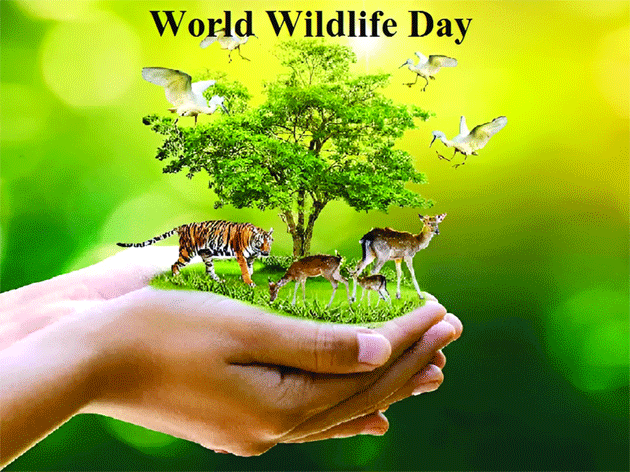
World Wildlife Day is celebrated every year on 3rd March across the world to create awareness among people and to highlight the importance of wildlife and the measures required for its protection. This day was proclaimed by the United Nations General Assembly in 2013 and coincides with the adoption of the Convention on International Trade in Endangered Species of Wild Fauna and Flora (CITES). It is observed worldwide by various countries, international organisations, government bodies, non-governmental organisations, educational institutions, and environmental groups through seminars, awareness campaigns, exhibitions, and conservation programmes, thereby reinforcing the shared global responsibility of protecting wildlife and preserving biodiversity for future generations.
Human lnduced Threats To Wildlife.
Wildlife is a lifeline for the Earth, playing a fundamental role in sustaining ecosystems and supporting human survival. However, humans are responsible for making many wildlife species endangered through activities such as illegal wildlife trade, deforestation, and exploitation. Indiscriminate development and large-scale infrastructure projects are increasingly disturbing natural habitats and forests, leading to environmental consequences. The loss of wildlife disrupts ecosystems and creates ecological imbalance, which ultimately poses serious threats to biodiversity, food security, climate stability, and the overall well-being of present and future generations, making wildlife conservation an urgent global responsibility.
India As A Global Biodiversity Hotspot.
India is exceptionally rich in biodiversity, with nearly 25% of its total area is covered with forests and trees . Approximately 9% of the global plant species and 7.5% of the world’s animal species are native to India. The country is home to an estimated one lac species of animals and around 55,000 species of flora (plants) including flowering plants, trees, shrubs, grasses, algue, fungi and lichens making the country one of the world’s richest region in plant diversity.
India’s unique geographical and climatic variations , from the high Himalayan ranges in the north to the coastal ecosystems in the south, contribute significantly to this remarkable biodiversity. These regions support a wide range of ecosystems, including dense forests, grasslands, wetlands, deserts, and mangroves.
Many habitats in India are home to rare and endangered species such as the Bengal tiger, Indian elephant, one-horned rhinoceros, and the snow leopard, among others.
Jammu and Kashmir is also endowed with exceptionally rich biodiversity of flora and fauna due to its wide range of climatic zones, diverse topography, and unique Himalayan ecosystem. The region supports thousands of plant species, including dense forests of deodar, pine, fir, oak, and a wide variety of medicinal and alpine plants. Its varied habitats, ranging from subtropical forests in Jammu to temperate valleys and alpine meadows in Kashmir also sustain a remarkable diversity of wildlife. Several species of mammals, birds, reptiles, amphibians, and fish are found here, including rare and endangered species such as the snow leopard, hangul (Kashmir stag), Himalayan black bear, and migratory birds that visit its wetlands each year. This rich biodiversity not only maintains ecological balance but also highlights the urgent need for conservation and sustainable development in the region.
Major Global Conservation Initiatives .
An alarming average decline of nearly 73% in monitored wildlife populations between 1970 and 2020 highlights the urgent need for comprehensive and coordinated conservation efforts worldwide. Addressing this crisis requires multifaceted action involving governments, international treaties, scientific institutions, and robust funding mechanisms to halt and reverse biodiversity loss. The protection of wildlife and the preservation of biodiversity are critical for maintaining a healthy ecological balance and ensuring the long-term sustainability of life on Earth. Key global conservation initiatives include the Global Wildlife Programme led by the World Bank, along with the efforts of international organisations such as the International Union for Conservation of Nature and the World Wide Fund (WWF). The WWF plays a significant role by operating in over 100 countries to protect threatened species and their habitats through scientific research, conservation strategies, and community-driven initiatives. These efforts aim to mitigate major threats such as habitat destruction, climate change, and illegal poaching. Similarly, organisations like Conservation International and the Wildlife Conservation Society are actively engaged in research, policy advocacy, and on-ground conservation programs. Collectively, these organizations work closely with governments, local communities, and scientific experts to develop sustainable solutions for global biodiversity conservation.
Conservation of Wildlife Efforts by India
India, being exceptionally rich in biodiversity and a responsible, globally conscious nation, has consistently demonstrated a strong commitment to wildlife conservation and the maintenance of ecological balance. Nearly 25 percent of its total geographical area is covered under forests, providing a pollution-free and conducive environment that supports diverse flora and fauna. As part of its conservation strategy, the country has established a vast network of protected areas, which includes 106 National Parks, 567 Wildlife Sanctuaries, large number of Conservation Reserves, and Community Reserves spread across different ecological zones. These protected areas play a vital role in safeguarding critical habitats and endangered species. Through these measures, India addresses pressing threats such as habitat loss, deforestation, climate change, illegal wildlife trade, and human-wildlife conflict. Supported by strong legal frameworks, scientific management, and active community participation, India continues to strengthen its conservation efforts to ensure the long-term protection of its rich wildlife heritage.
Changing Trends in Wildlife.
Wildlife in India and across the world is witnessing significant changes due to climate change, rapid urbanisation, and increased human activity. Animals are increasingly entering urban and rural human settlements as their natural habitats shrink, leading to new patterns of coexistence as well as conflict. Migration timings and routes of birds and animals are changing in response to rising temperatures and altered food availability. Many species are showing remarkable adaptability by modifying their behaviour, such as becoming more nocturnal to avoid human disturbance or adjusting to noise and artificial lighting. At the same time, advancements in technology like GPS tracking, camera traps, and satellite monitoring are helping scientists better understand these changes. Overall, these evolving trends reflect not only the pressures faced by wildlife but also their growing resilience and ability to adapt in a rapidly changing world.
Acts Against Cruelty to Animals in India
India has enacted several effective laws to prevent cruelty towards animals and to ensure their humane treatment. The Prevention of Cruelty to Animals Act, 1960 is a landmark legislation aimed at preventing the infliction of unnecessary pain or suffering on animals. The Act also provides for the establishment of the Animal Welfare Board of India, which promotes animal welfare and advises the government on related matters. Penalties under this Act primarily include fines and, in certain cases, limited imprisonment.
Similarly, the Wildlife Protection Act, 1972 serves as the principal legislation for the protection and conservation of wild animals in India. Recent legal developments, including provisions under the Bhartiya Nyay Sanhita, 2023 (which consolidates and modernizes criminal laws in India), supplement the Wildlife Protection Act by imposing stricter criminal liability and enhanced penalties for wildlife offences. These reforms reflect India’s broader commitment to strengthening legal deterrents against animal cruelty and wildlife crime.
Conclusion: Collective Global Responsibility
Forests and wildlife are invaluable assets that enrich our planet and make it a beautiful place to live. Their incredible diversity sustains ecosystems and supports the survival of all living beings. Protecting and nurturing wildlife is not the responsibility of a single nation or occasion but a shared global duty. We must cultivate a strong sense of empathy and care towards all forms of life, both flora and fauna, not only on World Wildlife Day but every day. Conservation is not a matter of choice; it is a necessity for ensuring ecological balance and a sustainable future for generations to come.
(The author is a Retired Tehsildar and President,
Golden Age Welfare Society, Jammu)
 Follow our WhatsApp channel
