

Col J P Singh
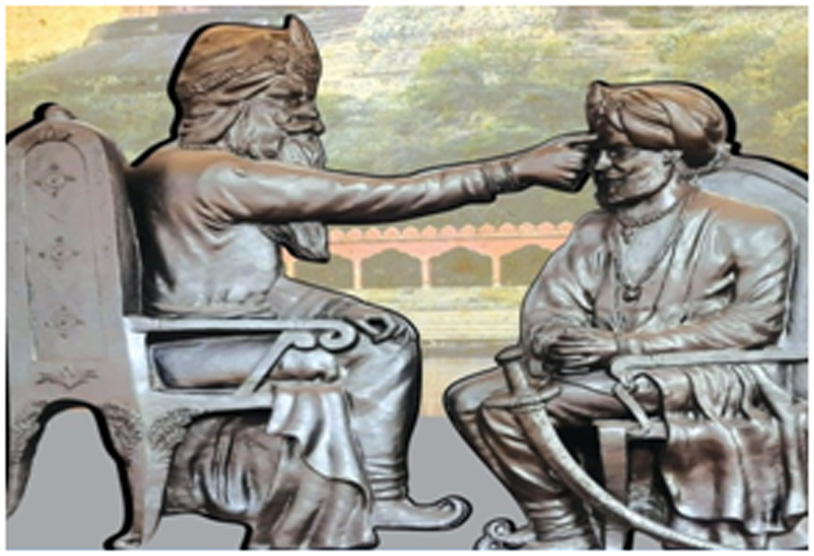
In the picture is Maharaja Ranjit Singh, the Emperor of Punjab, anointing a Dogra Rajput Gulab Singh, on 17 June 1822 at Jeo Pota Akhnoor and declaring him Raja of Jammu. This is a rare happening in the history of India. An effort is made through this story to unravel the mysteries of meteoric rise of the Dogra Chieftain.
During the 1st quarter of the nineteenth century, Bharat’s general body politics was in a general state of decay. The Mughal Sultanate had long been in the process of imploding. The only reckonable political power in India was British East India Company.Most of the Indian Rulers had either lost their empires to the British or had accepted Suzerainty of East India company. But there was still a notable exception. Ranjit Singh, a versatile Sikh warrior. He succeeded in establishing a vast and powerful kingdom in the northwest of India at the very critical time when other Indian Princes had either relinquished or were in the process of relinquishing their sovereignty to the British. At the very time, a Dogra from Jammu, a General in the Army of Maharaja Ranjit Singh was advancing his career with his visionary moves &military acumen. He earned the favours of Sikh ruler to the level that the Emperor himself came to Akhnoor to crown him. Emperor applied the Raj Tilak himself and that too upside down to the surprise of priests and gentry clarifying that he is implanting a tree with roots deep down in the mother earth so that it sustains with strength for long. That prophesy came true when Raja Gulab Singh thereafter didn’t look back. Through ability and foresight on the one hand and intrigues on the other,he expanded his Raj to Ladakh, far-off Gilgit-Baltistan and even made lengthy adventurous forays into Western Tibet till asked to stop further ingress. Soon after that hediplomatically brought Kashmir under his direct rule thereby knitting an empire spanning over 80 Lakh Sq. Miles of territory. Many allege treachery in doing so. What & how he did it is enshrined in ‘Gulab Nama’ compiled by Dewan Kirpa Ram in 1865. However the most and widely acclaimed biography on Maharaja Gualb Singh was written by Sardar K M Panikkar, a distinguished Indian Diplomat and historian who even served as an official in the govts of Kashmir Maharaja’s. Almost all the writers have given comprehensive & dispassionate account of the life and achievements of Dogra Chief who indeed played a significant role in the recreation of histography of Northwest India during the 19th Century.
Gulab Singh was Maharaja on the one side but as a man he was a great soldier, a politician, a diplomat and a strategist. Later traits were abundantly exhibited by Gulab Singh on several occasions particularly on various expeditions despatched by Sikh Emperor to Northwestern boundaries. In 1813 Maharaja Ranjit Singh was impressed by Gulab Sing’s performance in an otherwise disastrous campaign against Afghans occupied Kashmir. In 1818 Gulab Singh participated in the invasion of Multan. During theSiege of the Fort, he volunteered to rescue a Sikh Warrior who had fallen at the foot of the wall. Despite the incessant enemy fire, brought him to safety. Maharaj lauded this brave act in his Darbar. Deception singularised Gulab Singh’s next exploit. In 1819-20 he sought Ruler’s permission to crush an uprising in Jammu. A rebellion had been incited by Mian Dido. Dido roamed around the countryside with a large number of followers bidding open defiance to the Sikh rule and gained popularity by robbing the wealthy and distributing the booty to the poor. Gualb Singh reached Jammu and set out to locate the illusive Robin Hood. He found that wherever Dido went people offered him food & shelter. Hence the willy Dogra impersonated the rebel Mian to appear in several villages. Those who unsuspectedly came forward to welcome him were severely punished. Soon people started refraining from welcoming and supporting Dido either because they feared that he was an imposter or they dreaded the consequences of assisting him. Bereft of the local support Mian was compelled to fall back to his estate of Jagti, Nagrota. Sikh forces easily spotted him and surrounded him atop a hill asking him to surrender. Refusing to do so, Mian was shot at. When Emperor heard that Mian Dido has been eliminated, Gulab Singh was awarded additional Jagirs. In 1820, Dogra Chief seized Rajouri & Bhimber. In 1821 he seized the Fort of Basohli and secured Kishtwar by yet another deceitful act. Maharaja was so elated with the latest territorial acquisitions in Jammu Hills that he decided to place entire Jammu under direct rule of Gulab Singh.Thus the Maharaja personally travelled to Akhnoor to confer upon him the Title of Raja in a colourful ceremony on the bank of Chenab. His control over Jammu wasfurther strengthened when during the same year his distant cousin, Chet Singh, a grandson of Raja-e-Rajgan Ranjit Dev formally renounced all claims to the hill territories in favour of Raja Gualb Singh. Similarly many Principalities fell in lap one after the other.
His meteoric rise to prominence in the Sikh Durbar is marked by numerous salient features. First. He was brave, assiduous, handsome and robust; the qualities which earned Emperor’s admiration. Second. He possessed a character which could both charm and churn the opponent. Third. Generally soft spoken, gracious and affable, he could, if necessity arose, would transform into a cold-blooded schemer or a savage tormentor. Four. Gulab Singh received the solid backing of his younger brothers, Dhian Singh & Suchet Singh for his phenomenal rise to power. (His brothers through theirpolitical acumen &administrative qualities acquired remarkable strength and patronage at Lahore Durbar). Five. Gulab Singh and his brothers were lavishly rewarded by the Sikh emperor for their loyalty and unstinted selfless services. Six. The Sikh ruler’sfatherly infatuation for Dhian Singh’s son, Hira Singh further elevated the Dogra brother’s fortunes. Such occurrences are rare in today’s politics.
Sikh historians have called him Jammu Fox because they attribute fast imploding of Sikh empire after Maharaja Ranjit Singh’s death,in 1839, to Maharaja Gulab Singh. They advocate that by the blessings of British, Gulab Singh manipulated the dismemberment of Sikh empire to grab Kashmir for himself being very rich in resources. There is no denying that he was no saint and where his interest clashed, he would not hesitate to resort to shrewd stratagem which would in ordinary life be considered deceitful because he was trained in environs where intrigue and treachery were all considered an integral part of politics. He was willing to yield with grace where there was no other option open to negotiate when that suited his interest and even to part with money when that would serve his purpose.Thusthe adage ‘Fox’, denounced by Dogras, may not be considered obnoxious in such cases.
Gulab Singh’s justice was simple but prompt. It was expeditious and on the spot. He made a whirlwind tour of the state and cleaned the corrupt and despot officials from the administration. His summary method in dealing with them made him a terror to the tribe of petty functionaries who indulged in corruption. For large numbers he was a just ruler.
Gulab Singh was one of the most remarkable warriors that India produced in the 18/19th Century. Others, such as Haidar Ali and Maharaja Scindia who began their life in obscurity, also founded Kingdoms and Dynasties. But Gulab Singh’s case was entirely different where a man started his career as a petty official in Lahore Durbar, conquered Kingdoms and territories and established himself as a sovereign ruler of a composite state of Jammu and Kashmir. In a century devoid of historical achievements in India, Gulab Singh stands out as the solitary figure of political eminence. No previous Indian ruler, not even Samudra Gupta or Akbar, had ever dreamed of invading Tibet.He did it. A ruler of monumental achievements should be celebrated which is appreciably being done by Raj Tilak Celebration Committee led by Th. K P Singh as a public function every 17 June.
(Authoris Co-Chairman of Celebration Committee)
 Follow our WhatsApp channel
