

‘Udhampur-Baramulla rail link project completed’
*Pace of work tripled in Central Govt’s 3rd term
NEW DELHI, Jan 31:
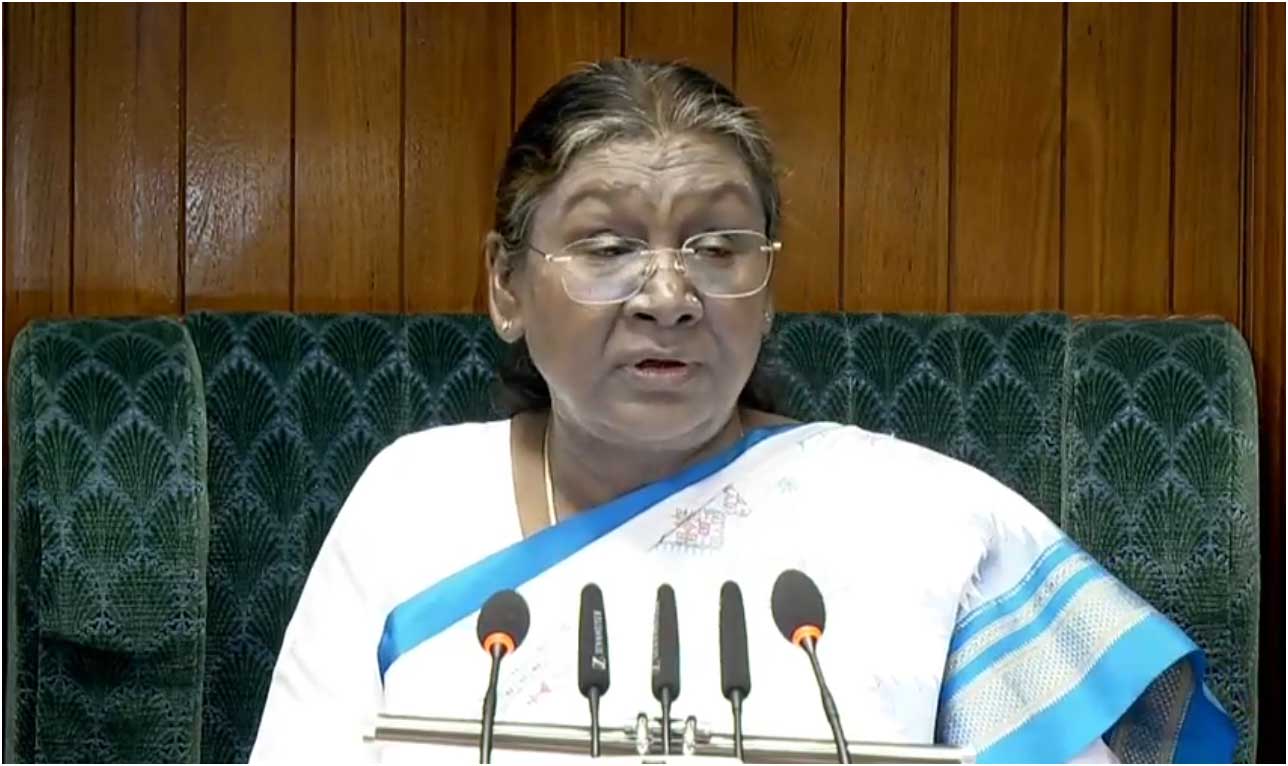
President Droupadi Murmu on Friday said there is a conducive environment for development in Jammu and Kashmir after the abrogation of Article 370.
Addressing both Houses of Parliament assembled together in the Lok Sabha chamber, Murmu noted that the Lok Sabha and Assembly elections were conducted in a peaceful manner in Jammu and Kashmir and the people deserve commendation for this achievement.
Follow the Daily Excelsior channel on WhatsApp
“After the abrogation of Article 370, there is a conducive environment for development in Jammu & Kashmir,” she said.
CLICK HERE TO WATCH VIDEO
The President said the Udhampur-Srinagar-Baramulla Rail Link Project has been completed, connecting the nation from Kashmir to Kanyakumari through railway line.
“Under this ambitious project, the Chenab Bridge has been constructed, which is the highest railway bridge in the world,” she said.
Murmu said India’s first rail cable-stayed bridge, the Anji Bridge, has been completed and the work on the Shinkun La tunnel was also progressing successfully.
“Upon completion in the near future, it will be the world’s highest tunnel, ensuring year-round connectivity between Ladakh and Himachal Pradesh,” she said.
Murmu said the pace of work has tripled in the third term of her Government which has worked with strong determination to lift the economy out of the state of “policy paralysis”.
She said the nation was witnessing major decisions and policies being implemented at an extraordinary speed, with the highest priority given to the poor, the middle class, the youth, women, and farmers.
“My Government is infusing new energy through unprecedented achievements in this Amrit Kaal of India’s development journey. The pace of work has tripled in this third term,” she said in her 60-minute speech, peppered with occasional protests from the opposition benches.
In an address to the two Houses at the beginning of the first session of Parliament every year, the President outlines the vision of the Government and this is considered a policy statement.
The address also outlines the views of the Government on key issues and also gives out a broad roadmap for the future.
At the outset, Murmu condoled the deaths of pilgrims at the Kumbh congregation at Prayagraj on Mauni Amavasya on Wednesday when millions of devotees had gathered from all over the country to bathe at the confluence of the Ganga, Yamuna and the mythical Saraswati.
She also paid tribute to former Prime Minister Manmohan Singh, who passed away recently.
Murmu listed out the achievements of the Government including building houses for three crore additional families, welfare of tribals, issuing property cards for the rural folks, building rural roads and extending the health insurance scheme to six crore citizens above the age of 70 years.
“The Government has also made swift progress on critical issues like ‘One Nation-One Election’ and the ‘Waqf Act Amendment’,” she said.
She said India was setting an example for the world by emerging as a pillar of economic, social and political stability in an environment of global instability.
Murmu said the world has placed its “trust” in India’s “strength, policy, and intent”.
In this context, she especially mentioned key groupings such as Quad, BRICS, Shanghai Cooperation Organisation and G20.
The President said the Government has taken “historic” initiatives to ensure defence of India’s borders and internal security and “highly encouraging results” were seen in achieving self-reliance, especially in the defence sector.
She lauded the Indian Space Research Organisation for launching 100 missions from the spaceport at Sriharikota and asserted that the day was not far when an Indian citizen will travel to space aboard the indigenously developed Gaganyaan spacecraft.
“My Government has worked with strong determination to lift the economy out of a state of policy paralysis. Despite global concerns such as the COVID-19 pandemic, its aftermath, and war-related uncertainties, the Indian economy has demonstrated remarkable stability and resilience, proving its strength,” she said.
The President said the Government has also implemented several significant measures to promote Ease of Doing Business and introduced the GST system with the spirit of ‘One Nation, One Tax’ which has been benefiting all states across the country.
Noting that development is truly meaningful when its benefits reach the person standing at the last rung of society, the President said initiatives like the construction of 12 crore toilets under the Swachh Bharat Abhiyan, 10 crore free LPG connections under the Pradhan Mantri Ujjwala Yojana, ration for 80 crore needy citizens, the Saubhagya Yojana, and the Jal Jeevan Mission have given poor the confidence that they can live with dignity.
“When poor people are provided with a dignified life, it instills a sense of empowerment that helps them fight poverty. Due to such efforts, 25 crore people have overcome poverty and are moving forward in life. They have formed a Neo Middle Class, a group that is infusing new energy into India’s growth journey,” she said. (PTI)
 Follow our WhatsApp channel
