

C M Sharma
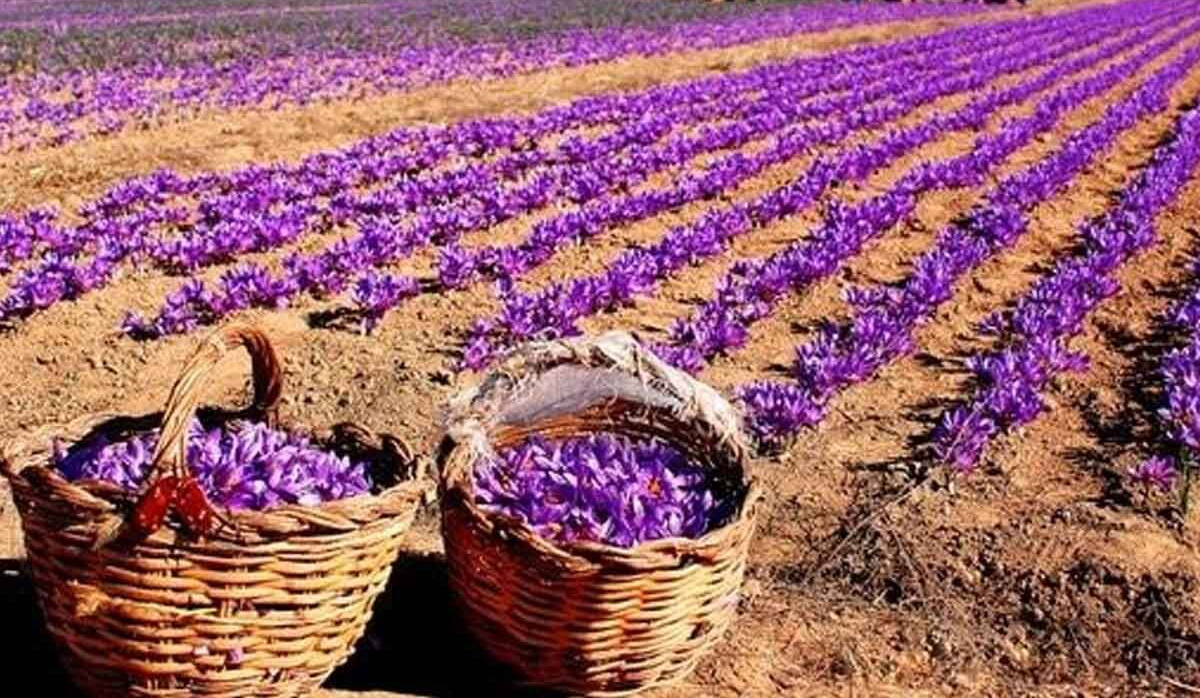
Apart from Kashmir division, the invaluable niche crop of Saffron or Crocus sativus is cultivated in Kishtwar district of Jammu division also. Malik (2023) has reported that 4670 families inhabiting a cluster of 19 villages in the district are engaged in its de-fault organic production of saffron in an estimated area of 202 hectares with production level of about 10 quintals and monetary value of about Rs. 22 crores per annum. it’s also reported that about 692 hectares of the cultivated area falls in traditionally saffron growing villages of Kishtwar and about 50 hectares in the non-traditional (newer saffron growing) villages. The data reveals a good scope for further expansion of saffron area in Kishtwar.
Ironically, the production levels and economic returns to saffron farmers aren’t encouraging for the past few years, despite of better production and marketing incentives provisioned by the UT government under various schemes.
Ramesh Kumar Bhagat a senior agriculture expert hailing from Kishtwar attributes this negative trend to long and frequent dry spells, high labour costs, slump in profitable marketing and an aversion of youth towards farming in the last 15 to 20 years. He also cautions about the cheaper, synthetic and adulterated produce of countries like Iran, flooding the Indian Saffron markets having produce from Kishtwar and Kashmir only,.
An optimistic view for early revival and rejuvenation of the industry stems from the fact that, Kishtwar has a history of ‘producing saffron since Mahabharata times (A.K. Khanna, 2020)’; Kishtwar has provided saffron seed to Kashmir in early times (Sir Walter R Lawrence, 1885) and the traditional saffron growers of Kishtwar have generations of experience in saffron cultivation.
To tide over the present crisis, just a few but crucial interventions and innovations will be required urgently. A crash programme (short to medium term intensive initiative) for saffron will have to be implemented to re-motivate and up-skill stakeholders of the area, particularly the educated youth.
Dealing with moisture stress
Kishtwar is a known dryland/ drought prone area. Though the saffron seed corms don’t require much water during their dormancy period in summers (June to end of September), but when the soils are dry with no rain forecast and corms start rooting and sprouting, watering becomes a must. Again, critical irrigation @ 15mm twice a week is highly recommended during periods of drought from March to June. Irrigation must also be given after harvesting the saffron, if snowfall or rains remain elusive. In the spring season also, water is crucial for saffron because then the new ‘daughter bulbs’, which have formed on top of the ‘mother bulb’, must grow large enough to be able to form flowers in the fall.
Therefore, essentially install/ establish water storage tanks (WST) of HDPE or RCC of appropriate capacity in the saffron plots to which truck or tractor mounted water tankers can bring water from the nearest available source such as the River Chenab or other available perennial streams. For efficient use of this water, gravity-run or pumped drip/sprinkler irrigation system must be provided as per feasibility. Researchers can consider appropriate design for these WSTs to enable harvesting of rain water as well.
Popularizing organic/plastic mulching for soil moisture conservation will complement this effort.
Protection from untimely precipitation
To protect emerging flowers of saffron from damage by hailstorm, snow and untimely rains, low cost RCC or Iron pole structures must be installed in saffron plots at appropriate distances to facilitate immediate covering of saffron crop with tarpaulin sheets, anti-hail nets, or any other appropriate protective sheets in case of any such exigency.
Ramesh Kumar Bhagat suggests effective curbs on adulterated and synthetic saffron coming from Iran etc. and adversely affecting prices of pure saffron in Indian markets. His other points of emphasis include:
i. Early setting up of Saffron Quality Control Lab in Kishtwar as a major push for quality control and development of authentic brand of Kishtwar Saffron;
ii. Frequent and regular Buyer-Seller meetings of reputed Ayurvedic and Unani pharmaceutical industries of India with saffron growers of Kishtwar;
iii. Effective hand holding of saffron growers of Kishtwar by concerned government departments for 5 years.
Planting of Seed Corms and Cultivation Cycle:
Saffron growers of Kishtwar are aware of the fundamental agronomic techniques for the crop, but still, they do require regular training programmes and skill/ knowledge up-gradation. For this purpose, Department of Agriculture and SKUAST-Jammu should always remain forthcoming with hand-holding support.
Important points for Disease and pest management:
* Carbendazim 50 WP effectively reduces corm rot disease severity when corms are dipped overnight in fungicidal suspension or given wet slurry treatment, respectively.
* A biocontrol agent ‘Trichoderma’ treatment also helps to control corm rot disease while enhancing plant growth and cormlet production.
* To prevent harmful rodents from getting into the soil to eat the corms, cover saffron plots with some fine-meshed chicken-wire after planting. Diameter of the mesh is often a bit larger than a mouse hole, but the animals don’t like it.
* Surround saffron plantation with a “smelly” and repelling crop like garlic.
* Create vibrations in the ground by placing PET bottles upside down with thin metal pins in these. The blowing wind transfers vibrations to the ground and scares away the rodents.
Harvesting
The Saffron of Kishtwar is distinct from that of Kashmir because of the method by which flowers are picked in the early morning before these open, preferably before sunrise, in contrast to the later picking done in Kashmir after opening of the flowers when the pistils grow longer and easier to harvest. In Kishtwar, the whole pistils are stripped from the petals and a beautiful bunch of pistils from a number of flowers is formed by intertwining the lower light yellow and white parts, while the saffron coloured stigmas are kept free to form the head. The bunch gives a unique look for presentation, display and use.
Drying of saffron pistils:
Saffron Stigmas/Pistils must be dried in electric or solar driers at about 50 to 60 degrees Celsius temperature immediately after stripping from saffron petals to prevent loss of quality. Drying takes between 15 and 30 minutes, depending upon the type of oven and the quantity being dried at a time.
Storage of the saffron threads:
The dried saffron threads should be packed airtight in glass jars or tightly closed tin boxes, but never in polythene containers. These should be stored in cool, dry and dark place. These become ready to use after about a month and can be kept for 2 years without loss of quality.
Last word:
Admirers of Kishtwar Saffron have been longing for the much publicized Saffron Park and it must be established without any further delay. Further, saffron farmers and entrepreneurs in Kishtwar must focus on good agricultural practices (including irrigation WUE and crop protection) for production of higher quality and quantity of seed, observing 5 year moratorium on sending seed corms outside the district and expansion of saffron area in identified traditional and non-traditional saffron villages, if seed shortage is to be prevented and the entire 742 hectares of potential area is to be covered in near future.
(The author is Dy. Director of Agriculture, Retd.)
 Follow our WhatsApp channel
