

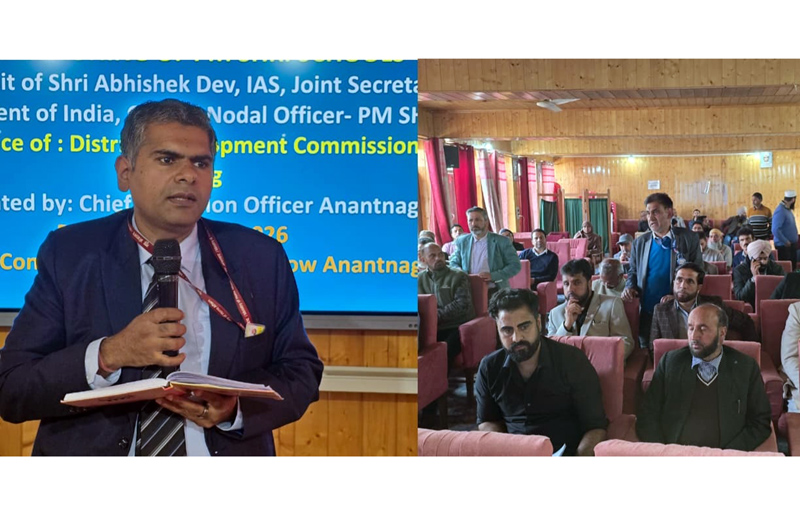
ANANTNAG, MARCH 28: In a significant step towards strengthening the vision of PM SHRI Schools as centres of excellence under the national education transformation agenda, Abhishek Dev, Joint Secretary, Government of India, and Central Nodal Officer (CNO–PM SHRI), concluded his two-day official visit to District Anantnag with extensive school inspections and a high-level review of implementation progress across PM SHRI institutions.
During the two-day visit, the Central Nodal Officer undertook a comprehensive assessment of academic, infrastructural, and administrative dimensions of PM SHRI schools in the district, focusing on institutional preparedness, implementation quality, and alignment with national educational priorities.
On the first day, the officer visited multiple PM SHRI institutions across the district and reviewed progress under the PM SHRI framework with special emphasis on Performance Grading Index (PGI), quality of teaching-learning processes, competency-based education, and integration of innovative and experiential pedagogies. He interacted extensively with students, teachers, and Heads of Institutions to obtain firsthand insights into classroom practices, learner engagement, and school leadership processes. The visible transformation in school ecosystems and commitment of educators towards learner-centric and inclusive education were appreciated during these interactions.
On the second day, the visit commenced with an inspection of PM SHRI High School Semthan, where the overall institutional status, academic practices, infrastructural development, and key achievements under the PM SHRI initiative were closely evaluated. The officer reviewed the school’s progress in implementing child-centred pedagogy, digital interventions, and holistic development activities.
Thereafter, the team visited PM SHRI SRJ Higher Secondary School Khanabal, where detailed interaction was held with school authorities regarding academic outcomes, innovation initiatives, resource utilization, and challenges in implementation. The school’s efforts towards creating an enriched learning environment and integrating PM SHRI objectives into daily academic functioning were examined in detail.
The visit concluded with a comprehensive review meeting held at District Institute of Education and Training Anantnag, attended by district administration and education department functionaries.
The district administration was represented by Tariq Ahmad Malik, Assistant Commissioner Revenue, Anantnag. Senior officers of the Education Department including the Chief Education Officer Anantnag, District Education Planning Officer, Samagra Shiksha Coordinator, DIET faculty and Zonal Education Officers of PM SHRI school zones also participated in the deliberations.
The review meeting witnessed a threadbare and constructive interaction wherein district officials presented institutional progress, achievements, and field-level challenges emerging during implementation. Stakeholders also highlighted practical concerns relating to infrastructure optimization, academic flexibility, capacity building, digital access, and school-level administrative needs. Several policy suggestions and implementation-oriented recommendations were placed before the Central Nodal Officer for consideration.
During the deliberations, the Central Nodal Officer emphasized continuous academic monitoring, optimal utilization of resources, digital integration, competency-based learning, and stronger institutional leadership to further improve educational outcomes. He reiterated that PM SHRI schools must evolve as model institutions that establish benchmarks in innovation, sustainability, inclusion, and holistic student development.
The visit concluded with a renewed collective commitment by district administration and the education department to transform PM SHRI schools of Anantnag into vibrant, future ready centres of excellence capable of delivering quality, equity, and excellence in education to every learner.
 Follow our WhatsApp channel
