

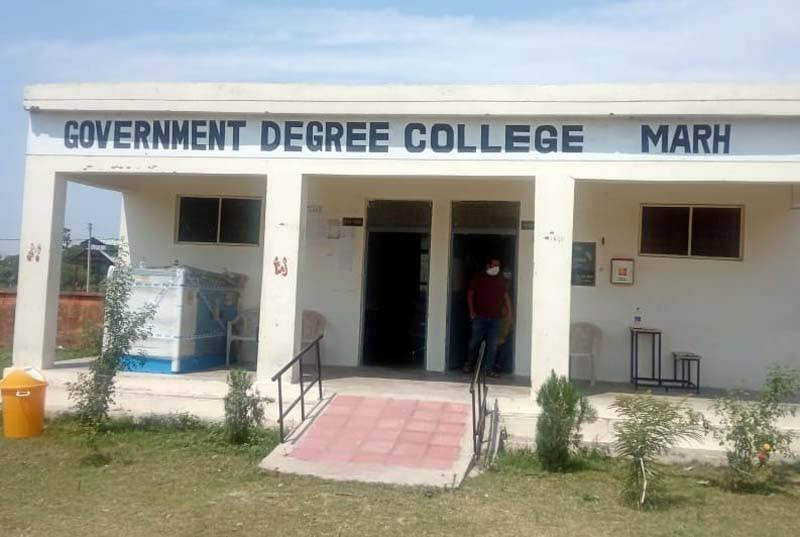
The prolonged delay in completing the buildings for GDCs at Bhagwati Nagar and Marh is not merely an instance of bureaucratic sluggishness; it is a stark reminder of how administrative apathy can derail the academic aspirations of hundreds of young students. Years after the stipulated handover deadlines, only 30 to 40 per cent of the construction work stands completed. The consequences of such neglect extend far beyond unfinished walls and half-laid foundations-they directly impact the intellectual growth, professional readiness, and morale of the youth these institutions were meant to serve. When the Government decided to establish new degree colleges in areas like Bhagwati Nagar and Marh, it was presumably after careful deliberation. Such decisions typically factor in student intake capacity in existing colleges, rising enrolment trends, demographic needs, and the distance students must travel to access higher education. These colleges were envisioned as accessible centres of learning at the doorstep of local communities. They were meant to reduce educational inequities and expand opportunities for rural and semi-urban youth.
However, the reality on the ground stands in sharp contrast to those promises. Students who enrolled in these institutions did so in good faith, trusting the Government’s assurance that proper infrastructure would soon follow. Today, some of them may have already graduated without ever seeing the promised college building come to fruition. What was projected as a major academic facility has instead become a symbol of missed opportunities and broken commitments. The hardships faced by students are both visible and invisible. With only a handful of classrooms available and no functional computer laboratories or smart classrooms, academic delivery is severely compromised. In the digital age, the absence of computer labs is indefensible. Practical exposure, digital literacy, and technological competence are no longer optional-they are essential components of higher education. In a fiercely competitive world, denying students access to learning and practice tools amounts to placing them at a structural disadvantage. It limits not only their academic experience but also their employability and confidence in professional spaces.
Equally troubling is the restriction on course offerings due to inadequate infrastructure. The denial of the science stream, reportedly by Jammu University on the grounds of insufficient facilities, was a prudent academic decision. Laboratories and specialised classrooms are non-negotiable requirements for science education. Without them, academic standards would inevitably be compromised. Yet, for students aspiring to pursue science in their hometowns, this represents a lost opportunity. They are either forced to travel longer distances or abandon their preferred disciplines altogether.
What makes the situation even more baffling is the absence of financial constraints. Official records indicate that substantial funds were transferred to the executing agencies, but a significant portion remains unutilised. When money has been sanctioned and disbursed, the persistent delay reflects deeper issues of accountability and project management. The gap between transferred funds and actual expenditure raises legitimate questions about transparency and efficiency. If resources are available, what then justifies the inordinate delay? The matter has not gone unnoticed. Local MLAs have repeatedly raised concerns, even in the Assembly. Yet, the continued inaction from the authorities suggests either a worrying indifference or an institutional inability to enforce timelines and responsibilities. In the meantime, students continue to bear the brunt of administrative inertia.
Colleges are not routine Government buildings that can afford indefinite delays. They are crucibles where the future of a region is shaped. Every academic session lost to inadequate infrastructure translates into diminished learning outcomes and weakened career prospects. The cumulative impact on an entire cohort of students can be profound and long-lasting. The Government must now move beyond assurances and take decisive action. A firm, non-negotiable deadline for completion should be announced and strictly monitored. Accountability and financial reconciliation must be made transparent. If completion within a reasonable timeframe is not feasible, authorities should seriously consider temporarily transferring students to nearby fully functional colleges to ensure uninterrupted and quality education. No authority has the right to play with the academic and professional futures of young citizens. What was meant to empower local youth must not be allowed to become a cautionary tale of a failed system. What is required now is swift, visible, and responsible action.
 Follow our WhatsApp channel
