

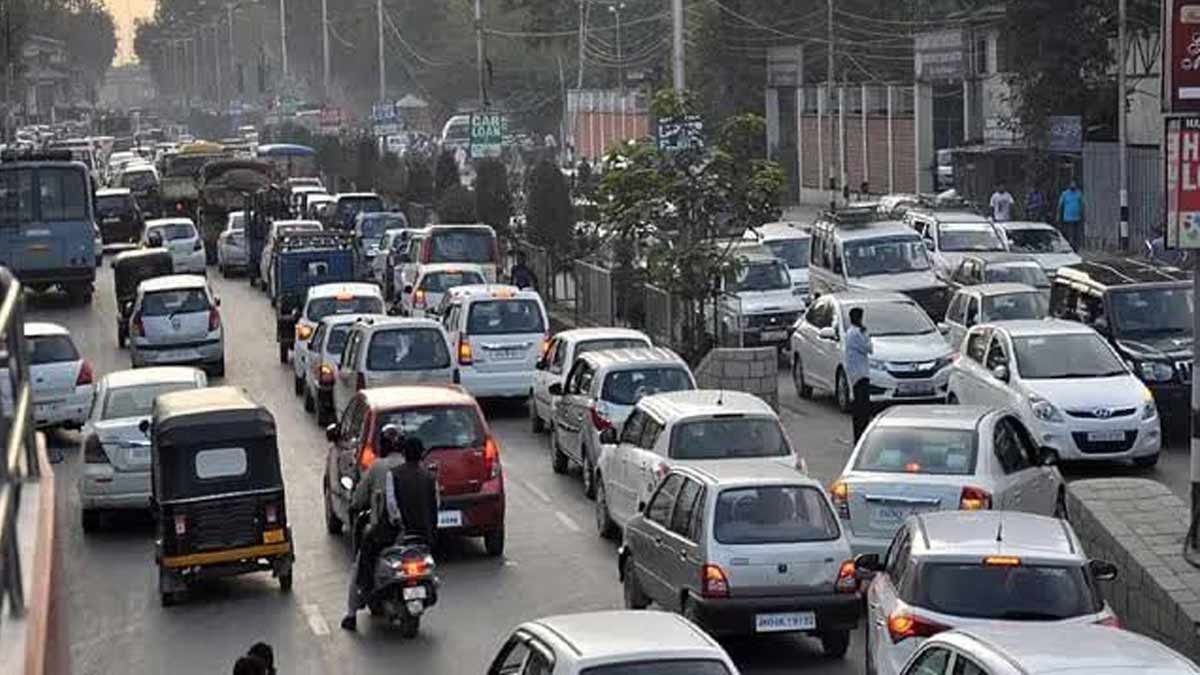
Jammu at a stands till
Raman Suri
ramansuribjp@gmail.com
Chief Secretary, Atal Dulloo recently presided over a meeting of the Multi-Disciplinary Committee (MDC) on Traffic Management Systems for Jammu and Srinagar, and took a comprehensive look at the measures already undertaken and those proposed for easing congestion, strengthening road safety, and improving overall urban mobility in both cities. The Chief Secretary realised that Intelligent Traffic Management Systems (ITMS) and Integrated Traffic Light Systems (ITLS) is lying dysfunctional and need to be made operational.
Though the meeting deliberated upon measures to reduce traffic congestions, there’s yet more to do on the ground. These officials must know that Jammu, a municipal area spread across approximately 240 sq. km including the expanded zones of Digiana, Sidhra, and Bahu Niabat and divided into 75 wards, is today gasping for breath under unprecedented urban chaos. What should have evolved into a steadily growing, well-planned urban centre has instead deteriorated into a maze of congestion, delays, and disorder.
Master plans, crafted after years of consultation and crores of public expenditure, now lie abandoned in files, gathering dust and awaiting implementation. As a result, the city wakes up every day to the same grim reality: endless traffic jams, frustrated commuters, stranded ambulances, and a civic system pushed far beyond its capacity.
Traffic congestion in Jammu has taken a massive, almost unmanageable shape. The reasons are not only many but also deeply interconnected. The traditional Darbar Move season still places additional load on roads. The number of vehicles has skyrocketed far beyond what the city’s narrow roads can handle. The ongoing marriage season adds a fresh layer of chaos, with banquet halls refusing to use or expand their own parking spaces and instead pushing their guests’ vehicles onto already packed roads.
Illegal parking has emerged as perhaps the biggest villain. Cars, two-wheelers, load carriers -everything seems to find a place on the roadsides except the roads themselves. Ill-planned crossings, minimal road expansion, encroached footpaths, congested bazaars, and the complete absence of lane discipline further convert every intersection into a conflict zone. Public transport continues to remain unreliable and outdated, forcing people to depend on private vehicles for even the shortest of distances.
Certain roads have now become synonymous with suffering. Ambphalla, Janipur-High Court road, BC Road, Jewel Chowk, Satwari, Railway Station area, the Trikuta Nagar canal road, and the entire old Jammu city including Parade remain almost permanently choked. In these areas, even ambulances often struggle to pass, putting lives at risk and compounding the misery of patients and their families. Jammu’s parking crisis deserves special mention. Many designated parking spaces developed by the Jammu Municipal Corporation and Jammu Smart City have turned into den-like zones for illegal activities, liquor consumption, unauthorised parking, and roadside encroachments.
They are overcrowded far beyond capacity, leading to damage to vehicles and blocking of carriageways. The Panjtirthi parking lot is a telling example. When it was managed by the JMC, it functioned well spacious, orderly, and user-friendly. But after leasing it out, the entire structure has deteriorated. Entry and exit gates are non-functional, digital screens showing available slots lie dead, washrooms and lighting are broken, and the lifts critical for car owners, especially women and disabled are out of order. Descending dark staircases and deserted corridors has forced many to fear for their safety after parking their vehicles.
Adding to Jammu’s traffic woes is the unchecked spread of rehris and street vendors many operating without licences issued by the JMC. Most vendors are from outside the Union Territory (UT) and function without any verification or regulation. They have every right to earn their livelihood but operating without norms is not only crime but a secueity threat as well. This is not only a civic issue but also a serious security lapse. Delhi has already shown what such negligence can lead to. The police claim they can act, but there is no space available for keeping confiscated rehris. The responsibility, therefore, rests squarely with the Jammu Municipal Corporation, which must ensure that every single vendor is registered, licensed, and verified.
Another major contributor to congestion is the absence of systematic urban planning. The Housing & Urban Development Department has failed to create organized colonies that would draw people away from the old city and onto wider, scientifically designed roads. With no new planned colonies coming up, the pressure on the existing road network continues to mount. Several old-city roads must now be declared one-way, and e-rickshaws must be regulated so that they keep moving rather than occupying entire stretches as informal stands.
If Jammu is to emerge from this crisis, urgent and comprehensive measures are needed. Illegal parking must be addressed immediately through heavy penalties, dedicated enforcement teams, and proper demarcation of no-parking zones. Road repair and expansion must be taken up on war footing. Traffic signals that lie dysfunctional must be restored without delay. Parking spaces built under Smart City projects must be revived and brought under strict accountability. Public awareness about lane discipline, parking etiquette, and responsible driving must be instilled from a young age through schools, colleges and driving institutes.
Public transport should be strengthened so that people are not forced to rely entirely on private vehicles. More traffic police personnel must be deployed at critical points to monitor and manage flow. Unauthorised vendors must be regulated and licensed, ensuring both their livelihood and the city’s safety. Planned colonies must be developed with wider roads and proper layouts to shift population pressure away from the old city.
Jammu is a city of heritage, culture, and immense sentimental value. But today, it lies strangled under its own unchecked growth. Without decisive action, compassion, and vision, the city will continue to crawl-even when minutes matter, even when ambulances need to get through, even when people are simply trying to earn a living with dignity. The people of Jammu deserve a city that moves, breathes, and thrives-not one that is stuck in a permanent traffic jam of apathy and mismanagement. The time for action is now, before this beautiful heritage city loses itself under the weight of its own neglect.
(The writer is Joint Treasurer BJP Jammu Kashmir)
 Follow our WhatsApp channel
