

Aditya Chouhan
On the eve of Independence Day 2025, Chishoti, like many other villages enroute to Machail, was bustling with activity and palpable enthusiasm. The coming two days were going to be very busy as the next day was the nation’s 79th Independence Day, and the day after was the sacred festival of Krishna Janmashtami. Both these festivals are celebrated in Paddarwith great reverence and devotion, like any other part of India. This year, though, Chishotiwas experiencingmuch more rush of people than usual as it had become the de facto base camp of the holy Machail Yatra, after which the pilgrims had to walk on foot to complete the remaining stretch of the yatra. The PMGSY road was completed only a few months ago, bringing much joy to the local dwellers and pilgrims.So, it was natural that many pilgrims halted here for a break before setting on for the arduous trek ahead.A massive langar (community kitchen) was also setup in the precincts of Kali Mata and Myo Nag templessituated on the upper side of the village. Hundreds of pilgrims availed the services of the langar every day. A mountain stream or nallah flows through the village with many houses and temporary shops, and tea stalls lining its banks. A narrow wooden bridge was the sole means to get across the other side of the nallah as work on the new motorable iron bridge, beingconstructed adjacent to it, was still ongoing. It was slated to be completed in a few days.
The 14th of August was no different in Chishoti. Children in the local Middle School were giving the final touches to their preparations for the forthcoming cultural programme to be showcased as part of the Independence Day festivities. The langar was brimmingwith devotees, many of whom were returning from Machail after performing darshan of the revered Chandi Mata. There was a forecast of heavy rain and a flash-flood warning issued by the Meteorological Department. But there was only a drizzle going on, and nothing of the sort, such as to evoke the local administration to suspend the yatra. Scores of yatris were crossing the wooden bridge to go to the other side of the nallah and continue their journey onwards, either towards Machail or Gulabgarh. Frequent traffic jams of people could be witnessed on the bridge every day owing to its narrowness and the bad condition of the approach pathways to it. The scene was no different on this day as well.
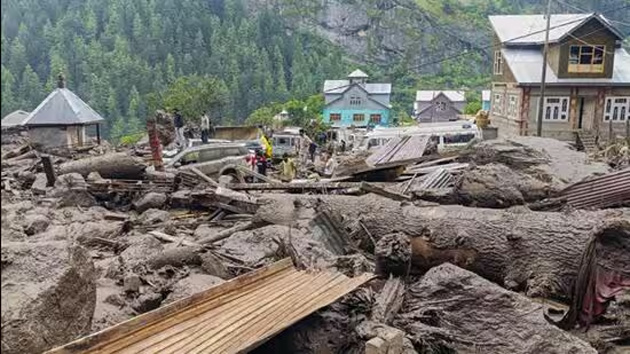
At around 12.20 pm, according to eyewitness accounts, a loud sound accompanied by the shaking of the ground was heard by the people. People could not immediately make sense of it,as many thought it to be an earthquake or a helicopter flying very low, or maybe a landslide. But a much more horrendous fate awaited the hundreds of people present there around the otherwise calm stream of water that had flown through the village for ages. A few moments later, Death came gushing down in the form of water and mud, carrying with it its weapons of destruction in the form of massive boulders and the gigantic deodar trees that got uprooted along the way.
Reportedly, a cloudburst had happened upstream in the nallah. Within a few seconds, it devoured the entire area of langar as well as the two temples that had stood there for centuries, and laid to waste every structure standing along its periphery. At the time of writing this piece, 66 dead bodies have been recovered from the debris, and more than 80 people have been reported missing. Many of the missing persons are thought to be washed away downstream with the unimaginable force of the flash-flood where the stream further meets mighty Bhot nallah. By all estimates, this count is expected to rise as the rescue and search operation is still going on. Among the dead, 13 are locals. Many have been rendered homeless as around 15 houses have been completely washed away or severely damaged. The rest of the victims are from across the Jammu Division, including a few from outside Jammu and Kashmir. More than 150 people were injured and shifted immediately to the nearest Sub-District Hospital at Atholi for the initial first aid. Thereafter, the more seriously injured were shifted to Kishtwar, Doda, and Jammu. A few fortunate ones were able to come out alive from under the debris.
Like many of you, I, too, am still to come to terms with the scale of this tragedy. It has left in deep shock and lifelong trauma those who have lost their loved ones or are missing and yet to be found. Flash floods and cloudbursts are not uncommon in this part of the Himalayas, but the destruction and the loss of lives of this magnitude are unheard of and unprecedented in the whole region from Ramban to Kishtwar, which formed the erstwhile Doda district.
Questions are being raised now about the unplanned development of roads, illegal mining of riverbeds, loss of forest cover to wildfires and illegal felling,and the numerous hydropower projects being executed on the Chenab River in this region—particularly in Kishtwar District—without adequate regard for environmental safeguards.Global warming and climate change are compounding the problem with extreme weather events—like the recent cloudburst in Chishoti—rising exponentially over recent decades. Weather patterns are changing leading to unseasonal rainfall, low snowfall in winters, early onset of summer, and shortening of winter season. Glaciers are melting at an alarming rate, enlarging many glacial lakes in the upper reaches, posing potential risks of glacial lake outbursts, which can cause large-scale destruction like what happened in Kedarnath in 2013. Continuous monitoring of such high-altitude lakes and localized weather forecasting is the need of the hour in this region to help prevent any future disaster.
The unchecked flow of people to the fragile ecosystem of the Himalayas is putting the carrying capacity of these mountains under severe strain. In recent years, the number of devotees thronging the various annual pilgrimages of Paddar—prominent among them being Machail Yatra, Mindhal Yatra, which goes through Paddar in Himachal, and Chitto Yatra—has grown manifold in recent years. Concomitant infrastructure and facilitieshave not been created,and the existing ones are proving to be inadequateto cater to the massive influx of people. Concerns are being raised from various quarters to not treat the sacred sites like Machail as mere picnic spots and to maintain the sanctity of such holy places.
Nature has the habit of reminding mankind, often in painful ways like the recent incident in Chishoti, of the dangers ofnot treating it with the required care and consideration that it deserves. Works of development, be it roads or power projects, are essential, too, for the progress of the nation as well as the upliftment of local populace. The remote regions of these mountainous districts are still deficient of basic facilities such as roads, piped drinking water, electricity, communication, medical services. The various developmental works often provide job and business opportunities to the locals.
But the time has come to earnestly evaluate our developmental philosophy in such fragile ecosystems like Himalayas, which is regarded as the youngest mountain range in the world and is constantly rising owing to the collision between the Indian and the Eurasian plates. This phenomenon has put the entire Himalayan region from Jammu and Kashmir to Arunachal Pradesh in the highest seismic risk category, namely Zone IV and Zone V, which is an added area of concern for the region. Government and corporations need to execute development projects in a sustainable manner with compulsory prior environmental impact assessment so that they do not become bane for the people in future. The citizens, too, should introspect, inculcate civic sense, and behave in an environment-friendly way. Otherwise, I am afraid, the Chishoti tragedy might not be the last one. May Maa Chandi bless us all.
 Follow our WhatsApp channel
