

By Nitya Chakraborty
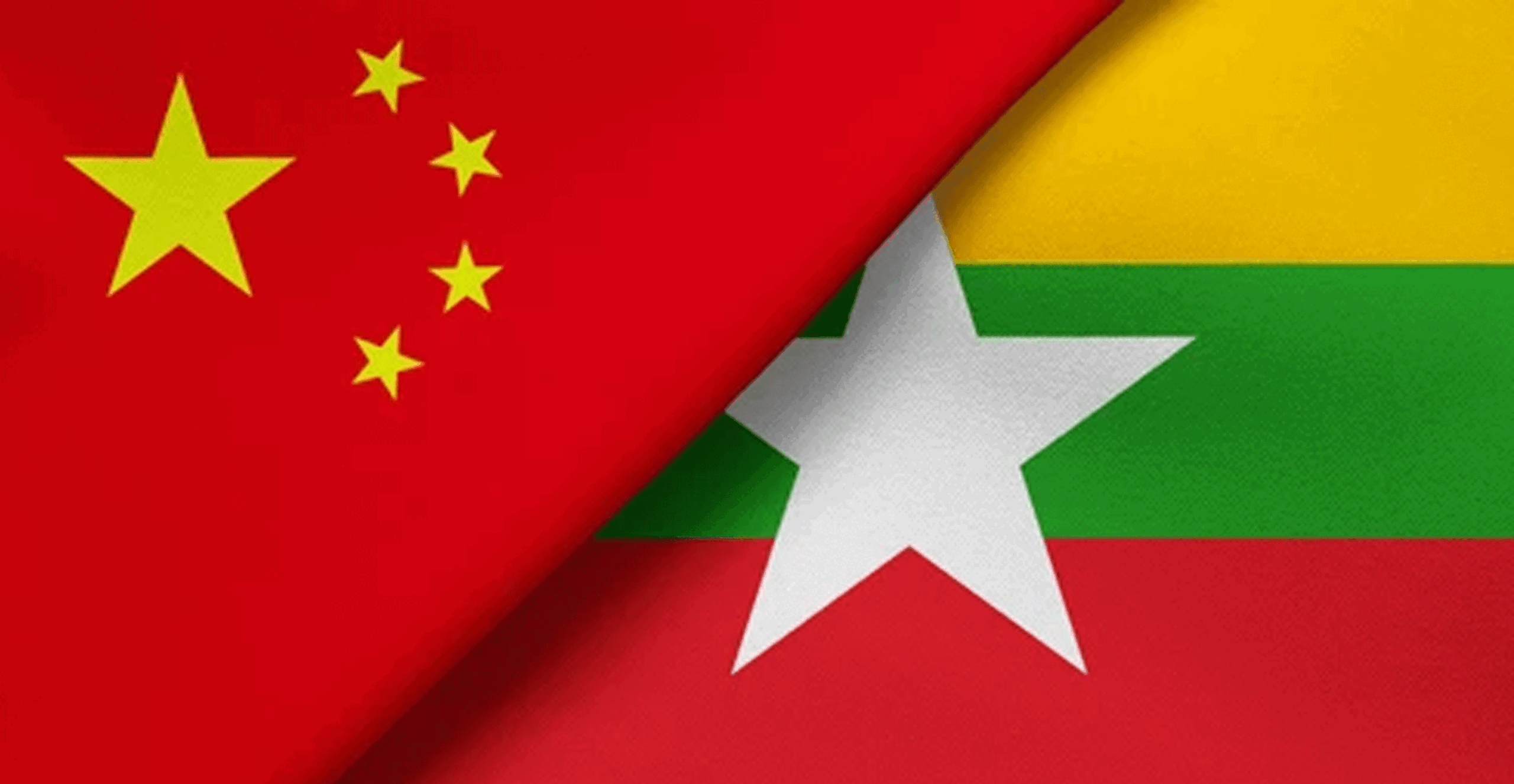
China and Russia are the two major countries which are going the wholehog in boosting the Myanmar junta chief Min Aung Hlaing who has just been elected as the new President following national elections which were rigged, according to the international poll observers. India also exercised its diplomatic pragmatism by doing away with morals and ethics by agreeing to send the Minister of State for External Affairs Kirti Vardhan Singh to attend the inauguration of the new President of Myanmar on April 10.
India’s action was low key-the sending of a junior minister but the signal is apparent-India will do business with this defacto army regime and very soon may give official recognition. Significantly, the same day Monday when India announced its decision, a petition was filed in an Indonesian Court accusing the new Myanmar President for genocide. Indonesia is the leader of the ASEAN which is presently headquartered in Jakarta, the capital of Indonesia.
As of now, no western nation including the USA has recognized the new Myanmar President, they have also not given any credibility to the election results, calling it a junta organized rigged elections.. China, on the other hand, gave credibility to the elections and even praised efforts of the newly elected regime for their efforts in ensuring peace and stability in Myanmar as also the regime’s keen interest in Belt and Road projects of China. The transactionist nature of Chinese diplomacy was apparent from the beginning after the junta coup in February 2021. China was interested in protecting its investments and the work on the China organized Belt and Road Projects. Chinese leadership ignored the civilian killings by the junta in the last five years since the coup.
For India, the dilemma was acute. India has major investments in Myanmar. The country has to protect them. So the government maintained contacts with the Junta administration but did not identify with the regime, while China took all the advantage by identifying with the junta and arranging for all protection of its investments including the expansion of Belt projects. Further, China used its bargained with army led government by using its control over the rebels dominating the border provinces connected to China. These pro-China rebels even got arms and ammunitions from the Chinese sources.
While China has a long term interest in the political future of Myanmar since it has borders with Myanmar and has huge investments, for Russia, the interest is all defence supplies related. President Vladimir Putin took an active role in supplying arms and ammunitions to the junta led government after the arms supplies from the western sources dwindled following sanctions by the western countries. Russia has been a big beneficiary of the Myanmar civil war as the major supplier of arms, apart from China.
India shares a 1,643-kilometre land border with Myanmar through Arunachal Pradesh, Nagaland, Manipur and Mizoram. The instability has affected connectivity initiatives such as the India-Myanmar-Thailand trilateral highway and raised concerns over cross-border insurgency and trafficking. India is the shelter of more than 80,000 Rohingya Muslim refugees from Myanmar. India has been making efforts to see that India is not totally marginalized during the junta regime by China. But despite all efforts, India is now a minor player in Myanmar politics compared to neighbouring China.
In the army manipulated rigged elections,, the results of which were announced on January 29 and 30 this year, the army aligned United Solidarity and Development Party (USDP) won 232 out of 263 seats in the lower house and 109 of 157 seats in the upper house.
The Suu Kyi led National League of Democracy which was the ruling party before the 2021 coup, was able to organize resistance along with other civil society organisations as also students, but the nature of resistance varied from province to province. In the provinces adjoining China, the rebels were helped by the Chinese army thereby helping the process of their consolidation. In the army organized elections, Su Kyi’s NLD was banned along with other opposition parties. The former Prime Minister is in jail with a bad health condition.
Since the coup, the junta has systematically banned dozens of political parties and detained more than 30,000 political prisoners. In January 2026, the regime initiated legal action against more than 400 individuals under an “election protection” law passed in July 2025. The law criminalises virtually all forms of criticism of the electoral process, outlawing speech, organising, or protest deemed to disrupt any aspect of voting, making the entire exercise a clear example of pervasive surveillance.
From the beginning of the coup in February 2021, China has been playing a dual role since it needs the support of the junta to protect its projects under China Myanmar Economic Corridor (CMEC). China even employed its own forces to protect its projects. The junta in fact allowed free mixing of its army troops with the Chinese security forces even when the junta troops were engaged with the pro-China rebels. During the inaugural ceremony for the new Myanmar President, China will be the most sought after foreign country by the junta govt.
Indian minister will be staying for three days in Myanmar on April 8 to 11 and will be having extensive discussions to improve India-Myanmar relations. He will have talks with the senior Myanmar ministers. Myanmar’s army backed new regime must be looking for immediate official recognition by India to their regime. It is to be seen whether India now rushes with the official recognition while the western nations are still not reconciled to the legality of the new regime. (IPA Service)
 Follow our WhatsApp channel
