

Dr Bhavna Singh
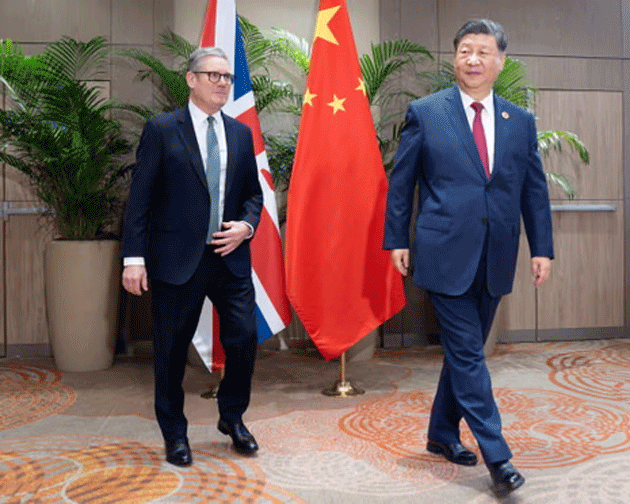
China and the EU experienced a breakthrough in their ties last month with British PM Keir Starmer’s visit to China. It comes at a time when the UK is looking for possible alternatives to US’ forced protectionism, just like the other middle rung powers. Sir Keir’s visit between 28-31st January is the first by a UK prime minister to China since Theresa May in 2018. Both countries sought to resolve economic barriers in trade but no sweeping concessions were made. Similar visits by several other countries of the European Union are also reflective of the change in the winds.
Deals ‘n’ Deals but no FTA
Agreements on visas, services, healthcare, green technology and finance were made; most importantly, commercial announcements from the pharmaceutical firm AstraZeneca came through, which promised to invest USD15bn (£11bn) in China over the next four years. This is the company’s biggest investment in China till date. There were other deals with the Pop Mart, the toymaker behind Labubu dolls, e-commerce group JD.com, and battery giant CATL. Besides, Chinese automaker Chery Commercial Vehicles promised to establish a regional headquarter in Liverpool and is expected to partner with the UK’s Jaguar Land Rover for its British operations. There were four economic and trade cooperation documents signed in all: an MoU on export cooperation with China, an MoU on launching a joint feasibility study on a China-Britain services trade agreement and an MoU on establishing a bilateral partnership on services; and lastly, an MoU on strengthening the work of the China-UK Joint Economic and Trade Commission with an aim to consolidate the commission’s role as a platform for bilateral economic and trade policy dialogue and trade and investment promotion.
Tianjin-headquartered life sciences group Asymchem also declared an intention of major expansion of its UK operations, which will add 150 jobs over the next five years. Chinese energy storage manufacturer HiTHIUM pledged to invest £200 mn in Britain and to add 300 jobs in the country. Hence, employment generation was one of the larger focus areas of the meet. In addition, the visit also achieved a diplomatic thaw and renewed high-level dialogue. Both sides reinstated parliamentary, people-to-people and business exchange mechanisms. Starmer’s visit also promised to expand cooperation between UK brands like Welsh manufacturer Cultech and British bikemaker Brompton to increase exports to China.
The visit is more significant because Britain choose to engage with China despite US president Donal Trump’s warning against closer business ties with China; that it would be ‘very dangerous’. Starmer envisioned that the engagement with China would help in balancing economic opportunities with concerns about security threats and human rights. Not only the UK, but many other countries have paid subsequent visit to the emperor of the ‘middle kingdom’. There is a broader understanding amongst the EU nations that pragmatic engagement with China is necessary if they hope to sustain the momentum of growth in their economies in this era of global uncertainty. It also reflects a broader debate in Western policy circles about whether to engage pragmatically with China without compromising on strategic principles. The Transatlantic alliance has been the corner stone of European politics so far, but today, due to conflicts, economic stagnation and growing questions over long-term strategic dependencies, the European countries are undertaking a necessary recalibration.
Geopolitical Implications
China’s renewed ties with the UK signal that China is likely to reassert itself as a dependable partner for the West despite Trump’s ‘my way or highway’ attitude. The British PM went so far as to comment that China and its overcapacity was ‘marginally less acute a concern’ in comparison to the vagaries of Trump’s regime. For China, this means increased acceptance of the narrative of the ‘community with a shared future for the mankind.’ China has time and again expressed concern over the European Commission’s unfair market competition by deciding to launch in-depth investigations into the Chinese wind power companies under the EU’s Foreign Subsidies Regulation (FSR). In return, Chin also promised to expand market access for British companies and improve its business environment that has deteriorated in recent years.
Now, with the EU suddenly showing interest in renegotiating the terms of trade, China has an opportunity to bolster its foreign policy objectives through the trade agreements. Stammers visit was followed by several other EU leaders. Their alacrity to engage was reflected in the statements of the leaderships as China and Finland pledged to ‘deepen mutually beneficial cooperation and jointly uphold the multilateral international order,’ following a meeting between Chinese President Xi Jinping and Finnish Prime Minister Petteri Orpo in Beijing. During these trips, Xi Jinping encouraged expanded cooperation in areas including energy transition, the circular economy, agriculture, forestry, and technological innovation.
This renewed engagement with the European Union countries, also demonstrates an opportunity for China to promote and demand loyalty to its ‘One-China policy’ amongst the EU nations, which often remains a lynchpin amongst the two sides. It also demonstrated how the two sides are willing to overlook past misunderstanding over critical infrastructure security, espionage risks and bolster technology dependency on China, in a view to create more jobs and sustain a positive growth over the coming decades. In a foray of articles published in the Chinese media, an article in the China Daily by Maya Majueran stands out, as it emphasises how the coming together of these two entities reflects a belief that ‘engagement, despite its frustrations, remains preferable to containment or confrontation and an acknowledgment that the future international order will be shaped not by the design of any single nation, but through the complex, often messy interactions of many.’ China’s clarion call to engender and support the bulwark of a multipolar world then, has finally found salience and is shaping up amongst others and the EU is now keen to be an active and incremental partner.
(The author is Visiting fellow, CRF)
 Follow our WhatsApp channel
