

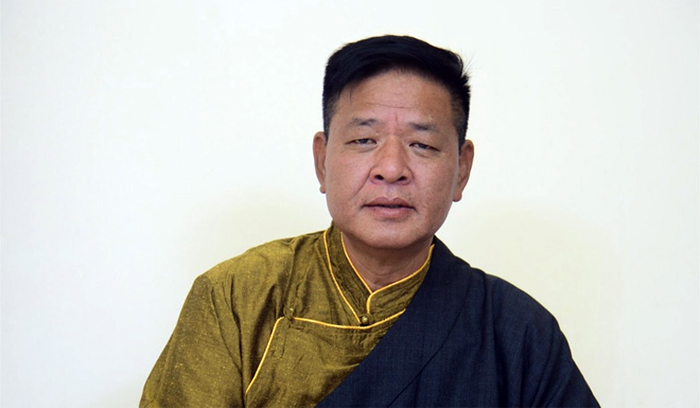
LUCKNOW, Nov 23: President of the Tibetan Government-in-Exile (Central Tibetan Administration (CTA), Pempa Tsering, has alleged that China is attempting to eliminate the younger generation.
He stated that Tibet has a population of 7.5 million, with one million consisting of children aged four to young adults. By putting these young people in boarding schools, China is alienating them from Tibetan language, culture and religious sentiments, even though the language of Chinese boarding schools is Chinese.
President of the Tibetan Government-in-Exile, Pempa Tsering, who arrived in Lucknow a day earlier, spoke to media here on Sunday.
He stated that Tibetan Buddhist institutions are facing increasing pressure due to policies aimed at Sinicization. China claims Tibet as autonomous, but there appears to be no sign of independence. During the presentation, he gave a comprehensive presentation on Tibetan history, culture, and the current situation in Tibet. He explained that the Tibetan script evolved from Devanagari.
He emphasized Tibet’s long-standing role in preserving the Buddhist teachings of India’s ancient Nalanda tradition. He stated that these cultural traditions continue to serve as an important repository of ancient Indian knowledge. During the 8th and 13th centuries, numerous Buddhist texts were translated, and work is now underway to translate them into Sanskrit.
When asked about mobilizing public support for Tibet’s independence worldwide and independence from China, President Pema Tshering said that many people are still unaware of Tibet’s situation. Therefore, it is important to educate everyone.
Regarding independence from China, it can only be resolved through face-to-face dialogue. He stated that we are not in favor of war. India will not fight China over Tibet, nor will NATO or the US. In such a situation, the issue cannot be resolved without discussion.
When asked about the improving India-China relations, he said that sometimes both countries move forward and sometimes backward. He stated that he has a very deep relationship with India and is deeply grateful to the Indian government for this.
Tibetan President Pempa Tshering expressed concern about large-scale dam construction projects in Tibet and warned that these developments could have long-term impacts on downstream countries.
Earlier, President Pempa Tshering met with several political figures in Lucknow, the capital of Uttar Pradesh, on Sunday morning. During the meeting, he discussed the current state and direction of Tibet and sought cooperation in maintaining its autonomy. Following this, the President of the Tibetan Government in Exile (Central Tibetan Administration – CTA) addressed aspiring army officers at the Warriors Defense Academy in Lucknow.
He provided detailed information on Tibetan history, culture, and the current situation in Tibet.
Dr. Sanjay Shukla, Regional Coordinator (U.P. & Uttarakhand), Core Group for Tibetan Work, highlighted the introduction of the programme.
(UNI)
 Follow our WhatsApp channel
