

The Homeland Beyond the Gate
Dr Vikas Sharma
drvikassharma20202020@gmail.com
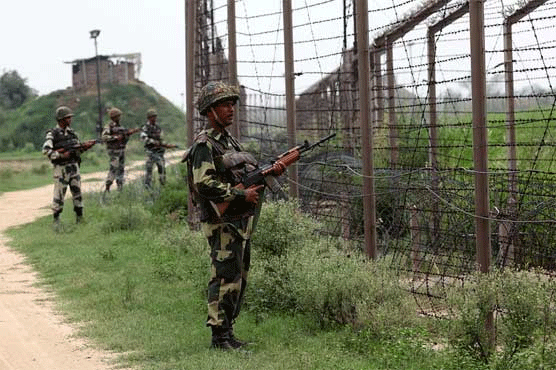
There are places that never find space in travel brochures or television debates, yet they carry the nation’s unspoken burdens in silence. Chhamb’s border villages that are now trapped under fences near the Indo-Pak border are one such land. Resting along the frontier, these villages have lived for decades with uncertainty as a constant companion-where peace is fragile, waiting becomes a way of life, and endurance is passed down like an inheritance. Here, life was shaped not by comfort but by courage; not by spectacle, but by quiet sacrifice. Patriotism was never shouted through slogans or ceremonies-it was lived daily, absorbed through the soil beneath bare feet, the long silences of restraint, and losses borne without applause.
These border villages once had something far rarer than modern comfort-homes where three generations lived under one roof, without Wi-Fi but filled with warmth. Temples did not wait for renovation grants; belief itself sustained them. Wells were dug by hand, not by machines. Wealth was counted in relationships, not rupees. Even poverty carried self-respect, and labour was treated as worship. Life was simple, but it was complete.
To bureaucratic files in distant offices, Chhamb may appear as a “sensitive military zone.” To its people, it was home. A place where the tricolour was not saluted only on national holidays but carried quietly in the heart every single day. Children grew up hearing artillery, not alarms. Calm here was not learnt from comfort, but from living with uncertainty and courage shaped by experience.
The elders of these villages did not need history lessons; they were history. They spoke of 1947, 1965, and 1971 not from textbooks, but from memory. Their words carried no bitterness, no complaint. They spoke softly, often with a smile, wearing sacrifice like medals rather than grievances.
Then came 1999.
As conflict unfolded elsewhere, the nation did not ask these villages for blood. It asked for something quieter-absence. For reasons of safety, families were requested to leave for “a few days.” They complied without protest, without slogans, without drama. Homes were locked not out of fear, but out of trust. Gods were wrapped carefully, elderly parents supported by steady hands, and newly built houses in villages like Samwan were left unfinished-cement still fresh, festivals yet to be celebrated. Everyone believed the separation would be brief.
Weeks turned into months.
Months turned into years.
Years quietly turned into decades.
What followed was displacement presented as rehabilitation. Families were given four to five marla plots in unfamiliar places and expected to rebuild their lives, as though a home were merely a structure and not a bond built over generations. Land was allotted, but closure was not. A path back was never shown.
Villages such as Samwan, Chaperial, Chakla, Deva Batala, Garh Sainth, and many others slowly slipped into what can only be described as a no man’s land. Not because they belonged to the enemy, but because policy placed them behind fences. They remained Indian and legal, yet physically and emotionally separated from their own soil.
The children who were carried away in 1999 are now adults in their mid-twenties. They grew up listening to stories of homes they could see but not live in. Their sense of belonging was inherited, not experienced. An entire generation grew up between memory and hope, carrying a silent psychological burden of displacement, uncertainty, and unfinished identity.
The emotional and psychological trauma among these border villagers remains largely unacknowledged. Anxiety became routine. Uncertainty became normal. Many lost loved ones in firing over the years. Homes were damaged, fields abandoned, lives interrupted forever. Land was lost-but so were people. Grief became private, trauma normalised, and silence became a survival skill.
Farmers continue to wait. Even today, many are allowed to enter their fields only during daylight hours to cultivate their land, only to be asked to leave by sunset. They are permitted to farm their soil, but not to live on it. Hope exists in daylight; helplessness returns with dusk. For these farmers, land is not merely livelihood-it is identity. A small plot can never replace fertile fields, orchards, wells, and ancestral soil.
The fence, built in the name of national security, was understood, accepted, and supported. But what was never explained was that it would not only stop enemies-it would also stop Indians. Life inside the fenced villages is governed by gates, identity checks, time restrictions, and permissions. Temples fall silent after dusk. Wells exist without use. Homes stand without life. Ownership survives on paper, while dignity remains conditional.
And yet, there has been no rebellion. No highways blocked. No slogans raised. No demand for attention. Border villagers waited-believing that obedience would be remembered, that trust would be honoured, and that one day the nation would think about the people and land left behind inside the fencing.
This is not merely a question of territory or security. It is a question of identity, dignity, and psychological survival. How long can citizens live as strangers to their own homes? How long can hope survive without resolution?
Chhamb should not remain a forgotten footnote in official files. It is a living reminder of quiet patriotism-of villages that stood firm without noise, of people who never left in spirit even when circumstances pushed them away physically.
Some homelands are not lost across borders.
They are lost behind gates-still waiting to be opened.
 Follow our WhatsApp channel
