

Tarun Upadhyay
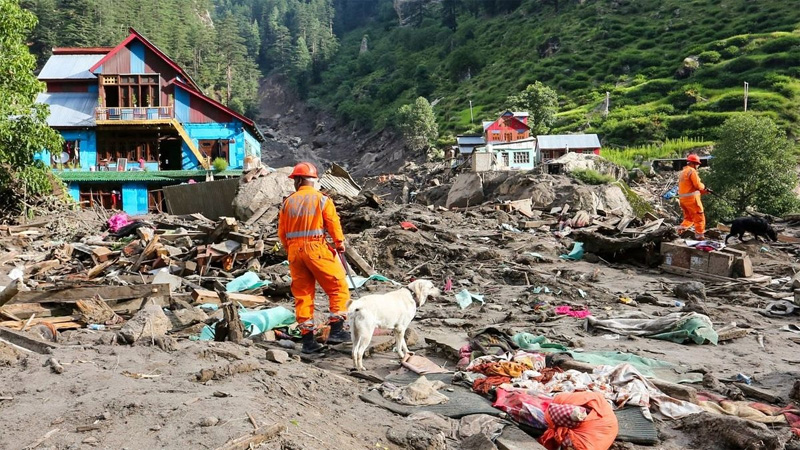
CHASHOTI (KISHTWAR), Aug 21: Chashoti in Kishtwar bears the grim imprint of the August 14 cloudburst that claimed 65 lives – a landscape scarred by death and destruction, where helplessness hangs heavy and hope of finding the missing alive fades with each passing day.
Follow the Daily Excelsior channel on WhatsApp
Nestled amid deodar forests and towering mountains, with the nullah-that unleashed devastation- flowing through it, the town had in recent years grown into a bustling business hub for the annual Machail Yatra, boosting both economy and importance of the town.
When the cloudburst struck, the Nallah turned into a raging torrent, carrying boulders and fury in its flow. It swept away lives, homes, shops, and standing crops, leaving behind nearly 100 meters of land buried under thick slush.
Sight of mangled vehicles flushed out from Nallah is so surreal that even Bollywood’s wildest special-effects teams would have hesitated to imagine it. Each twisted frame stands as stark testimony to the sheer force of the deluge.
“We have been living here for generation. Nallah does swell up at times but never imagine tragedy of this magnitude could struck us. We just rushed away for safety on witnessing flood. It took us years to build our homes. But everything – cash, ration, jewellery – was gone in a flash. What ever I earned during yatra has also been washed away. It will take years to get back to normal life,” said Kuldeep Singh Thakur (45-yr), whose home was washed away. His wife was severely injured and has been shifted to Government Medical College Jammu.
About 10 homes were completely destroyed and many others left partially damaged, while nearly 80 kanals of standing crops were ravaged. Makeshift kiosks were swept away, and pilgrims’ belongings – laced with slush – lay scattered along the town’s kucha road. Unclaimed handbags, duffle bags, even a silver bracelet recovered from the muck told silent stories of those still missing.
A few meters from the raging Nallah, survivors who narrowly escaped the catastrophe now watch the rescue operation unfold from their rooftops. Their eyes follow the JCB machines clawing through debris, shoving back slush and boulders into the nullah. On their blank faces flickers the weight of memory, as the grim sight of a body pulled from the rubble just outside their homes forces the horror to replay again. Some, eyes swollen with tears, retreat quietly into their rooms, unable to bear the scene any longer.
“It was just a normal day,” recalled Billu Raj, who had set up a small tea kiosk for the yatra pilgrims. “The stream of devotees was flowing, and I was busy serving tea. Suddenly, I heard people screaming – I thought maybe a gas cylinder had exploded. But when I stepped out, I saw boulders tumbling down with gushing water. I froze for a moment, then ran. Within minutes, everything had changed forever. I could never have imagined that a body would be dug out from the very place where, only days ago, a family had been living happily in their home.”
Billu and his family survived, but the pain is etched on his face as he watches the rescue operation unfold from his rooftop – a silent witness to loss and devastation.
As the Army laid a T-Span bridge over the nullah, restoring connectivity to Machail Mata, ponies laden with goods of stranded traders crossed it. These small businessmen had come from as far as Uttar Pradesh and Madhya Pradesh and had set up stalls that sold toys, trinkets, toffees, photos of Machail Mata and other deities, along with puja items.
When they finally reached Chashoti, both the pony wallahs and traders sighed in relief – but it was a relief tempered with loss. Their businesses had been washed away, their investments shattered, and with the Machail Yatra now closed, the cycle of earnings had abruptly ended. For them, the flow of pilgrims had meant the flow of livelihood; now both were gone.
Among them was 30-year-old Jairam Sharma, a resident of Madhya Pradesh. He unloaded his belongings from the ponies, shared a simple meal at the langar with three companions from his hometown, and waited impatiently for scarce public transport to continue his journey home.
“I have been putting up a stall at the darbar for the last three years,” Jairam said. “Some others from my town also came here. It had started turning into a good business venture. I had invested one lakh rupees this year but managed to sell goods worth only a few thousand before the disaster struck. I was stranded for four days. Physically, I survived – but economically, I am ruined. I don’t know if I will return next year. Even if I do, my family won’t allow it. The scar of this tragedy is etched in my memory, and it won’t fade anytime soon.”
As JCB digs out and debris and machines cut boulders to bring back normal life here for survivors but for some the relief and rescue operation doesn’t hold good for any reason. These are people who were not as unlucky as those who had died or are missing but were not as lucky as Jairam. There entire investment, earning and saving was washed away.
Surjeet Kumar, resident of Ramnagar, district Udhampur, just stares at damaged tilted homes filled with slush and JCB machines at work . He recounts days before Aug 14 and bleak future ahead.
“I was selling tea and pakoras when it happened and barely managed to run away. There was no time to collect even my cash. My entire earning and investment were washed away in few minutes and I helplessly watched it. How will I stand up economically again I just shudder at this thought. I came here to make some good life but who would have imagined my life will be ruined-economically- here itself,” said Surjeet.
 Follow our WhatsApp channel
