

Dr Mrinalini Atrey
“She didn’t perform the story-she became it.”
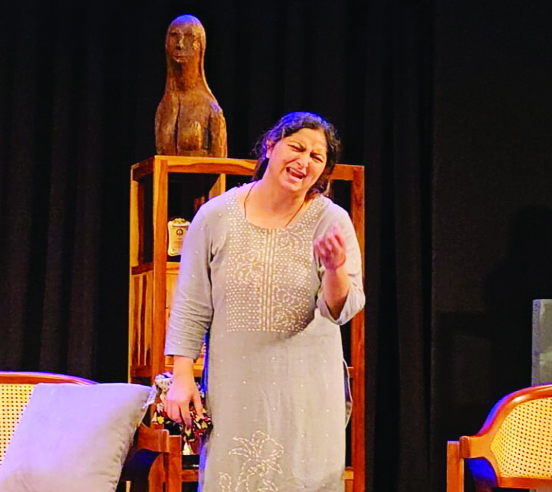
It wasn’t merely a performance-it was a revelation. For ninety uninterrupted minutes at Abhinav Theatre, Dr. Juhie Mohan held the stage alone, commanding attention, empathy, and awe. Chanchlo-a record-setting solo act-marked a historic moment in regional theatre, shaking audiences into silence before stirring them into applause. Sociology scholar and the vibrant voice behind 92.7 Big FM, RJ Juhie Mohan stepped beyond the airwaves to deliver a tour de force rich in emotional intelligence, cultural critique, and dramaturgical elegance.
Chanchlo scrubbed the marble floor in concentric sweeps-her hands mapping circles of memory and survival. Phone calls interrupted her rhythm: instructions, gossip, commands from the lady of the house and her well-heeled friends. The mop glided, paused, resumed, absorbing each echo like the riverbank that never forgot its floods. Somewhere between the fourth rinse and a doorbell, her body slowed-but memory surged forward.
She saw herself again-bare feet beneath a frayed dupatta-arriving in the city with her mother and younger brother Nitan. Her father and sister remained in the village, a place that receded behind them like a forgotten stanza. They worked as domestic help, sheltering in her maternal grandparents’ house. There, her uncle’s shadow grew long and cruel when she became a young maiden.
Marriage followed. A man whose touch bruised and strayed. He courted infection with other bodies until HIV nested in theirs. Her sister eloped into oblivion and returned only as a death certificate-a life erased by stigma. In a moment of desperate vulnerability, Chanchlo and her family endured police aggression-shoved, silenced, and humiliated. Violence, both systemic and personal, clung to her like a second skin
That day, inside her employer’s house, a phone rang-and pierced the ambient monotony with a voice she had once feared she’d never hear: “Ma, I topped my graduation!” In that instant, wounds loosened, betrayals evaporated into air. Her daughter’s words held not just achievement but redemption. She told her mother that the house was overflowing with reporters, their cameras flashing like reimagined futures. Just beyond the terrace, the ghanighata-dense and brooding-split open into a double rainbow. And with that, Chanchlo’s resurrection unfolded-not alone, but cloaked in her daughter’s triumph, radiant with colour, promise, and the kind of remembered rain that nurtures new beginnings.
Adapted from Nadira Zaheer Babbar’s Sakubai, Chanchlo was not storytelling-it was invocation. Mohan did not merely enact the life of a domestic worker; she embodied the silenced resilience of countless working-class women whose lives remain invisible to polite conversation. Her presence radiated raw honesty-gestures weighted like ghanighata, silences drifting like a jhonka across mustard fields. With minimal set and props, each movement became monumental. A folded dupatta, a glance at an imagined doorway-these were punctuation marks in Chanchlo’s quiet rebellion.
Performed under the banner of Rangyug, Jammu’s pioneering theatre collective with over 900 productions since 1984, Chanchlo echoed its ethos of socially engaged theatre that privileges truth over spectacle. The Dogri adaptation stripped away sajj-pajj and gifted us sachchai-a distilled emotional terrain where absence spoke louder than exposition. Director Deepak Kumar’s intuitive direction paired seamlessly with the design contributions of Dr. Vinay Puri (set), Niharika (costumes), Shivam Vyas (sound), Ashish Sharma (lighting), and a backstage crew whose restraint was its own virtuosity.
Mohan’s voice-textured with fatigue, tenderness, and fierce defiance-navigated caste, class, and gender with lyrical intensity. Her performance alchemised lived reality into theatre, and theatre into testimony. Headlines called it “emotionally shaking”-not as hyperbole, but as an archive.
When the lights dimmed and the silence returned, the applause was thunderous-not just for the art, but for the life it reclaimed. Chanchlo was not merely performed-it was maan-na: an act of cultural witnessing. Dr. Juhie Mohan didn’t just redefine the solo play; she redefined who gets seen, heard, and remembered.
In a world stripped of ornament, she dressed the stage in humanity.
(The reviewer is Secretary-General, ICICH Co-Counselor, ICOMOS- India)
 Follow our WhatsApp channel
