

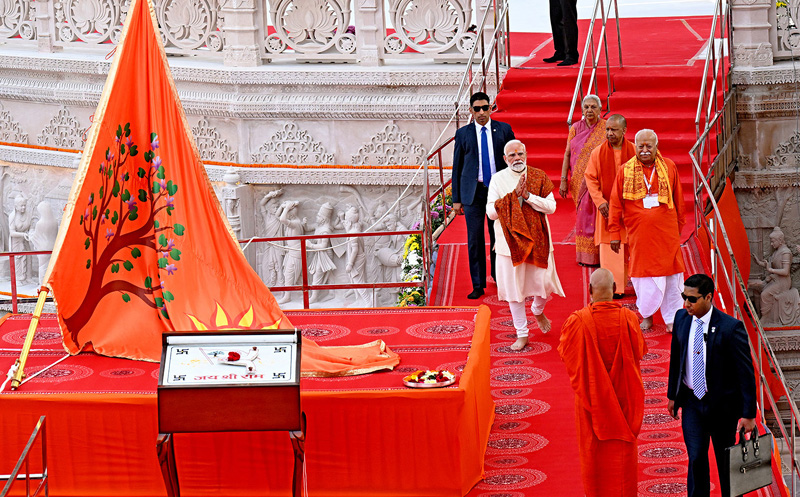
PM hoists ‘Dharmadhwaj’ atop Ram Mandir
*Ayodhya is the land where ideals are transformed into action
Prabhat Ranjan Deen
AYODHYA, Nov 25. Ayodhya witnessed a historic turning point in India’s cultural consciousness. The entire nation, and indeed the world, is filled with the spirit of Ram. Every devotee feels an unparalleled sense of satisfaction, boundless gratitude, and immense spiritual joy. After hoisting the Dharmadhwaj (saffron flag) on Shri Ram Janmabhoomi Temple in Ayodhya, Prime Minister Narendra Modi said this while addressing the huge gathering. He added that centuries-old wounds are being healed, long-standing pain is finding rest, and a centuries-old vow is finally being fulfilled. Today marks the culmination of a 500-year-long yajna (yagya), a yajna that remained steadfast in faith and unwavering in belief. The divine energy of the sanctum sanctorum of Shri Ram Temple has now been enshrined in the form of the Dharmadhwaj atop this magnificent temple.
Follow the Daily Excelsior channel on WhatsApp
The ceremony took place atop the Shri Ram Janmabhoomi Temple in the presence of Prime Minister Narendra Modi and RSS chief (Sarsanghchalak) Dr. Mohan Bhagwat. After offering salutations to the saffron flag, Chief Minister of Uttar Pradesh Yogi Adityanath presented mementoes to the Prime Minister and RSS chief. The ceremony was graced by Governor Anandiben Patel, President of the Shri Ram Janmabhoomi Teerth Kshetra Trust Mahant Nritya Gopal Das, Treasurer Swami Govind Dev Giri, along with saints and dignitaries from across the country. The ceremony was conducted by Champat Rai, Secretary of the Shri Ram Janmabhoomi Teerth Kshetra Trust.
Modi said on the occasion that the Dharmadhwaj is more than a flag; it is a symbol of the renaissance of Indian civilization. Its saffron hue, the glory of the Suryavansh, the Om symbol, and the Kovidara tree inscribed upon it represent the ideals of Ram Rajya. This flag embodies determination, struggle, and ultimate success. It is the realization of a dream nurtured for centuries, the culmination of the spiritual efforts of saints, and the devotion of society at large. For centuries to come, this Dharmadhwaj will uphold the ideals of Lord Ram. It will proclaim that truth alone triumphs over falsehood, that dharma is founded on truth, and that promises must always be kept, ‘Praan jaaye par vachan na jaaye’. It will inspire action and duty, ‘Karma Pradhan Vishwa Rachi Rakha’, and pray for a society free from discrimination, suffering, and hardship, where peace and happiness prevail, the Prime Minister said.
He added, the Dharmadhwaj signifies the temple’s purpose. Even those unable to visit in person can derive spiritual merit. This flag allows a glimpse of Ram Lalla’s birthplace from afar, conveying his message and teachings to humanity for generations. Modi expressed heartfelt gratitude to millions of devotees, philanthropists, laborers, planners, and architects who contributed to the Ram Temple’s construction. He said that Ayodhya is the land where ideals are transformed into conduct. This is the city where Shri Ram began his journey. It demonstrated to the world how a person becomes the ideal human through societal values and guidance. When Shri Ram went into exile, he was Prince Ram; upon his return, he emerged as the embodiment of virtue. The wisdom of Maharishi Vashistha, the guidance of Maharishi Vishwamitra and Maharishi Agastya, the friendship of Nishadraj, the devotion of Maa Shabari and Hanuman, and countless others shaped him into the most virtuous man.
The Prime Minister emphasized that the Ram Temple’s divine courtyard is becoming a beacon of India’s collective strength. It houses seven temples, including those of Maa Shabari and Nishadraj Guhya, alongside shrines of Maa Ahalya, Maharishi Valmiki, Maharishi Vashistha, Maharishi Vishwamitra, Maharishi Agastya, and Saint Tulsidas. Here, along with Ram Lalla, every sage and devotee is honored. Even the statues of Jatayu and the humble squirrel reflect how every small effort contributes to achieving great goals. Modi said, the temple empowers values of faith, friendship, duty, and social harmony. Shri Ram connects with us not by birth or status but by devotion and virtue.” He valued cooperation over power, principles over salvation. Today, India carries forward this spirit. Over the past 11 years, every segment of society, women, dalits, backward classes, tribal communities, the deprived, farmers, labourers, and youth, has been central to development. By empowering every individual and region, India moves together toward a developed nation. By 2047, as India celebrates 100 years of independence, it will realize a vision of development shaped by the collective efforts of all its people.
The Prime Minister said that if India is to achieve holistic development and empower its society by 2047, we must awaken the Ram within ourselves. There can be no better day than today to take this resolution. November 25 marks yet another historic moment of pride in India’s heritage. Referring to the Kovidara tree depicted on the flag, Modi said it symbolizes the importance of staying rooted. When a civilization forgets its roots, its glory is lost in history. He recalled how, when Bharata reached Chitrakoot, Lakshmana recognized the army of Ayodhya from afar by seeing a flag resembling a huge, radiant tree, bearing the auspicious Kovidar symbol. Today, the reinstallation of the Kovidar in the Ram Temple grounds signifies not only the return of the tree but also the revival of memory, identity, and self-respect. The Kovidara reminds us that forgetting our identity leads to weakness, while reclaiming it restores the nation’s confidence. True progress requires pride in our heritage and liberation from the mindset of subjugation.
He asserted that if India resolves to free itself from this mindset in the next ten years, a new flame of confidence will be ignited. The nation will march forward with such determination that nothing will be able to halt the realization of the dream of a Viksit Bharat by 2047. Modi stated that India’s foundation will be truly strengthened for the next thousand years only when Macaulay’s legacy of mental slavery is completely uprooted within the next decade. He added, “The Ram Lalla temple complex in Ayodhya Dham is becoming increasingly magnificent, and the beautification of Ayodhya is progressing continuously. Today, Ayodhya is once again emerging as a city that will set an example for the world. While the Ayodhya of the Treta Yuga gave humanity the gift of ethics and values, the Ayodhya of the 21st century is offering a new model of development. Then, Ayodhya was the center of dignity; today, it is becoming the backbone of a Viksit Bharat. The Ayodhya of the future will be a confluence of mythology and modernity, where the sacred waters of the Saryu River will flow alongside the stream of development, creating a harmonious blend of spirituality and technology, including artificial intelligence.
The Prime Minister said that the coming decades of the 21st century are critical. In the 70 years since independence, India has become the 11th largest economy in the world, and the day is not far when it will emerge as the third largest. These times are full of new opportunities and immense possibilities. Even during such a crucial period, the ideals of Lord Ram remain our guiding light. When Shri Ram faced the formidable challenge of defeating Ravana, he said that courage and patience are the wheels of the chariot needed to overcome obstacles. “Truth and righteousness serve as its flag, while strength, wisdom, restraint, and altruism are the horses. Forgiveness, compassion, and equality are the reins that keep the chariot on the right path”, he added.
 Follow our WhatsApp channel
