

By R. Suryamurthy
India’s decision to establish a domestic rare-earth magnet industry may seem like a technical footnote in a week crowded with political and economic headlines. In reality, it marks one of the country’s most important strategic turns in years. The Union Cabinet’s approval of a ₹7,280-crore scheme to build a complete ecosystem for sintered rare-earth permanent magnets (REPMs) is more than industrial housekeeping. It is New Delhi’s clearest admission that India can no longer afford to be a passive spectator in the global race for minerals that power the 21st century.
For two decades, China has dominated the critical minerals landscape with remarkable discipline and foresight. It did not merely mine these materials; it mastered the refining, separation, alloying, and processing stages where true value and geopolitical leverage sit. The result is a level of concentration that would be alarming in any strategic sector: Beijing controls most of the world’s rare-earth magnet output, a decisive share of lithium conversion, and an overwhelming percentage of the processing of cobalt, manganese, and graphite.
India, like most countries, has relied on this ecosystem because it was convenient, competitive, and seemingly reliable. But the last few years have shown just how fragile this arrangement is. Export controls, diplomatic tensions, price shocks, and geopolitical signalling have all demonstrated the risks of depending on a single supplier for minerals that underpin everything from EV motors to missile guidance systems. India’s own import bills tell the story. Lithium-ion battery imports have soared into the billions, and key intermediates such as lithium carbonate, nickel sulphate, cobalt sulphate, and LiPF₆ are still entirely sourced from abroad.
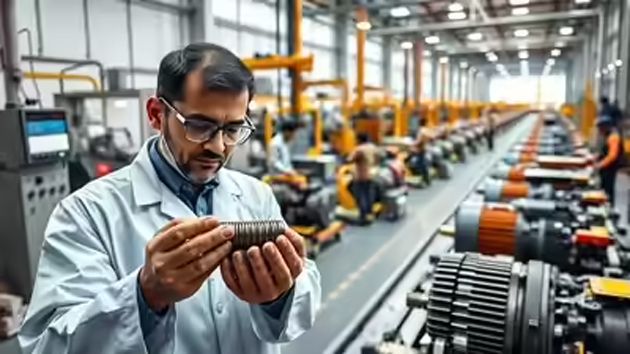
The newly approved REPM scheme is significant because it targets the segment that China has used most effectively as leverage: the midstream. The plan is not merely to assemble magnets, but to create full-stack capacity — converting rare earth oxides into metals, metals into alloys, and alloys into high-strength magnets. The government will back the initiative with heavy incentives, global competitive bidding, and a seven-year support structure that gives companies both the time and confidence to invest.
For India, rare-earth magnets are only the starting point of a larger strategic repositioning. Over the past year, the government has rolled out a series of decisions that indicate a new seriousness about critical minerals. Incentives now extend beyond exploration to refining, precursor chemicals, and high-purity processing — the very activities that India long ignored while China quietly fortified its industrial moat. Mining reforms have been aligned with industrial policy, and the National Critical Mineral Mission has been tasked with coordinating what used to be a fragmented policy space.
Just as important is India’s newfound diplomatic clarity. Recognising that no domestic strategy can succeed without diversified global access, New Delhi has intensified its partnerships with Latin America, Africa, Australia, and Canada — the geographies that hold the greatest reserves of lithium, cobalt, nickel, and rare earths. India’s state-backed vehicle, KABIL, has become more active in securing stakes and offtakes in overseas assets. Quiet but significant progress has been made in Argentina’s lithium triangle; exploratory ties are being deepened with mineral-rich African states; and India’s relationships with Australia and Canada — two of the world’s most stable providers of battery metals — have begun shifting toward long-term, strategic mineral cooperation.
These moves are not about rivalry for rivalry’s sake. India’s goal need not be to replace China — a task no country can accomplish soon — but to ensure that India is not exposed to one-sided risks in technologies central to its own growth and security. A balanced reading of global politics shows that mineral concentration is not a theoretical threat; it can manifest overnight in the form of export restrictions, price squeezes, or quietly withheld shipments during diplomatic friction. India’s energy transition, industrialisation, and defence modernisation cannot be built on supply chains that remain vulnerable to external shocks beyond its control.
At the same time, India’s domestic mineral base, while promising, is not something it can fully rely on. Many high-profile finds remain in the early inference stage. Mining and refining are long-gestation activities with complicated environmental and community considerations. For the foreseeable future, India will have to build a hybrid model: secure resources abroad, refine strategically at home, and recycle aggressively to recover materials from retired batteries and electronic waste. Recycling, in particular, is the fastest path for India to reduce import dependence. Recovery technologies for lithium, nickel, and cobalt have improved sharply, and India has the scale of end-of-life products to build a circular ecosystem around them.
There is, of course, a risk that India falls into its old patterns: fragmented decision-making, slow permits, policy drift, and the lure of cheaper imports that undermine domestic investments. That would be the fastest way to lose this race before it even begins. A laser-like focus on execution is essential. Mineral strategies require decades of consistency; without continuity, India will end up with scattered projects instead of a coherent industrial base. Getting the REPM scheme right — commissioning plants on schedule, achieving global quality standards, securing supply for defence and EV sectors, and eventually exporting magnets — will be a litmus test for whether India can execute complex industrial programmes.
But there are reasons for cautious optimism. India’s market today is large enough to justify full domestic value chains. EV demand is rising, grid storage is expanding, and renewable energy has become mainstream. These industries cannot grow on imported uncertainty. They require stable, predictable supplies of refined minerals. That urgency creates political alignment. It also gives Indian companies the confidence to invest in technologies that were once seen as too niche or too capital-intensive.
The geopolitical context further tilts in India’s favour. Many countries are searching for mineral partners that are both reliable and not entangled in great-power rivalries. India occupies a unique position: large enough to matter, trusted enough to partner with, and increasingly willing to bring diplomatic muscle to its industrial goals. If it can synchronise domestic incentives with overseas partnerships — something the REPM scheme hints at — India can carve out a meaningful place in global mineral supply chains without having to mirror China’s scale.
Still, realism is necessary. China’s dominance will not erode because India has announced a few strategic schemes. It will erode only if India stays committed for the long haul — building refineries, training metallurgists, investing in R&D, scaling recycling, securing overseas equity, and maintaining consistent policies across elections and budgets. This is a generational undertaking, not a typical five-year plan.
The magnet scheme is important because it marks the first concrete step toward that long horizon. It tells industry that India is ready to put money on the table. It tells partners abroad that India is serious about diversifying supply chains. And it tells China — quietly but unmistakably — that India is no longer content to occupy the weakest link in the minerals-to-manufacturing chain.
India’s fight to end dependence on China’s mineral muscle will be long, uneven, and at times frustrating. But for the first time, the country seems prepared for the effort. The clean-energy economy of the future will belong not just to the nations that build batteries, motors and turbines — but to those that can secure the minerals behind them.
India has taken its first step. What it does next will decide whether this becomes a turning point or another unfinished ambition swept away by the next cycle of cheap imports and lost opportunities. (IPA Service)
 Follow our WhatsApp channel
