

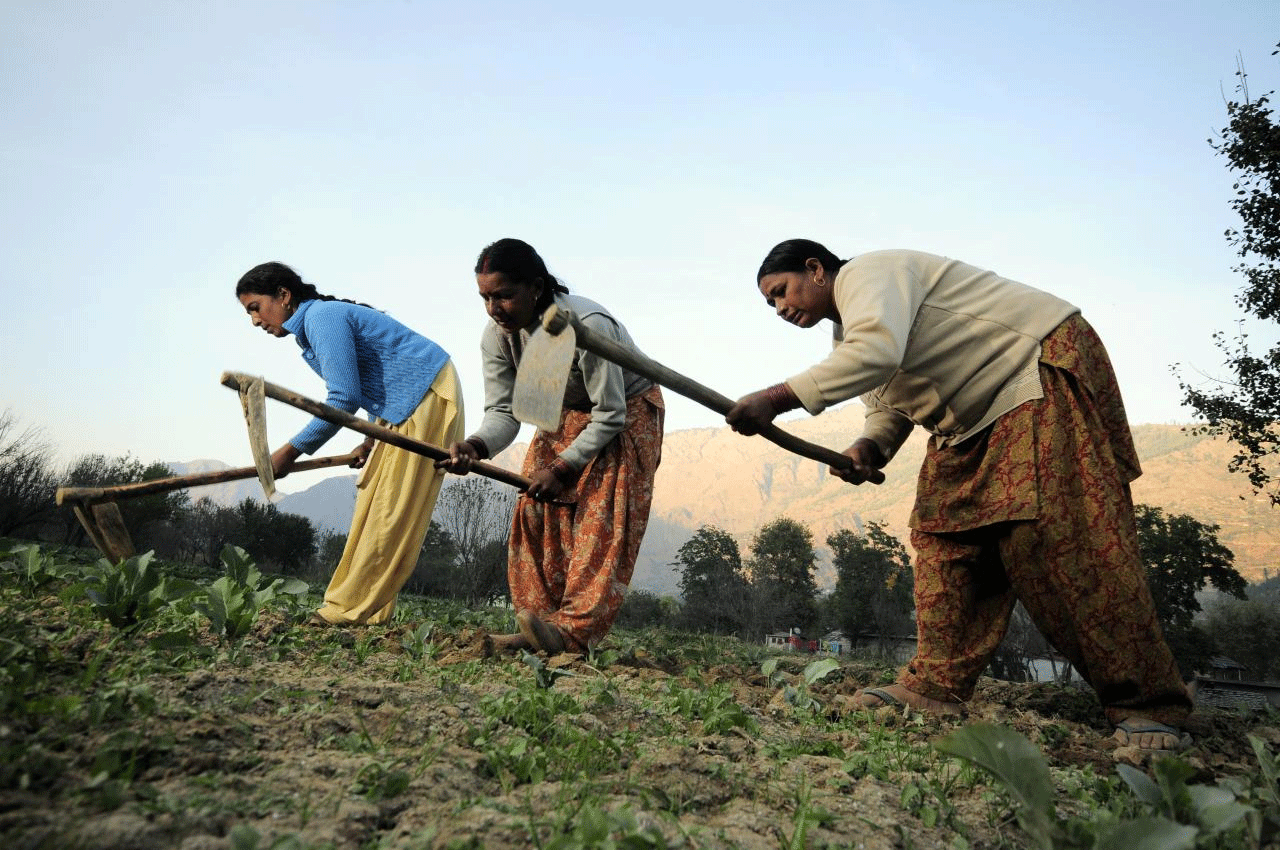
International Year of Woman Farmer 2026
Dr. Parveen Kumar*
pkumar6674@gmail.com
Women in farms are mostly invisible, but have a vital role contributing to food and nutritional security of humanity all across the globe making up to 60 to 80 per cent of food production in developing countries and 39% of the agriculture labour force in South Asia. They are the backbone of global agriculture performing critical tasks from planting to harvesting, managing livestock and processing and adding value to food. They are the one who undertake the most labour intensive works in agriculture and allied sectors. As per the data available from agricultural census 2015-16, the no. of rural women engaged in farming in the country stand at 73.2%. They grow as much as 80% of India’s food. Nearly 75% of full time workers on Indian farms are women. Studies further reveal that women farmers’ work 3300 hours, double the 1860 hours than their male counterparts per crop season. Further of the 263 million total agricultural workers, 37% (98 million are women). Farm women perform numerous labour intensive jobs such as ploughing, weeding, hoeing, cleaning, grading and storage of the produce and all other relevant operation related to farming, livestock and other allied sectors.
Despite contributing so much, they are still invisible yet to get the due recognition and acknowledgement for their work. They own significantly less agricultural land (around 15%) despite comprising a large workforce. In the 2025, World Economic Forum’s Global Gender Gap Report, India ranked 131 out of 148 countries with an overall Gender parity score of about 64%. It dropped by two points from its score of 129 in 2024. The report is based on assessment of four dimensions viz Economic participation and Opportunity, Educational Attainment, Health & survival and Political Empowerment. The report reveals that women in the country still have lowest economic participation levels and opportunities. Since its launch in 2006, it is the longest standing index tracking the progress of numerous countries efforts towards closing these gaps.
Ninety per cent of the agricultural land is transferred through inheritance and women struck as labourers generation for generation after generation. About 52-75% of women engaged in agriculture are illiterate. Various social norms and taboos, lack of access to land, education, training and equal treatment is still a concern as it affects agricultural yield. Percentage of female farmers’ enrolled under Prime Minister Fasal Bima Yojana (PMFBY) during 2020-21 was just 16%. Similarly percentage of female beneficiaries under PM Kisan Samman Nidhi (PMKISAN) was 22.6% in early 2024. Climate change also impacts women disproportionately. Farm women are also laggards when we see their participation in collective organization.
International Year of Woman Farmer 2026 (IYWF 2026): The United Nations Food and Agriculture Organization (FAO) estimates that if women had the same access to productive resources as men, they could increase yields on their farms by 20-30%, leading to higher agricultural output in developing countries and a dramatic reduction in hunger. Keeping in mind their contribution to agricultural sector, the United Nations has declared 2026 as the International Year of the Woman Farmer (IYWF 2026), a global initiative led by the Food and Agriculture Organization (FAO) to highlight women’s critical roles in agri-food systems.
The Government of India while recognizing their important role in farm sector has besides framing policies for woman farmer has also initiated a host of skill and entrepreneurship development programmes for them. Development of their skills and promoting their engagement in agri-business can be an important factor in their empowerment. It will not only give them an opportunity to be a part of an income generating group but will also lead to their socio-economic empowerment, creates jobs for others too thereby promoting the overall economic growth and well-being of their families too.
Some of the government scheme especially meant for farm women especially young girls include the Namo Drone Didi scheme which aims to modernize Indian agriculture and empower women-led Self-Help Groups (SHGs). Under the Yojana, drones are provided to 15,000 Self Help Groups (SHGs) for renting them to farmers for agricultural purposes. The women from SHGs would also be given fifteen days free of cost training on how to operate these drones. The member from women self help groups would rent out the drones to others and earn a decent livelihood. The Krishi Sakhi programme aims to transform rural India through the empowerment of rural women as Krishi Sakhi, by imparting training and certification of Krishi Sakhis as Para-extension Workers. Krishi Sakhis are chosen as agriculture Para-extension workers because they are trusted community resource persons and experienced farmers themselves. Their deep roots in farming communities ensure they are welcomed and respected. Government will update their skills in different farming practices by providing them appropriate trainings in different aspects related to agriculture and allied sectors. After acquiring training, their potential can be used in dissemination and transfer of technologies and in promoting agri based entrepreneurship through Krishi Sakhis.
Under the Rashtriya Mahila Kosh (RMK), micro-credit is extended to poor and underprivileged women through a collateral-free, quasi-formal delivery mechanism where NGOs, women co-operatives, federations etc. act as intermediaries.
The DAY-National Rural Livelihood Mission (NRLM) primarily focuses on formation of Self Help Groups (SHGs) with exclusive women membership for their mobilization and empowerment. A SHG usually consists of 10-20 women in plain areas and 5-20 in difficult areas. An important component of NRLM is the Mahila Kisan Sashaktikaran Pariyojana (MKSP) which aims to support women farmers’ and build their capacities in agro-ecological sustainable practices. Primarily, MKSP aims to recognize women farmers, a hitherto unrecognized category, even though most of the farming activities are almost exclusively handled by the women. MKSP also, inter alia, seeks to reduce drudgery for women farmers.
Under the Startup India programme, there is a provision for loan to the amount between 10 lakhs and 1crores to at least one woman per bank branch for setting up a green-field enterprise in manufacturing, trading or services sector. The scheme primarily targets women and individuals from SC/ST. The Mahila E-Haat is an initiative for meeting aspirations and needs of women entrepreneurs. It is an online marketing platform for women, where participants can display their products. It is an initiative for women across the country as a part of ‘Digital India’ and ‘Stand Up India’ initiatives. Under Micro-units Development Refinance Agency (MUDRA), any woman can start a new business or scale up an existing one can avail loan. Three categories of loan are being provided under MUDRA which includes Shishu (loan up to rupees 50,000), Kishore (loan up to 5 lakhs and Tarun (loan up to 10 lakh). Women account for 68% of all Mudra beneficiaries
The yearlong celebrations will recognize contributions of farm women; acknowledge women farmers’ vital roles in producing, processing, and trading food. At the same time, it also gives us an opportunity to address persistent inequalities, and promote policies that empower woman farmers to achieve food security and sustainable development goals. It is a year for all of us to work collectively to close gender gaps in access to resources, boost women’s leadership and build more resilient and inclusive food systems worldwide. The focus of our endaveour should be to do away with the issues like limited access of farm women to land, credit, technology, extension services and decision making and at the same time encourage effective policies for social protection and gender equality in agriculture. Empowering women farmers enhances household well-being, boosts productivity, and strengthens climate resilience. It is also crucial for achieving the Sustainable Development Goals (SDGs) especially reducing poverty and hunger.
The author writes on agriculture and social issues; can be reached at pkumar6674@gmail.com
Forwarded message ———
From: p kumar <pkumar6674@gmail.com>
Date: Mon, 19 Jan 2026, 12:49
Subject: article for publication
To: editor <editor@risingkashmir.com>
 Follow our WhatsApp channel
