

B L Razdan*
Krishna of the Gita stands for the infinite in the finite, the God in man concealed within the folds of flesh and the powers of sense. (S Radhakrishnan)
Gita Jayanti is the birthday of Shrimad Bhagavad Gita. This day falls on Shukla Ekadashi of the Margashirsha month and according to the English calendar, this festival falls in the month of November or December. It is that sacred day when Lord Krishna gave the immortal message to Arjuna in Kurukshetra. The followers of Lord Krishna all over the world celebrate this day by engaging themselves in discourses on the holy scripture and contemplation on its various Shlokas that appeal to them individually. This year Gita Jayanti falls on Wednesday, the 11th December 2024, according to the lunar calendar.
Also referred to as ‘The Song by God’, the Gita, a 700-verse Sanatan Scripture, forming chapters 23–40 of book 6 of the Mahabharata titled as the Bhishma Parva,was lying dormant till itwas retrieved by Adi Shankara, who wrote the most meaningful commentary on it. It is one of the Prasthanatrayi, and is also known as Sadhana prasthana (practical text), and the Smriti prasthāna.The Bhagavad Gita is the most popular religious poem of Sanskrit literature. It is said to be ‘the most beautiful, perhaps the only true philosophical song existing in any known tongue’. It conveys lessons of philosophy, religion and ethics. It is not looked upon as a shruti, or a revealed scripture, but is regarded as a tradition. Yet, if the hold which a work has on the mind of man is any clue to its importance, then the Gita is the most influential work in Indian thought.
Its message of deliverance is simple. While only the rich could buy off the gods by their sacrifices, and only the cultured could pursue the way of knowledge, the Gita teaches a method which is within the reach of all, that of bhakti, or devotion to God. The poet makes the teacher the very God descended into humanity. He is supposed to address Arjuna, the representative man, at a great crisis in his life.
Arjuna comes to the battlefield, convinced of the righteousness of his cause and prepared to fight the enemy. At the psychological moment he shrinks from his duty. His conscience is troubled, his heart is torn with anguish and his state of mind “like to a little kingdom, suffers then the nature of an insurrection.” If to slay is to sin, it is a worse sin to slay those to whom we owe love and worship. He typifies the struggling individual who feels the burden and the mystery of the world. He has not yet built within himself a strong centre of spirit from which he can know not only the unreality of his own desires and passions, but also the true status of the world opposing him.
The despondency of Arjuna is not the passing mood of a disappointed man, but is the feeling of a void, a sort of deadness felt in the heart, exciting a sense of the unreality of things. Arjuna is ready to repudiate his life if necessary. He does not, however, know what is right for him to do. He is faced by a terrible temptation and passes through an intense inward agony.His cry is a simple yet tremendous one, significant of the tragedy of man, which all who can see beyond the actual drama of the hour can recognise.
The mood of despair in which Arjuna is found in the first chapter of the Gita is what the mystics call the dark night of the soul, an essential step in the upward path. The further stages of illumination and realisation are found in the course of the dialogue. From the second chapter onwards, we have a philosophical analysis. The essential thing in man is not the body or the senses, but the changeless spirit. The mind of Arjuna is switched on to a new path.
Arjuna attempts to recapture the kingdom of man by resisting the temptations and controlling the passions. The path of progress is through suffering and self-abnegation. He tries to evade the rigorous ordeal by subtle arguments and specious excuses. Krishna stands for the voice of God, delivering His message in thrilling notes, warning Arjuna against dejection of spirit.
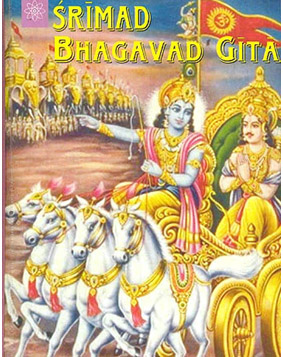
The opening chapter shows great insight into the heart of man, its conflict of motives, the force of selfishness and the subtle whisperings of the Evil One.As the dialogue proceeds, the dramatic element disappears. The echoes of the battlefield die away, and we have only an interview between God and Man. The chariot of war becomes the lonely cell of meditation, and a corner of the battlefield where the voices of the world are stilled, a fit place for thoughts on the Supreme.
The teacher is the favourite god of India, who is at once human and divine. He is the god of beauty and love, whom his devotees enthrone on the wings of birds, on the petals of flowers, on whatever they most delight in of all that lives on earth. The poet vividly imagines how an incarnate God would speak of Himself. There is support for the poet’s device to make Krishna say that he was Brahman. In the Vedanta Sutras (1.30), the Vedic passage where Indra declares himself to the Brahman is explained by the hypothesis that Indra is only referring to the philosophical truth that the Atman in man is one with the Supreme Brahman. When Indra says “Worship me”, he means “Worship the God I worship.” On a similar principle, Vamadeva’s declaration that he is Manu and Surya is explained.
On the first reading of the Bhagvad Gita, we read it as blind people; all we come to know is about some names and their relationships. A second reading makes us inquisitive as to why they did what they did. It is on the third revision that we begin understanding the meaning according to our own perceptions. On the fourth read are we able to understand the emotions of the various people involved. Reading Bhagvad Gita for the fifth time enables us to subjectively imagine the scene at the Kurukshetra. While reading it for the sixth time, we do not feel that we are reading but get the feel that someone is telling us about the war. During the seventh read we identify with Arjuna and feel that what he says is what Krishna says. While going through the Bhagvad Gita the eighth time there is a feeling that Lord Krishna is within us and that he tells us the easiest way of liberating ourselves. We also realise that we get answers to all the questions we might ask God directly. We realise that there are ways to cope with the difficulties we face in life, described in an easy and lucid manner.
The intellect discriminates between pairs of opposites. A dull, undeveloped intellect leads to confusion, loss and sorrow. A sharp, clear intellect guarantees prosperity and success. An intellect focused on world welfare gives happiness. When the intellect distinguishes between the eternal and the ephemeral, you get anchored in the permanent and reach enlightenment. The intellect is most important; it needs to be developed and strengthened with independent, original thinking. Thus, the mortal, gross body, mind and intellect can transport you to the immortal, subtle Spirit. Only then are you truly fulfilled.
Krishna encapsulates the entire spiritual path starting with Karma, Bhakti and Jnana Yogas and concludes with meditation. Karma Yoga is acting with the attitude of giving, not taking. Bhakti Yoga is inclusive love, not exclusive attachment. Jnana Yoga is distilling the permanent from the transient aspects of life. If you maintain your focus on Atman you will overcome all obstacles. When you are free of the bulk of desires you are fit for meditation. In the intense heat of meditation, the last traces of desire vanish and you become God!
Krishna then leaves you to do as you wish. The Gita is not a doctrine of adesha, (commandments), to be accepted without question. It is upadesha, advice based on logical, scientific exposition on the human personality. Reflect on these, experiment with them and draw your own conclusions – just as you would in physics or chemistry. Then you will experience the truths laid down in the Gita and find liberation while living in the world.
 Follow our WhatsApp channel
