

Jaipur Metro Project Phase-2 approved
NEW DELHI, Apr 8:
The government on Wednesday approved 12 per cent hike in subsidy for Phosphatic and Potassic (P&K) fertilisers for Kharif 2026 season to Rs 41,534 crore in order to insulate farmers from rising global prices amid the West Asia conflict.
Follow the Daily Excelsior channel on WhatsApp
The subsidy for P&K fertilisers for Kharif 2025 season was Rs 37,216 crore.
The decision, taken at a Cabinet meeting chaired by Prime Minister Narendra Modi, fixed subsidy rates effective April 1 to September 30, 2026.
For Kharif 2026, the government has set subsidy for nitrogen at Rs 47.32 per kg (up from Rs 43.02 per kg in rabi 2025-26), phosphate at Rs 52.76 per kg against Rs 47.96 per kg, and sulphur at Rs 3.16 per kg against Rs 2.87 per kg). The potash subsidy has been held steady at Rs 2.38 per kg.
Subsidy is extended across 28 grades of P&K fertilisers under the Nutrient Based Subsidy (NBS) scheme, in force since April 2010.
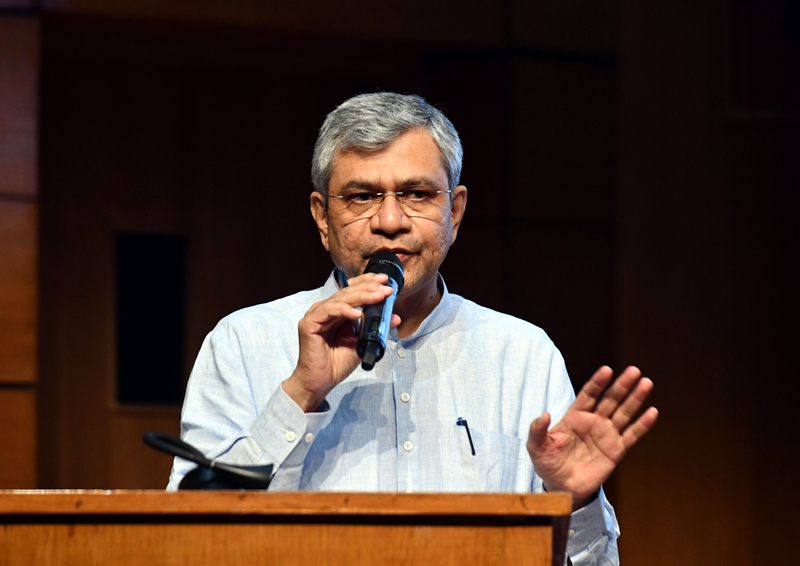
“The subsidy has been increased by Rs 4,317 crore over Kharif 2025 season,” Information and Broadcasting Minister Ashwini Vaishnaw told reporters.
Despite a sharp increase in Di-ammonium Phosphate (DAP) prices in international markets since the Covid years, the minister said the retail price for farmers has been held at Rs 1,350 for a 50-kg bag.
Be it Covid years or West Asia crisis, the Prime Minister has remained as a safety shield for farmers, insulating farmers from global price volatility, he added.
The Cabinet also approved a set of additional measures: provisions to manage global price volatility, extension of similar safeguards to imported Triple Super Phosphate (TSP) to ensure supply stability, continuation of freight subsidy for Single Super Phosphate (SSP), and inclusion of both imported and domestically manufactured Ammonium Sulphate under the NBS scheme for Kharif 2026.
Meanwhi, The Union Cabinet also approved the Jaipur Metro Project Phase-2, a 41-km corridor comprising 36 stations, at a total project cost of over Rs 13,000 crore, Union minister Ashwini Vaishnaw said.
The project will be implemented by the Rajasthan Metro Rail Corporation Limited (RMRCL), a 50:50 joint venture of the government of India and the government of Rajasthan.
The Union Cabinet, approved the North-South corridor from Prahladpura to Todi Mod, at a total project cost of Rs 13,037.66 crore, Vaishnaw said at a media briefing here.
The Phase-2 corridor will provide seamless connectivity to major activity nodes such as Sitapura Industrial Area, VKIA, Jaipur Airport, Tonk Road, SMS Hospital and Stadium, Ambabari and Vidhyadhar Nagar, an official statement said.
It includes underground stations in the airport area and will integrate with the operational Phase-1 through planned interchanges and feeder systems, ensuring a unified and continuous metro network across the city.
In a post on X, PM Modi said the Cabinet decision will expand connectivity, reduce congestion and enhance ‘Ease of Living’ in Jaipur.
At present, the Jaipur Metro Phase-1 records an average daily ridership of around 60,000 passengers on the shorter but critical 11.64-km corridor.
With the commissioning of Phase-2, the Metro network is expected to witness a manifold increase in ridership, substantially enhancing the share of public transport in Jaipur and reducing dependence on private vehicles.
The Union Cabinet also approved investments totalling Rs 40,150 crore for the construction of two major hydropower projects in Arunachal Pradesh, as the government accelerates development of renewable energy and regional infrastructure.
The Kamala Hydro Electric Project (1,720 MW) will be built across Kamle, Kra Daadi, and Kurung Kumey districts through a joint venture between state-owned NHPC Ltd and the state government, with a planned completion period of eight years.
“The Cabinet Committee on Economic Affairs, chaired by the Prime Minister Narendra Modi, has approved investment of Rs 26,069.50 crore for construction of Kamala Hydro Electric Project (HEP) in Kamle, Kra Daadi & Kurung Kumey districts of Arunachal Pradesh,” an official statement said, adding the estimated completion period for the project is 96 months.
The plant is expected to generate about 6,870 million units of electricity annually, supporting peak demand management, national grid balancing, and flood moderation in the Brahmaputra basin.
Separately, the Kalai-II Hydro Electric Project (1,200 MW) on the Lohit River in Anjaw district will be implemented via a joint venture between THDC India Limited and the Arunachal Pradesh government, with a target completion in 78 months.
The CCEA “approved investment of Rs 14,105.83 crore for construction of Kalai-II Hydro Electric Project (HEP) on Lohit river in Anjaw district of Arunachal Pradesh. The estimated completion period for the project is 78 months,” it said.
Once operational, it is expected to generate around 4,853 million units annually, strengthening power supply in the region and contributing to grid stability. (PTI)
 Follow our WhatsApp channel
