

Higher education regulator to replace UGC, AICTE etc
*71 laws to be repealed
NEW DELHI, Dec 12:
The Union Cabinet on Friday approved Rs 11,718 crore for conducting the Census of India, 2027, which would include the caste enumeration for the first time.
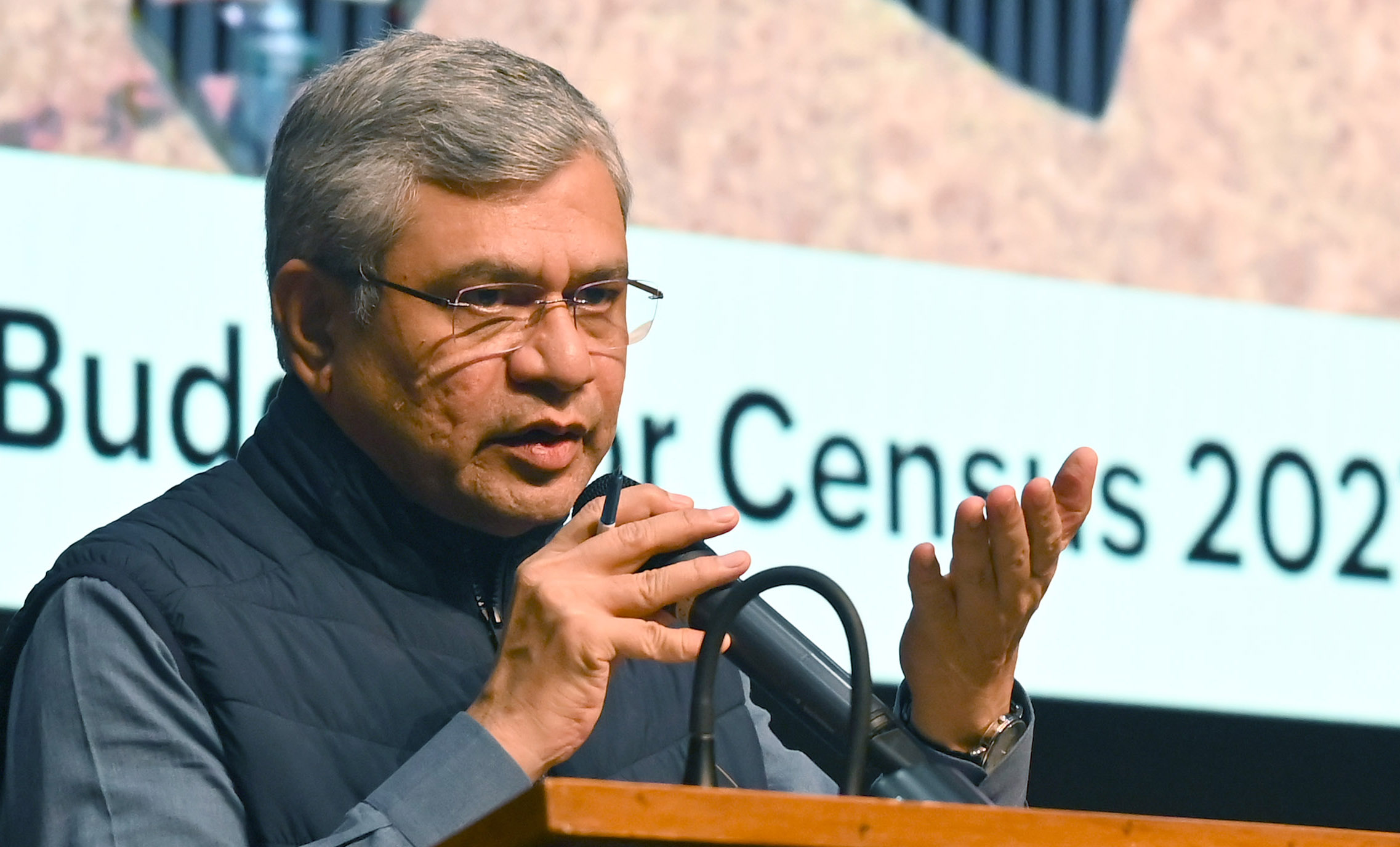
Addressing a briefing, Information and Broadcasting Minister Ashwini Vaishnaw said the Cabinet, chaired by Prime Minister Narendra Modi, approved the proposal to conduct the Census which will be the first digital exercise.
Follow the Daily Excelsior channel on WhatsApp
Around 30 lakh enumerators would be involved in the entire exercise.
The 16th edition of the Census since Independence will also provide an option of self enumeration to the citizens.
The decadal exercise which was scheduled to take place in 2021 got postponed due to the outbreak of the COVID-19 pandemic across the country.
The Minister said the Census will be conducted in two phases — house-listing and housing census from April to September, 2026; and population enumeration (PE) in February 2027.
For Ladakh and snow-bound non-synchronous areas of the Union Territory of Jammu and Kashmir and states of Himachal Pradesh and Uttarakhand, the PE exercise shall be conducted in September, 2026, the Minister said.
“This will become the first-ever digital census,” Vaishnaw told reporters.
Around 30 lakh enumerators will visit each and every household and canvass a separate questionnaire for houselisting and housing census and population enumeration. It will generate 1.02 crore human days of employment, the Minister said.
Vaishnaw said the entire digital census system has been created as a very robust system and all personal data protection laws will be applicable. The census will collect the micro-level data of every individual and household and present a macro-level data, he added.
“Data of the micro-level will be collected from each household and a macro picture will be present. Individual data will be kept confidential while the macro-level data of the Census will be published,” the Minister said.
“All the Census functionaries will be paid a suitable honorarium for the work of the Census as they will be doing this work in addition to their regular duties,” a Government statement said.
The Census 2027 will also capture caste data electronically in the PE phase, Vaishnaw said.
In the first-ever digital Census, data will be collected using mobile applications that will be available for both Android and iOS versions.
Meanwhile, a bill to set up a higher education regulator which will replace bodies such as the UGC and AICTE was approved by the Union Cabinet on Friday, officials said.
The proposed legislation which was earlier christened the Higher Education Commission of India (HECI) Bill has now been named Viksit Bharat Shiksha Adhikshan Bill.
The single higher education regulator which was proposed in the new National Education Policy (NEP), looks to replace the University Grants Commission (UGC), the All India Council for Technical Education (AICTE) and the National Council for Teacher Education (NCTE).
“The bill to set up Viksit Bharat Shiksha Adhikshan has been approved by the Cabinet,” an official said.
While the UGC oversees non-technical higher education, the AICTE oversees technical education and the NCTE is the regulatory body for teachers’ education.
The Commission is proposed to be set up as a single higher education regulator, but medical and law colleges will not be brought under its ambit. It is proposed to have three major roles — regulation, accreditation and setting professional standards.
The Government also approved a Bill that seeks to open up the tightly-controlled civil nuclear power sector for private participation as India eyes 100 GW atomic energy capacity by 2047.
The Union Cabinet is learnt to have approved the Sustainable Harnessing and Advancement of Nuclear Energy for Transforming India (SHANTI) Bill.
In a bid to expand insurance penetration in the country, the Union Cabinet also approved a bill to raise foreign direct investment in the insurance sector to 100 per cent, according to sources.
The bill may be introduced in the ongoing Winter session of Parliament, which is slated to conclude on December 19.
According to a Lok Sabha bulletin, the Insurance Laws (Amendment) Bill 2025, which seeks to deepen penetration, accelerate growth and development of the insurance sector and enhance ease of doing business, is part of the 13 legislations listed for the ongoing session of Parliament.
The Insurance Laws (Amendment) Bill, 2025, may be introduced in Parliament on Monday, sources said.
Finance Minister Nirmala Sitharaman, in this year’s Budget speech, proposed to raise the foreign investment limit to 100 per cent from the existing 74 per cent in the insurance sector as part of new-generation financial sector reforms.
According to sources, the proposed bill also provides a provision for at least one among the top management, like the Chairman, Managing Director, or CEO, to be an Indian citizen as part of the guardrails.
The Cabinet has retained the net worth requirements for insurance companies, sources added.
The Union Cabinet also cleared a Bill to repeal 71 laws which have outlived their utility in the statute books, officials said.
Out of the 71 laws, 65 are amendments to principal Acts and six are principal laws.
At least one law proposed to be repealed is of the British era, the officials said.
The proposed repeal nd amendment Bill is not aimed at striking off colonial laws but to remove Acts which have outlived their utility, an official said.
“Once an amendment is passed by Parliament, it gets subsumed in the principal law. It then only clutters the statute books. Its use has ended but it still exists, creating confusion,” an official explained.
So far, 1,562 old archaic laws have been repealed.
The Government also approved the ‘CoalSETU’ window for the auction of coal linkages for diverse industrial uses and exports to ensure fair access and optimal utilisation of the resource.
The Union Cabinet Committee on Economic Affairs, approved the Policy for Auction of Coal Linkage for Seamless, Efficient & Transparent Utilisation (CoalSETU), according to an official statement.
The policy will allow allocation of coal linkages on an auction basis on long-term for any industrial use and export by adding a separate window named CoalSETU in the NRS (Non-Regulated Sector) Linkage Auction Policy of 2016.
Any domestic buyer requiring coal can participate in the linkage auction, irrespective of the end use, Information and Broadcasting Minister Ashwini Vaishnaw said, briefing the media about the Cabinet decision.
Meanwhile, the Government increased the minimum support price for milling copra by up to Rs 445 to Rs 12,027 per quintal for the 2026 season, a move aimed at ensuring better returns to coconut growers and boosting production to meet rising demand for coconut products.
The MSP for ball copra has been raised by Rs 400 to Rs 12,500 per quintal for the same period, Information and Broadcasting Minister Ashwini Vaishnaw said after the meeting of the Cabinet Committee on Economic Affairs, chaired by Prime Minister Narendra Modi.
The MSP has been fixed for the ‘fair and average quality’ of both milling and ball copra on the recommendation of the Commission for Agricultural Costs and Prices (CACP).
The National Agricultural Cooperative Marketing Federation of India Ltd (NAFED) and the National Cooperative Consumers’ Federation (NCCF) will continue to act as Central Nodal Agencies for procurement of copra under the price support scheme, Vaishnaw said. (PTI)
 Follow our WhatsApp channel
