

By Dr. Gyan Pathak
The cabinet approved India’s Nationally Determined contribution (NDC) 2031-35 has clearly adopted a calibrated middle path between its climate responsibility and development sovereignty in the backdrop of the country’s unfinished development agenda. It signals India’s willingness to act on climate action but on terms that is consistent with our growth trajectory, and if greater climate finance will be available to the country, which India has been demanding from the developed countries during climate talks.
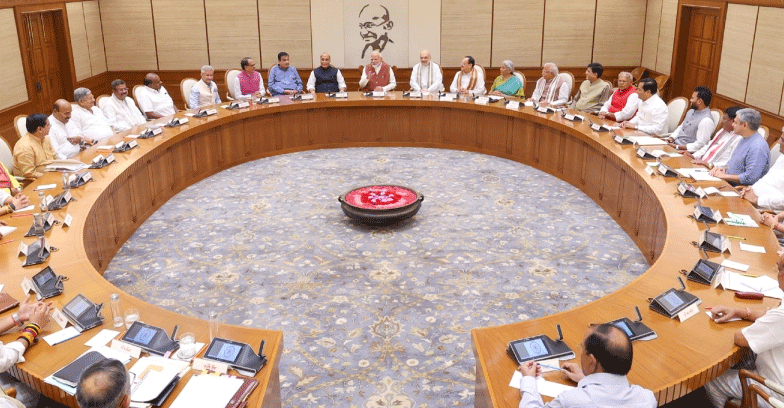
NDC 2031-35 approved by the Union Cabinet under the chairmanship of PM Narendra Modi on March 25, has enhanced the countries ambition under the UNFCCC and its Paris Agreement while reinforcing its commitment to sustainable development and climate justice. Government has said that it is guided by the vision of Viksit Bharat, which is not just a goal for 2047, but a commitment to act today to build a prosperous, and climate resilient Bharat for the future generations. It indicates India’s cautious approach on the issue while increasing its ambition but without committing to disruptive emission cuts. This approach of the country may be seen inadequate globally but is justified domestically.
In the cabinet approved NDC 2031-35, which is yet to be officially submitted to the UNFCCC, India’s key commitments are: India commits to reduce Emissions Intensity of its GDP by 47 percent by 2035 from 2005 level; India to achieve 60 percent cumulative electric power installed capacity from non-fossil fuel-based energy resources by 2035; India to create Carbon Sink of 3.5 to 4.0 billion tonnes of CO₂ equivalent through Forest and Tree Cover by 2035 from 2005 level; and India’s commitments are aligned with vision of Viksit Bharat @2047 and Net-Zero by 2070.
The NDC submitted by India in August 2022 for 2021–2030, had committed to reducing GDP emission intensity by 45 per cent below 2005 levels and achieving 50 per cent cumulative electric power capacity from non-fossil sources by 2030. That had updated the 2015 pledge of achieving reduction in emission intensity by 33–35 per cent and cumulative electric power capacity from non-fossil resources to 40 per cent. The 2022 update had aimed to create an additional carbon sink of 2.5 to 3 billion tonnes of CO₂ equivalent through additional forest and tree cover by 2030.
When we compare the level of commitments of 2022 and the cabinet approved NDC now on March 25, we find only a moderate increase in both ambition and commitments. It means that India has not changed its metrics, raised its ambition only moderately, not radically.
A special element of the document is that India’s emission reduction target is still intensity-based, in percentage of the GDP growth. The country has carefully avoided absolute emission cut target. It implies that as India will proceed ahead with its development agenda level of pollution will increase in absolute term, but the country will try to maintain its in percentage of its GDP growth.
There is no doubt that India will have strong push towards renewables, as the cabinet approved NDC for 2031-35 indicate, but it will still be capacity-based, not actual generation or emission.
India still does not commit to early peaking of emission, and the document suggests that emission may peak sometime between 2035-40, according to analysts. India, therefore, leaves room for continued emissions growth as the development activities get momentum in the coming years.
When we take into consideration both the NDCs – for 2021-30, and for 2031-35 – India is continued the same framework – that is intensity targets, not absolute cuts; and capacity targets, not fossil phase-out. The net result is – climate policy has been aligned with economic growth first and emissions cut later.
Government has said that India’s original climate commitments i.e NDC submitted in 2015, had laid a strong foundation, and the targets set by 2030 both in reduction of emissions and non-fossil resources based electric power installed capacity were met, 11 years and 9 years ahead of the committed timelines, which demonstrated a credible and action-oriented approach to climate governance.
As on February 2026, India has enhanced its non-fossil fuel energy resources in installed electric power capacity to 52.57 per cent, successfully meeting the target five years ahead of the timeline and now the ambition has been raised to 60 per cent by 2035.
As for carbon sing, the country has already created 3.29 billion tonnes of CO₂ equivalent by 2021, even as it maintained a high GDP growth rate. Now, we have enhanced the target to create 3.4 to 4 billion tonnes of CO₂ by 2035, which is only a moderate increase.
In shaping India’s NDC for 2031–2035, the Government said that it has considered the outcomes of the first Global Stocktake (GST), principle of Common but differentiated responsibilities and Respective Capabilities (CBDR-RC), and equity with a view to harmonize national realities, developmental priorities, energy security and the need for greater ambition in climate action, in line with the purpose and long-term goals of the Paris Agreement.
India has thus avoided forcing structural change in its climate action, aiming at low political or economic risks, but will have limited additional climate impact. The numbers of the cabinet approved NDC 2031-35 are not just technical, but have some geopolitical signals. India has been demanding trillions in climate finance, and has signalled that if finance and technology are provided, we can do more. Targets seem to be intentionally kept moderate to increase bargaining power in this regard. India seems to keep maximum policy flexibility up to 2035, and beyond.
India’s such an approach has been already criticised globally because it would increase carbon emission in absolute terms. However, India can defend its approach on the basis of per capita emission which is around one-third of the global average, though it is third largest emitter of the world in absolute terms. India needs growth and development to fulfill the needs of its people, which it can’t stop for a rigid emission cut target. It has to be a gradual process, as the cabinet approved NDC 2031-35 has indicated. (IPA Service)
 Follow our WhatsApp channel
