

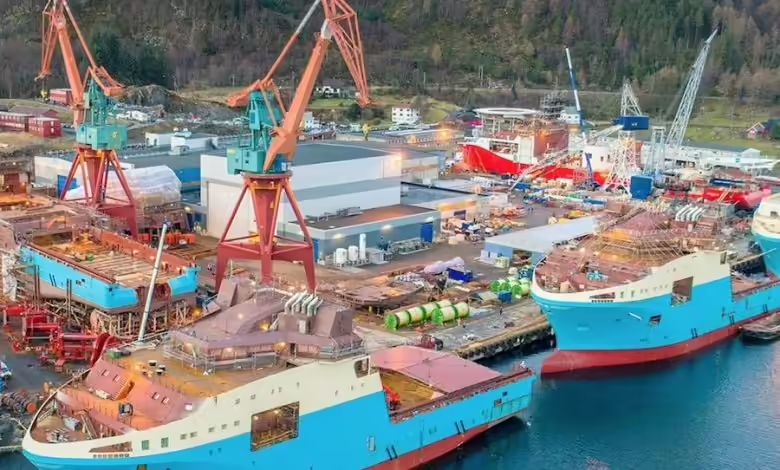
NEW DELHI, Mar 14: India’s shipbuilding and ship recycling sectors are poised for significant expansion, supported by policy reforms, large financial commitments and new industrial projects aimed at strengthening the country’s maritime ecosystem and reducing dependence on foreign shipping lines.
Addressing industry stakeholders, Susanta Kumar Purohit, Chairperson of the V.O. Chidambaranar Port Authority at a PHDCCI summit, outlined a comprehensive roadmap to strengthen India’s maritime capabilities, stating that the leadership of Narendra Modi and the strategic direction of union Minister for Ports, Shipping and Waterways Sarbananda Sonowal have helped create a strong fiscal architecture aimed at transforming India into a major maritime power.
The policy framework guiding the sector is anchored on four strategic pillars-financing, capacity expansion, policy reform and skill development.
Key financial initiatives include the Rs 69,725 crore Maritime Revitalisation Package and the Rs 25,000 crore Maritime Development Fund, along with the extension of the Shipbuilding Financial Assistance Scheme until 2036.
The Ministry of Ports, Shipping and Waterways has also received a significant budgetary push, with its allocation increasing by 48 per cent to Rs 5,164.8 crore.
The measures are aimed at strengthening domestic maritime capabilities and addressing the nearly Rs 6 lakh crore annual freight outgo paid to foreign shipping lines.
A major industrial initiative under the new framework is the proposed National Shipbuilding & Heavy Industries Park in Tamil Nadu.
The project will be executed through a Special Purpose Vehicle named the National Shipbuilding & Heavy Industries Park, Tamil Nadu, as a 50:50 joint venture between the V.O. Chidambaranar Port Authority and the State Industries Promotion Corporation of Tamil Nadu (SIPCOT).
The facility, estimated to cost Rs 30,000 crore and spread across 2,000 acres, is expected to become a major centre for domestic maritime manufacturing and heavy engineering.
The policy thrust also emphasises integrating a circular economy into the maritime sector through the Shipbreaking Credit Note Scheme. The scheme offers vessel owners credit notes equivalent to 40 per cent of the scrap value of ships recycled at Indian yards, which can be redeemed against the cost of building new vessels domestically.
India has also strengthened its position in global ship recycling, with 106 ship recycling yards at Alang already compliant with the Hong Kong International Convention, reflecting improved environmental and regulatory standards.
The V.O. Chidambaranar Port Authority has been highlighted as a model for the Maritime Amrit Kaal Vision 2047, with major sustainability and infrastructure initiatives underway. The port has become the first in India to produce green hydrogen and the first to exceed one megawatt of rooftop solar generation capacity.
It is also implementing a Rs 15,000 crore Outer Harbour project aimed at developing southern India into a major transhipment hub capable of competing with global ports such as Singapore and Colombo.
Industry representatives noted that India’s shipbuilding and ship-recycling sectors have made notable progress in recent years under the government’s ‘Make in India’ vision.
Public shipyards have delivered major milestones, with Cochin Shipyard Limited delivering nearly 400 vessels, including the indigenous aircraft carrier INS Vikrant.
Meanwhile, Mazagon Dock Shipbuilders Limited and Garden Reach Shipbuilders & Engineers Limited have together delivered around 30-40 vessels.
Government-backed financial assistance schemes amounting to nearly Rs 70,000 crore and plans to develop shipbuilding clusters across the country are expected to accelerate private investment and significantly expand India’s shipbuilding capacity in the coming years.
Experts also highlighted emerging opportunities in indigenous container manufacturing and ship recycling, alongside the strategic importance of the Rs 25,000 crore Maritime Development Fund and the broader Rs 69,725 crore revitalisation package aimed at strengthening India’s maritime industry.
(UNI)
 Follow our WhatsApp channel
