

Suman K Sharma
s2m2nr@gmail.com
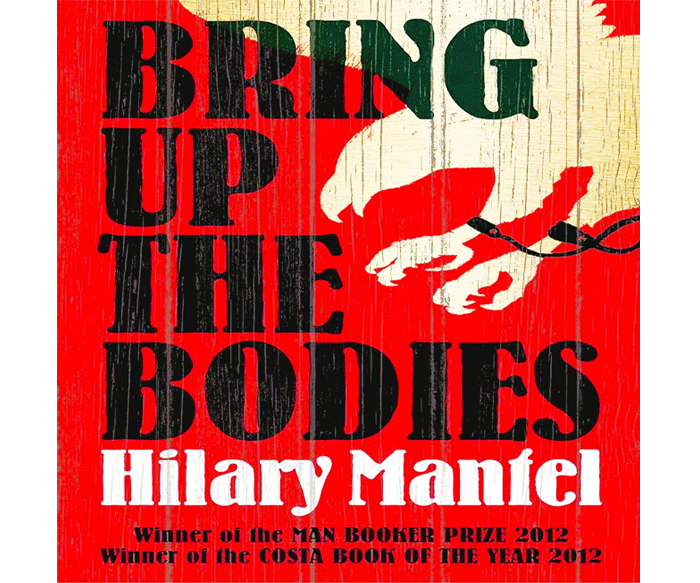
The British author, Hilari Mantel’s historical novel, BRING UP THE BODIES, describes the 16th century events of her country when it was in the throes of transformation. At the hub of the affairs was Thomas Cromwell, King Henry VIII’s deputy – a remarkable statesman, shrewd lawyer and adept administrator.
The massively popular novel, published in 2012, forms a part of the author’s trilogy on the life and times of Thomas Cromwell. It was preceded by WOLF HALL (2009) and succeeded by THE MIRROR AND THE LIGHT (2020). Mantel was twice awarded the Booker Prize, first for WOLF HALL, and then for its sequel, BRING UP THE BODIES. The latter novel also received the distinction of being the 2012 Costa Book of the Year.
Hilary Mantel (1952-2022), is an acclaimed author. Her oeuvre comprises 12 novels, 2 collections of short stories, a memoir and numerous articles. The British government bestowed on her the honours of DBE – Dame of the British Empire, and FRSL – Fellow of the Royal Society of Literature.
xxx xxx xxx
The storyline spans the period of September 1535 to May 1536 – some eight months. Britain is ruled by Henry VIII. The monarchy is in a frenzy because the king wants to marry a lady of quality and sire a male successor. It is not as easy for him as it seems. He is married twice and already has had two legitimate daughters with his successive queens, Princesses Mary and Elizabeth. His first spouse, old Katherine – now relegated to the life of a royal castaway – is dying by degrees. The second one, Anne Boleyn, has lost her lustre in just three years of marriage. The whisperings in the corridors of her licentious conduct apart, the queen has failed to give the realm a male heir. The roving-eyed king is now keen on marrying young Jane Seymour. Jane fires the king’s passion nonetheless with her high lineage and hard-to-get demeanour. He is determined to have her by his side, no matter what.
In the novel, it is not Henry VIII who is the hero, but his deputy, Thomas Cromwell. ‘He, Cromwell’ – as the author generally calls her protagonist – makes it possible for his master to fulfil his heart’s desire, by means foul than fair. His workings ensure that Katherine loses all the dignity of a former queen and dies a lonely death. Even her daughter, Mary, is not allowed to meet her. Katherine’s successor, Anne Boleyn, is denounced as a deviant and a traitor. Her marriage is annulled, and she is beheaded at the Tower of London along with five of her alleged lovers. Among the condemned adulterers are her own brother, George Boleyn, and her uncle, Thomas Howard. The bloodletting facilitated by Cromwell removes any possible hurdle in Henry VIII’s way to marry the coy lady, Jane Seymour.
Pandering to his royal master’s whim is not the only initiative that Cromwell succeeds to accomplish. He is too big for that. Born to the humble family of a blacksmith, he has risen to the pinnacle of power, next only to the king himself. In the government, he is the Chancellor of Exchequer, Chief Secretary to the king, Master of Rolls (the second highest post in the then British judiciary) and the Lord Privy Seal. In the Church, following Henry VIII’s decision to part ways with the Roman Catholicism and give unto himself the authority of the pope, Thomas Cromwell has secured for himself the appointment of Vicar General to handle the lucrative job of dissolution of monasteries.
The nobility, however, still looks down upon him as a ‘commoner’. Even Henry VIII nicknames him ‘Crumb’ (as in a breadcrumb!). Cromwell doesn’t mind it. Nobility is an accident of birth, he feels. His stature, and the power that comes with it, are the outcome of his own strengths with which he has made it to the top of his highly stratified society.
Bring Up the Bodies is a many-layered story. We see Cromwell using his near-absolute power to achieve his own ends, yet abiding by the king’s wishes all the while. As the Vicar General, he confiscates the wealth of monasteries, making himself rich, and his king richer by far. Henry VIII wants to get rid of Anny Boleyn, and Cromwell willingly carries out the ruler’s desire. Anne had played a significant role in the downfall of his mentor and former employer, Cardinal Wolsey. Now, Cromwell not only intends to avenge his mentor’s disgrace, but he also feels personally threatened by the wily queen. Only the previous year, in 1535, it was her coterie that had instigated Henry VIII to execute such a high personage as the Lord High Chancellor, Sir Thomas More.
But why did Anne hate Wolsey? What was the reason Henry VIII decided to kill Thomas More? Reading the novel gives one a feeling of peeling back the layers of an onion. Hillary Mantel’s distinctive style and diction add to the flavour of the novel.
Of the trilogy, BRING UP THE BODIES assumes significance in that it catches the hero at the apogee of his powers. But is he really the person that the British history records in its inert annals? For an answer one can only allude to the lecture Mantel gave in 2017. “I met a man who wasn’t there,” the author said.
 Follow our WhatsApp channel
