

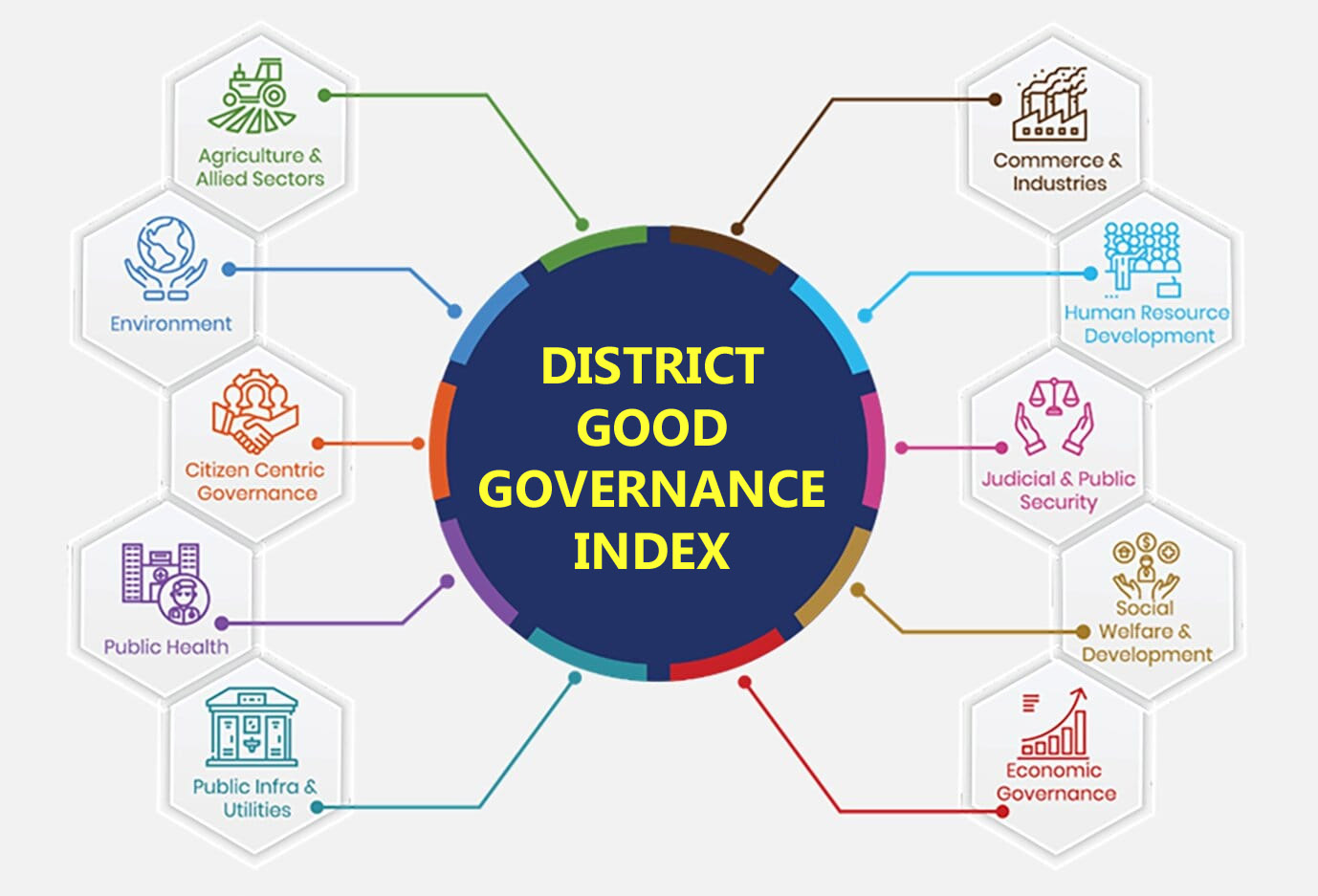
The release of the District Good Governance Index 4.0 marks another milestone in assessing the administrative performance of the 20 districts in the UT of J&K. It is not just a ranking tool; it serves as a mirror reflecting the strengths and shortcomings in public service delivery. While the report celebrates the success of districts like Jammu, Srinagar, and Samba, it also draws attention to chronic underperformance in districts like Kishtwar, Kupwara and Ramban. The composite DGGI scores-ranging from Jammu’s leading 6.9623 to Ramban’s bottom score of 4.9728-highlight significant disparities that need strategic attention.
Jammu district, once again, leads the governance index, demonstrating consistent administrative efficiency across most sectors. Although it lagged in the Agriculture and Environment sectors (ranking 13th and 12th, respectively), its overall excellence in Public Health, Social Welfare, and Legal & Public Safety sectors propelled it to the top. The district’s top rank in institutional deliveries, immunisation coverage, and conversion of PHCs into Health and Wellness Centres underscores the positive impact of focused health initiatives. Srinagar, securing the second spot, excelled in Industries and Allied Sectors and Public Infrastructure. The district’s performance reflects strong support for MSMEs, expansion of GST establishments, and better access to sanitation and safe drinking water. Likewise, Samba’s third rank is a result of its excellence in infrastructure and financial inclusion, underlining a robust developmental focus.
A granular look at sector-wise performance presents a mixed picture. Districts like Kulgam, Ganderbal and Shopian led the Human Resource Development Sector due to better gender parity and school retention rates. Meanwhile, Anantnag, Jammu, and Udhampur stood out in reducing crime against women and children-a critical marker of social progress. Interestingly, Kishtwar, while a bottom performer overall, emerged as the best district in the Agriculture sector and Social Welfare. This contradiction signals that poor overall ranking may stem from sectoral imbalances rather than outright administrative inefficiency.
Districts such as Ramban, Kupwara, and Kishtwar, which find themselves at the bottom of the composite index, reflect issues that go beyond administrative slackness. Many of these regions are geographically remote, face infrastructural bottlenecks, and have lower socio-economic baselines. For example, Ramban’s poor ranking could be attributed to inadequate access to quality healthcare, weak infrastructure, and limited industrial activity. Kupwara, a border district, faces logistical and communication hurdles that affect service delivery. In the case of Kishtwar, while agriculture and welfare schemes are well-implemented, deficiencies in health infrastructure, legal safety, and public utilities likely dragged down its overall score.
To improve the performance of underachieving districts in the DGGI, a comprehensive and strategic approach is essential. Firstly, each low-ranking district should be equipped with a tailored District Development Blueprint that aligns closely with the DGGI indicators. These blueprints must be realistic, time-bound, and subject to quarterly monitoring to ensure consistent progress. Secondly, there should be an emphasis on cross-district learning, where best practices from top-performing districts are studied and adapted. Infrastructure development, particularly in road connectivity, digital access and public utilities, must be prioritised in geographically challenging districts to enable seamless implementation of Government schemes. Additionally, capacity building among district-level officials is crucial. Citizen participation is another critical element; empowering Panchayati Raj Institutions and involving civil society in monitoring and feedback can ensure that governance is responsive and inclusive. Lastly, the establishment of real-time monitoring systems through dynamic dashboards for each district will help track key performance indicators, enabling timely interventions and promoting greater accountability.
The Planning Department’s recognition of the need to incorporate additional indicators for future DGGI editions is commendable. However, inclusivity must also mean enabling capacity for data collection and reporting, especially in weaker districts. Furthermore, the Government must institutionalise a system of performance-based incentives and penalties. Districts making notable improvements should receive recognition, while persistently lagging regions must undergo administrative audits and restructuring if needed. Addressing structural disparities, promoting innovation, and fostering healthy competition will ultimately create a more inclusive, resilient, and efficient governance framework-one that truly delivers for every citizen of the UT.
 Follow our WhatsApp channel
