

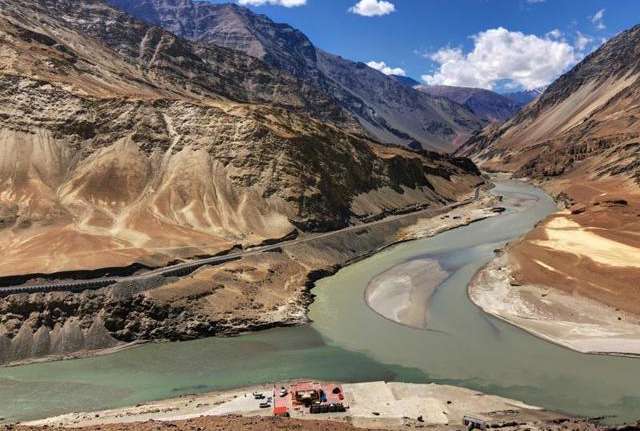
India’s decision to revive the long-stalled Tulbul Navigation Project marks not just an infrastructural development initiative but a significant geopolitical and strategic shift. With the Indus Waters Treaty (IWT) now officially “in abeyance” following Pakistan’s continued patronage of cross-border terrorism-exemplified by the recent Pahalgam terror attack-India is reclaiming its sovereign right to better utilise its share of western river waters, long underutilised due to treaty constraints and political hesitance.
The IWT is one of the most generous and one-sided water-sharing agreements ever negotiated. Despite being the upper riparian state, India agreed to allocate 80% of the waters from the Indus, Jhelum, and Chenab rivers to Pakistan-a gesture made in the spirit of good neighbourliness. For over six decades, India honoured its obligations even as Pakistan repeatedly violated the spirit of bilateralism by internationalising disputes, obstructing Indian projects, and, more gravely, abetting terrorism across Indian borders. That goodwill has now run dry, much like the Chenab River might in the coming years should India begin tapping its full water-use potential. Due to treaty limitations, India cannot store monsoon waters beyond 24 to 48 hours, which has historically led to inefficient flushing operations to manage sediment in dams. These operations are not only a logistical burden but also prevent India from exercising full control over water flow and seasonal regulation.
The Tulbul Navigation Project, the Wular Barrage, is one of the earliest casualties of Pakistan’s obstructionism. Conceived in 1984 by the Government of Jammu and Kashmir, the project aimed to restore year-round navigation between Wular Lake and Baramulla along the Jhelum River. Historically, this waterway was a crucial trade artery, with 70percent of Kashmir’s cargo transported by ‘khachus’, large boats capable of carrying up to 15 tonnes. The explosion of the horticulture sector in Kashmir, especially in Sopore, made efficient water transport all the more essential. Pakistan opposed the project, claiming it violated the IWT. Yet, in truth, Tulbul aimed to regulate, not obstruct, the river flow, particularly in winter months when natural water levels fall below navigable limits. It would also enhance downstream hydroelectric generation efficiency-benefiting both India and Pakistan. But for Pakistan, any Indian development on western rivers, however legal, is unacceptable.
India, under successive Governments, had shelved the project in the face of Pakistani opposition and a desire to maintain peace. But the ModiGovernment has demonstrated a clear policy reversal-one that prioritises national interest, water security, and strategic autonomy. With the DPR for Tulbul under preparation, India is preparing the groundwork not just for a navigation and flood control initiative but for a paradigm shift in its water diplomacy. This shift is already evident in India’s robust rejection of the so-called supplemental award by the Court of Arbitration on the Kishenganga and Ratle hydroelectric projects. India has made it unequivocally clear that it does not recognise the legality of this court, whose very constitution, it argues, is in violation of the IWT’s dispute resolution mechanisms. India’s assertion of sovereignty in suspending the IWT obligations until Pakistan “credibly and irrevocably” ceases support for terrorism is not merely rhetoric-it is a legal and strategic recalibration.
India has already completed the Kishenganga HEP (330 MW) and is fast-tracking the Ratle HEP (850 MW). These projects, along with the soon-to-be-resumed Tulbul Barrage, mark a new era where India intends to extract full utility from its rightful share of western river waters. Desperate, Pakistan continues to weaponise international forums, but the old tactics are losing potency. The narrative has changed. India is no longer shackled by the misplaced burden of moral superiority or by fear of global criticism. As a sovereign state, India is acting within the bounds of international law and treaty obligations-as they now stand suspended due to consistent provocations. More water diversion and storage initiatives will likely follow, especially to address the chronic water shortages in Punjab, Haryana, and Rajasthan. Citizens-first is now the guiding principle, not endless tolerance of a neighbour that refuses to reciprocate goodwill.
 Follow our WhatsApp channel
