

Sunny Dua
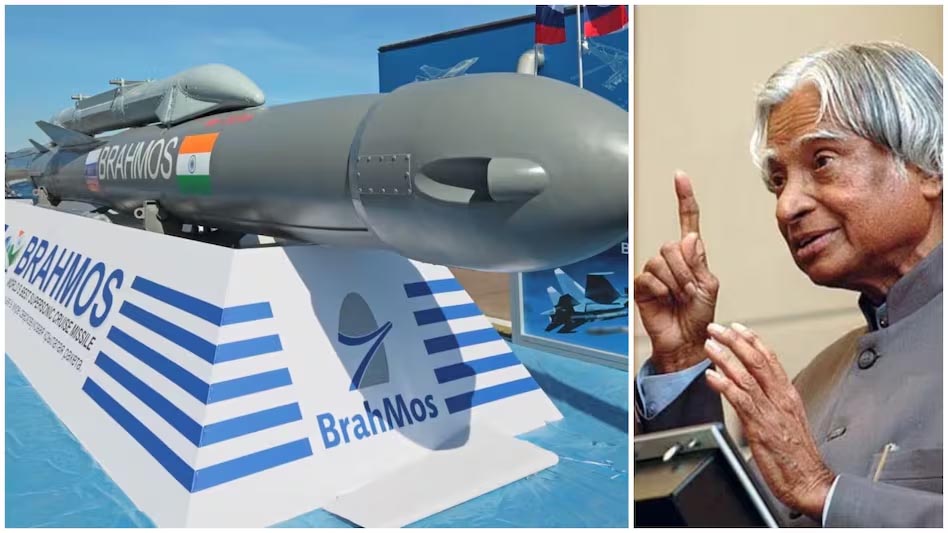
Way back in 2004, Jammu University hosted an exhibition featuring models of the Brahmos supersonic cruise missile and the Akash surface-to-air missile, coinciding with a visit by then-President Dr. A.P.J. Abdul Kalam, fondly known as India’s “Missile Man.” The display of these missile models, developed under the Integrated Guided Missile Development Programme (IGMDP) led by Dr. Kalam, showcased India’s advancements in defence technology and self-reliance in missile systems.
The exhibition held significant educational value, aiming to ignite interest in science and technology among students while highlighting the strategic importance of these missiles in bolstering India’s defence capabilities. Dr. Kalam’s presence added immense inspiration, as he interacted with students, emphasizing the role of youth in nation-building and technological progress.
After 21 years, Pakistan forced India to use these missiles for self-defence. During the recent India-Pakistan conflict, triggered by a terrorist attack in Pahalgam on April 22, 2025, which killed 26 civilians, the BrahMos and Akash missile system proved their mettle in Operation Sindoor. BrahMos supersonic cruise missile, a joint India-Russia development, proved its mettle marking its first combat use.
Launched primarily from Sukhoi Su-30 MKI jets, approximately 15 BrahMos missiles, it is said, targeted 11 Pakistani airbases, including Nur Khan and Rafiqui, crippling runways, command centers, and air defense systems with pinpoint accuracy. Its Mach 2.8-3.0 speed, 300-600 km range, and versatile altitude capabilities made it nearly uninterceptable, while coordinated strikes with decoy aircraft and Harop drones maximized its impact, forcing Pakistan into a defensive posture. India brought a rouge state Pakistan on its knees, thanks to our scientist and late President A P J Abdul Kalam and his team.
The BrahMos’s success underscored the legacy of India’s “Missile Men,” Dr. APJ Abdul Kalam and Dr. Prahlada Rama Rao, who shaped India’s self-reliant defence vision. The missile’s devastating strikes on high-value targets, like the Jaish-e-Mohammed headquarters, exposed Pakistan’s vulnerabilities and boosted India’s global defence stature, drawing interest from nations like the Philippines and Vietnam. While Pakistan downplayed the damage, satellite imagery confirmed significant destruction, validating the BrahMos as a game-changer in modern warfare and cementing India’s technological prowess.
Honored with the Padma Shri in 2015, Dr. Rao’s contributions extended to multiple missile programs, including BrahMos, Astra, and K-15, but his leadership in the Akash project remains his most celebrated achievement. By fostering indigenous technology, Dr. Rao has reduced India’s reliance on foreign systems, saving billions while enhancing national security. His leadership, rooted in perseverance and collaboration, too has transformed India into a missile superpower, with Akash standing as a testament to his legacy of innovation and self-reliance.
Akash missile system also proved its mettle in Operation Sindoor. According to available inputs, on the night of May 8-9, 2025, Pakistan launched drones and missiles targeting 15 Indian cities, including Srinagar, Amritsar (Golden Temple) and Chandigarh. Akash, deployed alongside systems like the S-400 and Barak-8, intercepted these threats with clinical precision, neutralizing Pakistani Byker YIHA III kamikaze drones and missiles across border areas in Jammu and Kashmir, Punjab, Rajasthan, and Gujarat.
Reportedly, Akash shot down three Pakistani F-16 jets near Srinagar, demonstrating its capability against high-speed, manoeuvrable targets. Dr. Rao had described this and I quote, “the happiest day of my life,” likening the system’s performance to watching his “child” excel in combat, surpassing expectations with unmatched accuracy. The system’s mobility, electronic counter-countermeasures, and ability to engage 64 targets simultaneously were critical in protecting civilian and military assets, reinforcing India’s air defence dominance.
The BrahMos missile, a supersonic cruise missile born from the strategic collaboration between India and Russia, stands as a testament to India’s growing defence capabilities and its commitment to safeguarding national security. Named after the rivers Brahmaputra and Moskva, BrahMos has emerged as a cornerstone of India’s military arsenal. The BrahMos missile owes much of its success to the vision and leadership of Dr. APJ Abdul Kalam, fondly known as “India’s Missile Man.”
As the head of the Defence Research and Development Organisation (DRDO) in the 1990s, Dr. Kalam spearheaded the Integrated Guided Missile Development Programme (IGMDP), launched in 1983, which laid the foundation for India’s indigenous missile technology. Under his leadership, missiles like Agni, Prithvi, Trishul, Akash, and Nag were developed, significantly enhancing India’s defence capabilities which today enabled our armed forces to not only defence India and its people but also defeat Pakistan in its nefarious designs to target civil population and important religious sites.
Handpicked by Dr. A.P.J. Abdul Kalam, India’s “Missile Man,” Dr. Prahlada Rama Rao had become the youngest project director for the Akash program in the early 1990s, when he was just 35. Conceptualized in 1983 under the Integrated Guided Missile Development Program (IGMDP), Akash was an ambitious endeavour to create a multi-target, short-to-medium-range surface-to-air missile system.
Now when Pakistan attacked India’s important cities, missiles developed by these two missile-men Kalam and Rao not only saved out fellow citizens but also demolished Pakistan’s citadel. The defeat Pakistan faced was seen by the world and this also established Dr. Kalam’s foresight that led to the conceptualization of BrahMos as a joint venture with Russia.
His famous quote, “In geopolitics, only a strong nation can advocate peace. And a powerful weapon like BrahMos can give strength to India to advocate peace in the world,” proved right when Pakistan called India for a ceasefire knowingly that BrahMos had hit it at it’s centre nerve sending shivers down Pakistan’s spines. India being a sensible and responsible nation, accepted the ceasefire only to ensure that Pakistan lost all its rights to negotiate on anything including Indus Water Treaty. Its, India which will now be calling shots and not the Pakistan.
During his presidency, Dr. Kalam continued to support BrahMos, attending its 13th Raising Day in 2014, where he had described it as a “hi-tech deterrence system” unique to India. His contributions were immortalized when the hypersonic BrahMos-II was named BrahMos-II (K) in his honor, with the “K” standing for Kalam. Pakistan must know that India has agreed to a conditional ceasefire and any misadventure by the enemy nation can force India to bank upon Kalam’s or for that matter Rao’s other visionary defence systems only to defend our borders and people.
The BrahMos and Akash missiles have established that it’s not just a technological marvel but also a symbol of India’s strides toward self-reliance in defence manufacturing, encapsulated in the vision of Aatmanirbhar Bharat (Self-Reliant India). India’s defence manufacturing ecosystem fostering public-private partnerships has attracted an investment of about ?34,000 crore and this push toward indigenization aligns with India’s broader defence production goals. This exemplifies India’s military strength and technological prowess. India’s decisive victory in Operation Sindoor showcases its unparalleled ability to strike anywhere within Pakistan’s borders, delivering a stern warning to global terrorists to cease their nefarious activities.
The pinpoint precision of BrahMos and Akash missiles, born from the visionary leadership of Dr. A.P.J. Abdul Kalam and Dr. Prahlada Rama Rao, has not only crushed Pakistan’s defences but also elevated India’s stature as a global defence powerhouse. I express profound gratitude to our valiant armed forces – Jal, Thal and Vayu for their unwavering courage and flawless execution in this four-day war against Pakistan-supported terrorism.
My hearts go out to those who suffered loss of life and property, and I honour their sacrifices. The triumph of these indigenous missiles reaffirms India’s commitment to self-reliance and peace through strength, ensuring that any future aggression will meet an even stronger response. Let this serve as a reminder: India’s resolve and technological prowess stand unmatched, ready to safeguard its sovereignty at all costs. In lighter vein, a tag-line to market our weapons is making rounds on social media which goes like: BrahMos & Akash Missiles – Made in India, tested on Pakistan!
(The writer is senior journalist)
 Follow our WhatsApp channel
