

Padam Dr K N Pandita
knp627@gmail.com
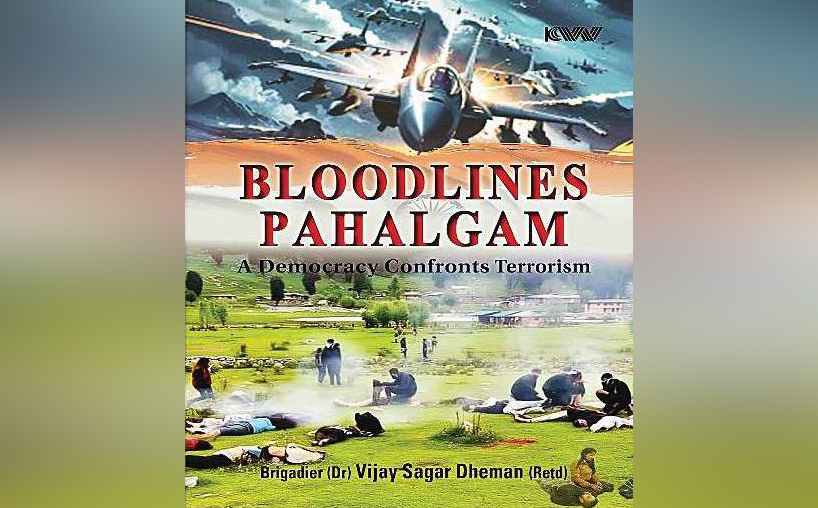
BLOODLINES PAHALGAM: A Democracy Confronts Terrorism by Brig. (Dr) Vijay Sagar Dheman (Retd), KW Publishers Pvt. Ltd. 4676/21, Ansari Road, New Delhi, Hard bound PP. 268 Price Rs 1380.00
The book has 20 sections besides Preface by Maj. Gen Goverdhan Singh Jamwal, AVSM. Positive comments from three senior army officers and one renowned columnist have been appended at the beginning.
Section 1 scripts what exactly occurred on April 22, 2025 and how the national grief on the tragedy developed into strong retaliatory action by the Government of India in the shape of Operation Sindoor.
The important point is that the IAF in particular, targeted the bases of Pakistani terrorists whether in POJK or deep inside Pakistan. In senses it was the extension of operation Balakot which also targeted the base of Pakistan’s designated terrorist organisation Jaishe Muhammad. The IAF smashed at least eleven air stations of Pakistan including the nuclear facility at Noor Khan Airbase. The author has given insights into Operation Sindoor, which is generally considered a game changer in Indo -Pakistan acrimonious relationship.
The author has candidly explained how the civilian populations in the valley and Jammu region reacted differently to the tragedy at Baisaran meadow where 26 innocent civilian tourists were gunned down by the armed terrorists from Pakistan. He questions the truth about the oft-repeated slogan of Kashmiriyat emphasizing that the foreign terrorists were provided logistic support by the locals thereby tarnishing whatever was left of the positive side of Kashmiriyat.
Deniability is the pattern which Pakistan, its army and its ISI have adopted to refute the Indian accusation of clandestine infiltration of Pakistani terror activists into our side of the LoC. Pakistan played this game after every Indo – Pak war from 1947 to the present day. It will be reminded that all these denials boomeranged on Pakistan when impartial and disinterested observers, commentators and media reporters unveiled the truth. In its dealings with India, Pakistan has always resorted to takiya, a religious commandment for the Muslims which means deception. Deniability is one of the means of takiya. How much damage it has done to Pakistan is not realised by her policy planners.
The author has rightly touched upon the vital component of Pakistan’s insurgency plan for Kashmir and that is “Information War” in his words. Pakistani ISI gives extraordinary media hype to false and fabricated news essentially not to mislead India but its own people. The common Pakistani citizen has not even an iota of dobt that the Pakistani government feeds its unsuspecting people with enormous lies and canards. Only to whip up anti-India and hate-India sentiments among its citizens, Pakistan must resort to disinformation campaign. For example even after having found eleven of its air bases badly damaged and incapacitated, Pakistan went on propagating that it had downed six Raffle jets of India. But when asked to show the photo of the downed jets, Pakistan had nothing to show.
The Pahalgam massacre led to serious domestic upheaval in the country. By and large the counter terror arrangements by the security forces in Kashmir had created a semblance of normalcy. Though intrusion incidents still continued at a lower scale but there was considerable reduction in the intensity of infiltration and terrorist activism in Kashmir. In this background, the Baisaran massacre came like a bombshell. Feeling the angry mood of the nation, the Prime Minister heavily depended on the advice from his Council of Ministers. This was the moment when Indian democratic system was under a litmus test of its ability to face the grave challenge. The author has traced how numerous meetings of the Cabinet Committee on Security (CSS) hammered the issue and lending credibility to the input from the defence chiefs, worked on a gainful strategy of undertaken the crucial task of first disabling Pakistan’s air power. If Indian troops had to embark on a pincer attack across the Indo-Pak border in Punjab, it had first to neutralise Pakistan’s air bases. Indian navy had already taken position to choke Karachi port and the navy commander had hinted at his ability to implement ‘Karachi blockade’. This is the reason why Indian Air Force was ordered to paralyse Pakistani Air Force so that the naval and ground forces would together carry fire to the ranks of Pakistani army. The author of the book has elaborately discussed the entire gamut of the retaliatory strategy. The vital and also the smooth coordination with which the CCS planned and worked out its war strategy has been eminently dealt with by the author. Only a soldier can analyse and depict the meticulous planning the way the author has done. Section 3 of the book titled “Convening the Guardians”, therefore, could be considered the most exciting portion of the book as it is spread over 32 pages of the book plus another two pages of footnotes.
Among other vital insights, the author writes at length about how India countered Pakistan’s disinformation campaign, targeted the terror financing, chartered the nuances of the diplomatic offensive, streamlined intelligence input from sources with access to the borders, upgraded the satellite surveillance and deputed NSA chief on a confidential mission to Washington etc. The author appears to have been facilitated by his resourceful contacts at the defence establishment level. That is how most of the information trickling down from his narrative is not to be easily found available with even the prestigious print media outlets. This increases the value and credibility of the book.
In larger context, Operation Sindoor has blasted the bottom of American theory that its nuclear strike power against China, Russia and India from nuclear hideouts in Pakistan would prove a game changer when the day of reckoning arrives. Soon after Operation Sindoor, President Trump remembered the Bagram air base in Afghanistan. Why was it so? Washington’s faith in Pakistan’s invulnerability is shaken ruthlessly by the precision strikes of Indian missiles. This precision flows from the technical excellence Indian scientists gained after landing Indian satellite on the moon.
In final analysis the exciting research work of Brig Vijay Sagar is a Herculean task of convincing the Indian nation and her defence forces that no power on earth can put down India, a country of 1.45 crores of people with thousands of years old civilization. She has carved her path to greatness and world leadership. While appreciating the wisdom and endurance of our political leadership, let us shower flowers on the samadhis of our brave hearts who laid down their lives so that Bharat Mata lives with dignity, pride and power.
 Follow our WhatsApp channel
