

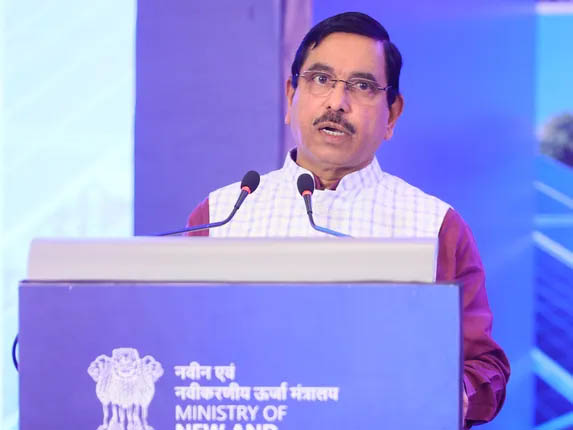
NEW DELHI, Jan 6: Union Food and Consumer Affairs Minister Pralhad Joshi on Tuesday asked Bureau of India Standards (BIS) to develop new standards expeditiously and also modernise testing labs for ensuring quality products and services to people.
He said that the BIS has been regulating the quality standards eco-system in an efficient manner, but now it should also focus on creating an enabling environment where the manufacturing industry itself do not make products below certain standards.
Addressing the 79th foundation day of the BIS here, Joshi said, “The government, under the leadership of Prime Minister Modi, is committed to ensuring that every citizen of India has access to safe, reliable and high-quality products and services.”
He noted that the BIS role is very important in achieving this objective.
“The BIS Mark has become a symbol of trust across multiple sectors, promoting growth in agriculture, manufacturing, and technology. BIS has been instrumental in shaping the country’s quality landscape. Since its inception in 1947, the BIS has evolved into a robust institution that formulates, implements and promotes the standards across the diverse sectors,” Joshi observed.
The minister highlighted that the Modi government brought a new BIS Act 2016, which established the bureau as the national standards body of India. The Act provides for high quality products and services to consumers by preventing the manufacturing and import of substandard products.
Stating that India wants to become a manufacturing hub, Joshi stressed the need to produce quality goods.
He said there is a need to protect consumers interest and also ensure ease of doing business to promote Make in India and Atmanirbhar Bharat initiatives.
Joshi highlighted that setting quality standards for toys has helped in boosting domestic production and curbing imports. “When we decide something, we can bring changes.”
The minister called for people movement to ensure quality products and services to consumers. He noted that industry bodies in many countries decide quality standards and do not make products below that norms.
Joshi said India cannot become a developed nation and compete with very big economies by “just regulating and making mandatory” quality standards.
“BIS as a body, so far, you have regulated well, and you have tried to motivate them well. Now, how we can make it a people’s movement,” he said.
The minister said there is a need to work towards creating an environment where industry itself does not make goods below certain standards.
Joshi said the country can make quality products with the kind of human resources it possesses, and cited the success of mobile manufacturing in India.
The minister said it is the collective responsibilities to ensure that the made-in-India label should become the synonym to quality products in global markets.
About the way forward, Joshi said, “BIS labs should continue to upgrade and modernise through the procurement of the latest and sophisticated equipment to reduce human intervention”.
He said the BIS should fast-track the standard-setting processes, especially for programmes of national priority, and technical committees should develop new standards in the quickest possible time.
Lauding the achievements of the bureau, Joshi said the BIS has been pivotal in formulating and implementing standards across various sectors, ensuring competitiveness and consumer protection.
Presently, around 23,700 Indian standards are in force. Around 94 per cent of Indian standards are harmonised with global ISO/IEC standards.
As of November 2025, 26,793 certifications have been obtained by manufacturers for notified products. Almost an equal number of 24,330 certifications have been obtained on a voluntary basis.
“This shows that over a period of time, the BIS Standard Mark has attained credibility and many manufacturers, especially MSMEs, are increasingly adopting Indian standards to enhance credibility and competitiveness,” Joshi said.
The Indian Standards Institution (ISI) came into being on January 6, 1947, and in June 1947, Dr Lal C Verman took over as its first Director.
Bureau of Indian Standards (BIS) came into existence, through an act of parliament, on April 1, 1987, with a broadened scope and more powers, taking over the staff, assets, liabilities and functions of the erstwhile ISI. (PTI)
 Follow our WhatsApp channel
