

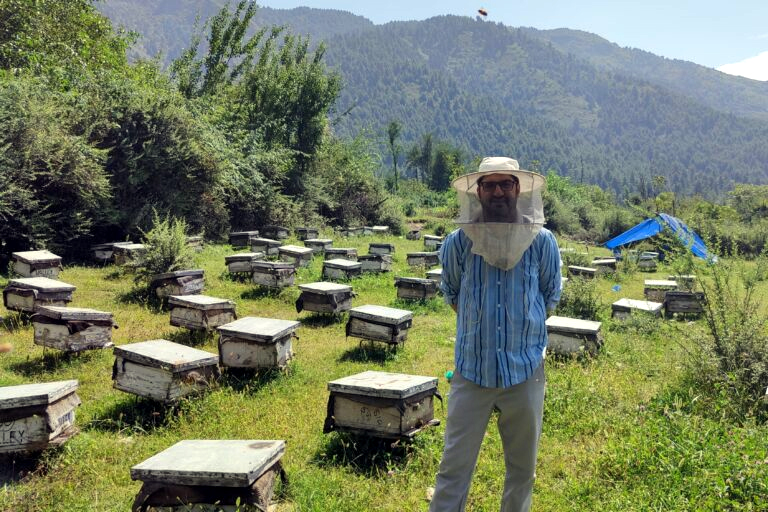
Dr. Banarsi Lal
Beekeeping or apiculture significantly contributes to agriculture and exports with the Indian
exports growing faster than production rates showcasing its profitability.Honey is recognised
for its health-enhancing properties including boosting immunity and antibacterial
effects.Honeybees are crucial for pollinating approximately 16 per cent of the world’s
important flowering plants species,enhancing crop yields and quality significantly.Union
territory of Jammu and Kashmir is said to be one of the most important and suitable
beekeeping places in India.J&K is suitable for the stationary and migratory beekeeping because
of its favourable climatic conditions and diverse natural sources. Beekeeping with Apis mellifera
is popular in Jammu &Kashmir. Beekeepers undertake bees’ migration for honey production
and there is an immense potential to improve honey production. Knowledge of floral resources
and appropriate migration schedules in different beekeeping regions can increase the quality
and quantity of honey. Researchers at the Central Bee Research and Training Institute, Pune
studied the floral resources for A. mellifera and suggest various migration schedules for
different phytogeographic regions in J&K and also in other parts of the country. Beekeeping has
been practised since ancient times mainly for the precious honey stored by the bees in combs.
It was practised in its simplest form in the forest areas. The indigenous oriental honey bee, Apis
cerana, was kept in wall niches, clay pots or other receptacles by the beekeepers. With the
introduction of scientific beekeeping, now the bees are kept in wooden boxes.
Since 1880 efforts are being made to introduce the European bees in India. Modern scientific
beekeeping was introduced in India through import of the Italian race of the European honey
bee, A. mellifera ligustica, in Langstroth and British Standard hives. The present day A. mellifera
colonies in the country have descended from the successfully introduced colonies during the
sixth decennial of the last century. Side by side with the development apiculture using the
indigenous bee, A. cerana, apiculture using the European bee gained popularity. Introduction of
A. mellifera bee species has revolutionized beekeeping and honey production industry in J&K
state. There are many attributes that make A. mellifera more successful and better suited than
the indigenous bees for commercial beekeeping. Its worker bees are larger than those of A.
cerana, and have larger foraging range and high forage carrying capacity. But A. mellifera need
plentiful floral sources and cannot survive in the regions with scant supply of pollen and nectar.
It has been observed that A. mellifera beekeeping has made rapid progress and production of
honey from the last few years. Beekeepers need new vegetation regions to keep the bees’
colonies for production and they need information on the availability of pollen and nectar from
different plants species. One of the important constraints for progress of A. mellifera
beekeeping is the scanty information available on their floral resources. Commercial
beekeeping with A. mellifera honey yield can be increased by adopting migration as a regular
management practice. Migration is important because (i) the bee adopt well to farms and
orchards with large areas under a single crop; (ii) the colonies need a large amount of pollen
and nectar for their survival and growth and (iii) productive efficiency can be achieved only
when a large number of colonies are maintained in an apiary in good strength. It is difficult to
get adequate bee forage throughout the year in one location. Thus, it is necessary for mellifera
beekeepers to have detailed information on the availability of different floral sources near their
apiaries, seasons of their availability and migration schedules for optimal utilization of the
available floral resources. The migration of bee colonies from forests in hills to farms and
orchards in the adjacent plains in order to utilize the local bee flora and improve bee forage
availability to bee colonies has been observed by the researchers. It has also been observed
that migratory beekeeping in the hilly areas enhances honey production and colony
multiplication. Migration is an important beekeeping practice for A. mellifera.
Mustard, gram, eucalyptus, shisham, berseem, toria, maize, citrus, guava, cucurbits etc., are the
crops which are preferred by the bee colonies. Migratory beekeeping in J&K helps to maximize
honey yields. Bees chose certain migratory routes for honey production and colony
multiplication. The natural flora of J&K forests is more varied than many other parts of the
country.Union Territory of J&K has vast geographical area, varying climate from temperate to
tropical, torrid to arctic and from total aridity to a maximum of humidity. Forests cover about
19.95 per cent of the area in J&K. Large quantities of deodar, fir, toon, teak and other trees are
grown for timber. Several of these species provide forage to honey bees. India's forest land
shrinks each year because people cut more trees than they plant. The government encourages
planting mostly of fast growing eucalyptus and pine. Recently karanj is also grown for bio-fuel.
Eucalyptus and karanj provide bee forage.
A. mellifera beekeeping is mainly dependent on cultivated and agricultural crops. A little over
70 per cent of cultivated land is under food grains including rice, wheat, jowar, bajra, maize,
gram and other pulse crops. Oilseed crops like toria, mustard etc. are useful to honey bees.
Among other commonly cultivated plant species useful to honey are mango, lemon, apple,
orange, plum, litchi, pear, peach, cherry, jamun, fodder legumes, coriander, fennel, fenugreek,
onion and other spices and condiment crops. Road-side plantations that contribute to honey
production include eucalyptus, karanj, gulmohr, hedges and fence plants like Duranta,
mulberry, Justicia and Jatropha also add to the bee forage value of farms and orchards.Rubber
tree is the single-largest sources of nectar in India. Rubber plantations are found in south-
western and north-eastern parts of India, where tropical and humid climate prevails. The
nectaries on young leaves of rubber trees secrete nectar profusely in the defoliation stage,
before the tree blooms. In 1990-91 this source alone provided over 6200 tons of honey. Next in
importance is the litchi tree. Jammu region has large areas under litchi orchards that constitute
an excellent source of nectar during March to May. Agricultural crops are seasonal and provide
bee forage for limited periods only. Bee colonies cannot be sustained throughout the year in
any cultivated area, unless it has an integrated intensive agriculture, agro-forestry and social
forestry systems. During the forage scarcity periods between two crop seasons, bee colonies
will have to be moved to another area. Thus, the beekeeping potential for the cultivated
vegetation becomes a part of the potential contained in the natural vegetation.
In J&K, Apis mellifera beekeeping is now well established and beekeepers generally undertake
migration as a matter of course. There is an ample scope for migration to enhance honey
production in the area, by adopting appropriate migration schedules for apiaries in different
locations. In J&K there are many success stories of honey beekeepers.They have established
various beekeeping units at their farms and earning a good amount of money.They are
benefiting the other farmers of J&K to increase their crops production as the honey bees help
to increase the crops production by the pollination process. In Jammu and Kashmir, colonies
from Jammu can be migrated to locations around or near Srinagar for Robinia pseudoacacia
during March-April. This species is dependable source of nectar and colonies can produce
surplus honey. It has been observed that honey yield increases from 40 to 80 kg/colony/season
by this species. In J&K, the colonies are situated in different locations in the plains where
mustard and toria are cultivated. During the severe cold in January, the colonies perform well
even when they get very short foraging time between 1100 to 1500 h. In the months of
February and March colonies get flows from mustard and eucalypts. Honey yield can be
increased in September from Citrus spp. In J&K, mustards and eucalypts flower later, i.e., in
February-March. Colonies can therefore be taken to areas for flow from mustards, sisham and
eucalypts. Colonies can then be migrated to litchi growing areas in March-April for the main
flow from litchi. J&K possesses a variety of crops and tree species and thus present good
opportunities for migratory beekeeping. Migration should be a common beekeeping practice
for beekeepers who kept A. mellifera. It is possible to increase honey production further by
optimal utilization of the floral resources available in J&K.
The writers are: Dr. Banarsi Lal,Chief Scientist & Head of KVK Reasi(Sher-e-Kashmir University
of Agricultural Sciences and Technology-Jammu) (SKUAST-J).
 Follow our WhatsApp channel
