

Ashok Ogra
ashokogra@gmail.com
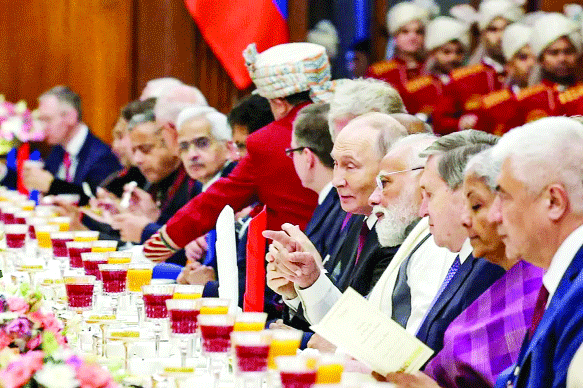
State banquets hosted for foreign dignitaries are about showing how seriously the relationship is taken. A state banquet is not judged by the number of dishes served or the novelty of ingredients. It is judged by the atmosphere in the room. The venue, the seating, the order of speeches and the menu together create a message that often speaks more quietly-but sometimes more effectively-than formal joint statements.
In this regard, the publication of the menu served at the banquet hosted for the President of Seychelles has ignited a debate about whether it is appropriate to serve the foreign dignitaries only the Indian vegetarian fare or include in the menu dishes that the guests will enjoy.
Such anecdotes quickly become symbolic. Not sure how far it is true that the French President, Emmanuel Macron, requested bread, cheese and cold cuts in his hotel room after a G 20 summit banquet where the millets dominated the menu.
Regardless, there are reports that a few of the foreign dignitaries, after attending the formal banquets either at Rashtrapati Bhavan or Hyderabad House, order food at their hotels.
This raises a question: are we over-asserting cultural pride? Are we over-curating the evening for domestic optics? Are we overlooking the simple fact that the state banquet is never only just about what is served for dinner? Aren’t state banquets about signalling respect, and about atmosphere and sensitivities?
It is important to remember that state banquets are not last-minute exercises. Weeks before a visit, officials from both countries exchange detailed notes. Dietary restrictions, allergies, religious sensitivities and personal preferences are discussed in advance. Security teams vet food preparation. Chefs are briefed carefully. Quiet alternatives are almost always kept ready. No professional diplomatic team wishes to see a guest uncomfortable at the table.
Let us admit something plainly: every country uses its state banquets to showcase itself. The French will not apologise for French cuisine. The Japanese take pride in their precision. Americans often highlight regional produce and culinary innovation. India, too, seeks to present its own flavours and traditions.
However, the host country, while curating the menu, will invariably balance their local cuisine with few popular dishes from the country of the guest.
Above all, a relaxed guest creates a relaxed evening. A tense guest does the opposite.
True, vegetarian menus in India are frequently chosen for practical reasons. They avoid contentious ingredients. They reflect the eating habits of a large section of the population. They are seen as diplomatically safe. Add to that the recent emphasis on millets-projected as healthy, sustainable and rooted in India’s agricultural history-and the menu becomes part of a wider narrative.
Also, vegetarian food is hardly alien to the global palate. Many world leaders prefer lighter meals while travelling. Several follow plant-based diets. The difficulty arises only when the dinner begins to look less like hospitality and more like a message crafted for headlines.
India’s early diplomatic history offers perspective. Gandhian ideals favoured simplicity. Yet Jawaharlal Nehru was realistic about the demands of international engagement. As per the former foreign secretary K.P.S. Menon later wrote India had to learn the “grammar of diplomacy.” That grammar included hosting in a manner that foreign guests would recognise as respectful.
Consider the 1961 visit of Queen Elizabeth II. The banquet followed international conventions. Wine was served. The food combined Indian and European elements. Walter Crocker described Nehru’s style as restrained but not austere. There was dignity, but no attempt to make a moral point through the menu.
Under Indira Gandhi, the tone became more polished. She paid attention to detail and presentation. Natwar Singh has written about how she understood that state occasions project national confidence. Her banquets were carefully designed, but they did not feel doctrinal. Indian flavours were presented, but comforts of the guest was not sacrificed.
Examples abroad underline the same lesson. When Richard Nixon visited China in 1972, he encountered elaborate dishes unfamiliar to many Americans. Yet the hosts ensured that the evening was structured carefully. When Indian leaders travel overseas, foreign hosts often include small Indian touches without overwhelming the guest. The emphasis is always on comfort first.
There are also lighter stories that remind us that food diplomacy has a human side. During his 2000 visit, President Bill Clinton reportedly took a particular liking to the dal served at the well-known Bukhara restaurant at The Maurya in New Delhi. Hosts ensured that, along with signature Indian dishes, spice levels were moderated, and other options were available. It was not about insisting that he try everything. It was about offering what India does best while paying attention to what the guest enjoyed. That is a useful example of balance.
Some years ago, in a Daily Excelsior piece titled “Diplomacy & Spirits,” I reflected on how food and drink at official events often reveal a nation’s self-confidence. A country unsure of itself may try too hard. A country at ease allows its culture to be appreciated without turning it into a declaration.
In that article, I also noted that India’s diplomatic style matured over time. Early debates between austerity and accommodation gave way to pragmatism. India did not abandon its traditions. Nor did it ignore international expectations. It found a middle path.
Let us also remember the obvious. State visits are exhausting. Leaders move through tightly packed schedules. Time zones disrupt appetite. Many prefer to eat lightly at formal dinners. Some later order something simple and familiar. That is not a diplomatic signal. It is human nature.
However, perception is part of politics. When menus are closely tied to public messaging, even routine personal choices by guests can be interpreted symbolically. If dinner is framed as a cultural assertion, then a late-night snack becomes a story.
Shyam Saran has often emphasised that diplomacy requires sensitivity to nuance. That nuance applies to the dining table as well. Cultural pride does not demand inflexibility. It demands awareness.
The solution is not complicated. Offer well-prepared Indian dishes that are accessible and thoughtfully presented. Introduce ingredients like millets in ways that invite curiosity rather than proclaim virtue. Keep familiar options that are in sync with the guest’s palate discreetly available. None of this weakens identity. It strengthens credibility.
It is also important to note that India is not only vegetarian. Surveys show that approx. 70 percent of Indians eat non- vegetarian food. From seafood along the coasts to meat dishes in the north, northeast and south, Indian cuisine is diverse. In that light, one may ask why foreign guests are often served only vegetarian food at formal banquets, when the country’s food culture includes many non-vegetarian traditions as well. A wider selection could better reflect this diversity. As a Kashmiri, I would appreciate it if a dish or two from my community is included in the menu at such banquets, as they are an important part of our culinary heritage.
In conclusion, a menu that reflects the country’s diversity and also considers the guest’s comfort makes the hospitality more welcoming. When cultural pride is balanced with sensitivity, such occasions help build goodwill and stronger relations between nations.
When pride is matched by grace, hospitality becomes genuine-and diplomacy benefits quietly from the warmth of the table.
(The author is works for reputed Apeejay Education, New Delhi)
 Follow our WhatsApp channel
