

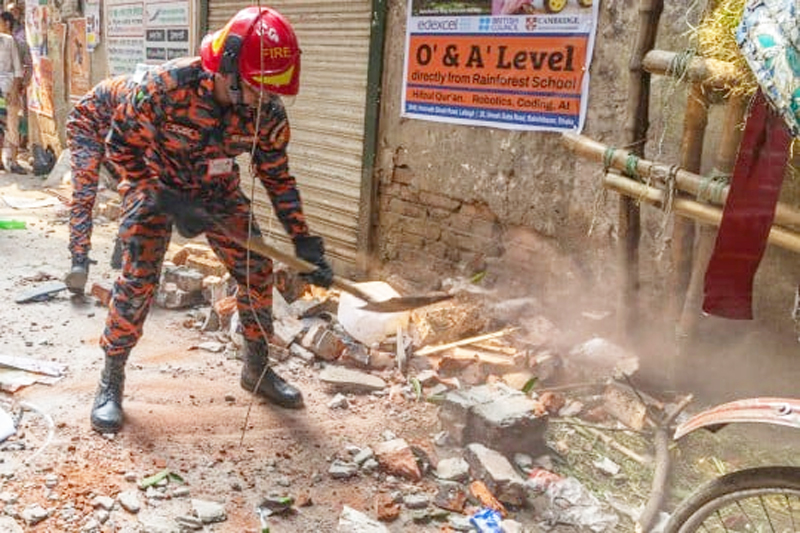
DHAKA, Nov 22: Rocked by seismic ruptures two days in a row, Bangladesh was again hit by a strong earthquake, just a day after it was jolted by a 5.7 quake.
According to the Bangladesh Meteorological Department (BMD), the far lighter 4.3 magnitude quake was recorded at 6:06pm on Nov 22, with its epicentre located in Dhaka’s Badda, about 6km east of the BMD Seismic Centre in Agargaon, the body said.
However, this report was disputed by international findings, as the US Geological Survey (USGS) while concurring with the intensity assessment, reported its epicentre to be 11km west of Narsingdi, while the European-Mediterranean Seismological Centre (EMSC) disputed the intensity, and measured the magnitude at 3.7.
Earlier today, a minor earthquake of magnitude 3.3 shook the Palash upazila of Narsingdi this morning. The epicentre of yesterday’s quake was also in Narsingdi.
The 5.7 quake from yesterday caused some major damage in Bangladesh, causing national power disruptions by tripping six power plants at once, damaging multiple buildings in both the capital and other districts, killing at least 10 people, including a newborn, and injuring hundreds, while also exposing many structural vulnerabilities in the country’s energy, and real estate infrastructure.
The shock from yesterday was reportedly the largest to hit the country in over a century as per analysts — who noted that the region constituting modern day Bangladesh has a long history of powerful earthquakes – with five 7.0 and above magnitude quakes being recorded in the period between 1869 and 1930.
Bengal as a whole is noted to be an earthquake vulnerable region, as it rests on a collision zone of major tectonic plates, crossed by several active fault lines, making it highly susceptible to high seismic ruptures.
On both sides, there has been a noted increase in seismic activity in recent years, with minor to moderate tremors on 3-4 magnitude on the Richter Scale being recorded since 2024.
Geological experts in the country warned that this century long absence of major seismic shocks should not be taken as a reassurance, but rather be treated like the calm before a storm, warning that this quiet period could be the precursor to a major event, calling the yesterday quake a mere warning sign for something greater yet to come.
(UNI)
 Follow our WhatsApp channel
