

Prof Dr RD Gupta
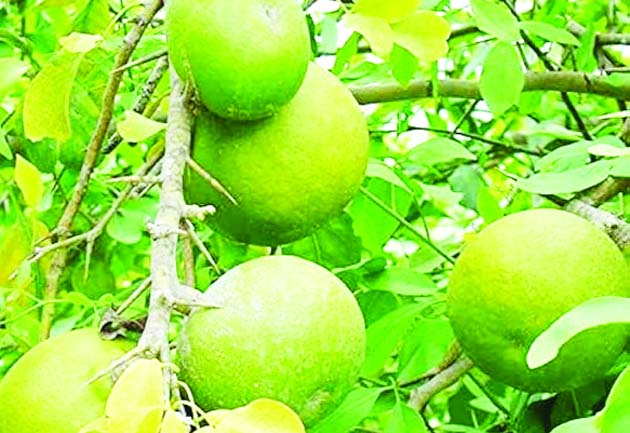
Bael (Aegle marmelos)or Bilva is one of the leading indigenous fruit tree of India. In West Bengal, bael is known as Bengal Quince-pear like. Besides high nuritional value of its fruit, it also possesses a number of medicinal values. All the parts of the bael tree viz, stem, bark, leaves, roots and fruits have some important uses at some stages. The leaves of the bael tree without any kind of damage are used to worship the Lord Shiva. It is believed that any person, who mounts the leaves of the bael on the Lord Shiva’s Ling (Shivling) relieves totally free from the sins which he has committed or commits.
It is worthwhile to mention that due to its hardy nature, it grows naturally under very adverse agro-climtic and soil conditions. The fruits of the tree can be kept for a longer period and can tolerate transport and marketing hazards. However, inspite of its so much nutritional and medicinal and religious importance, bael has not been given due attention. Rather, it has been even neglected by many of the people. If this tree is cultivated scientifically it can pay good dividend to the growers or the farmers
In this article, therefore, the composition of edible portion (fruit) of bael in terms of available nutrients, medicinal values, religious significance and its various cultural practices, have been detailed.
MEDICINAL VALUES
Fruit pulp of the bael is used as medicine against diarrhoea and dysentery and as sharbat. It is also a good source of vitamin-A due to the presence of carotene (precursor of vitamin-A) and vitamin-C. As such, it is useful to some extent for curing night blindness and scurvy diseases, particularly for the children.
Pulp of the bael fruit constitutes a rich source of vitamin-B, (riboflavin). Hence its consumption increases the loss of appetite and weight(Gupta etal,2016) . Its use is also beneficial to the patients suffering from sore throat, development of cataract, swollen nose as well as for those who are afflicted with osteoporosis (loss of calcium). Its regular use prevents gynecological disorder. The bitter pungent juice from the leaves mixed with honey is given to reduce mucous discharge from nose and throat. It is very effective to cure constipation. Ripe bael fruit has been found to be the best laxatives (Laland Tandon,2018).
COMPOSITION OF EDIBLE (FRUIT) PORTION
Average nutrients present in 100 g of edible portion of bael, have been presented in Table 1. The data indicates that it is the richest source of carbohydrates having 31.8 g 100 g of edible portion of bael followed by protein 1.80 g. minerals 1.70 and fat 0.40 g 100 g Carotene (a plant pigment) a precursor of vitamin-ABoel. Thiamine, riboflavin, niacin, are the other nutrients, present in the edible Portion of the bael.
RELIGIOUS SIGNIFICANCE
It is believed that any Lord Shiva devotee, who mounts two or three leaves of bael with strong and deep prayer, he always gets salvation from his sins. But a bael leaf should be entirely complete having all the three leaflets. It must never be broken one and nor have hole in any one of three leaflets. It should also be free from any attack of insect-pests or any woven thread made by insect or having excreta of any bird. Mounting such a single leaf on the Lord Shiva’s Lingam, one directly obtains an abode of Lord Shiva.
CULTURAL PRACTICES
Soil and climate: Bael tree grows in a variety of soils. However, a well drained sandy loam soil is considered to be the best for bael cultivation. It can even be grown in swampy, alkaline and stony soils, acidic and saline soils with pH ranging from 5 to 10. In Siwaliks of Jammu (Jammu and Kashmir), Himachal Pradesh, Punjab and Haryana it seems to grow naturally in the soils having pH range from 7.0 to 8.5. with free calcium carbonate content from 5 to 10 per cent.
Tropical climate with hot and dry summer has been found to be the best for its growth though it can grow well at very low temperature also ie to an extent of minus 70 degree Celsius (Khan et al., 2001). Arid and semi-arid regions of the country with low rainfall, low atmospheric humidity, high vapour deficient saline soil, poor water holding capacity have too been found suitable for the growth of bael.
 Follow our WhatsApp channel
