

Shagun Parihar
writetomlakishtwar@gmail.com
History in Jammu and Kashmir has rarely been neutral; it has often been curated, filtered, and shaped by dominant political narratives. For decades, one name has been consistently projected as the face of agrarian transformation: Sheikh Abdullah. This projection, however, raises a fundamental question-can the history of farmers’ struggles in Jammu and Kashmir truly be reduced to post-1947 political developments alone? The answer lies in revisiting the life and sacrifice of Baba Jitto, a figure deeply rooted in the soil of Jammu, whose legacy challenges the one-dimensional narrative that has long dominated the region’s historiography.
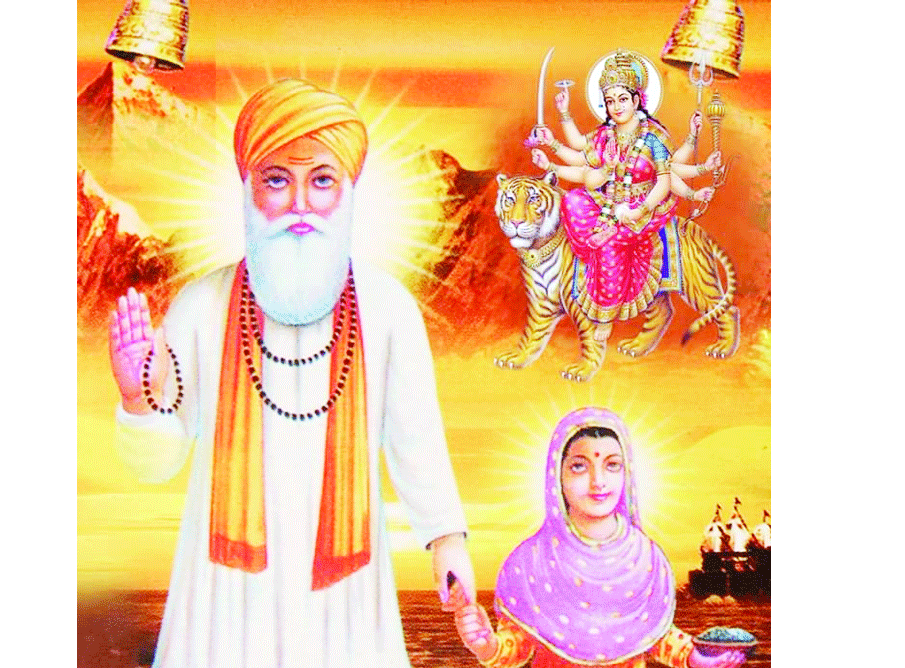
Baba Jitto, who lived in the Reasi region centuries ago, was not a political leader, nor did he possess institutional power. He was a farmer, representing countless cultivators who laboured under oppressive feudal systems. His story is one of resistance against injustice at a time when peasants had little recourse against exploitation. When he was denied his rightful share of produce by a landlord, Baba Jitto chose martyrdom over submission. This act was not merely symbolic; it was a powerful moral assertion of a farmer’s right over his labour and produce. In essence, it represented the core principles of agrarian justice-dignity, equity, and resistance to exploitation-long before such ideas were articulated through modern legislative frameworks. If land reforms are understood as a struggle to restore rights to the tiller, then Baba Jitto did not merely precede them; he embodied their spirit in its purest form.
Yet, despite this profound significance, Baba Jitto’s contribution has remained largely confined to folklore and local reverence, while the dominant discourse continues to centre around Sheikh Abdullah as the singular architect of agrarian change. This imbalance is not accidental. It is deeply intertwined with the political evolution of the region, particularly the long-standing influence of the Jammu & Kashmir National Conference, which played a decisive role in shaping public memory, academic narratives, and institutional recognition. Over time, this led to a streamlined version of history where certain figures were elevated to prominence while others, especially those rooted in Jammu’s indigenous traditions, were systematically sidelined. Baba Jitto, who did not fit into the framework of post-independence political movements and represented a distinctly Jammu-centric legacy, was effectively excluded from mainstream recognition.
This marginalization reflects a broader pattern of regional imbalance, where Jammu’s historical and cultural contributions have often been overshadowed by a Kashmir-centric narrative. The consequences of this imbalance are visible in multiple domains-academic curricula, public discourse, and even the naming of institutions. Heroes of Jammu rarely find a place in textbooks or institutional memory, leading to a gradual erosion of regional identity. Baba Jitto’s absence from mainstream narratives is therefore not just an oversight; it is indicative of a structural bias that has shaped how history is remembered and transmitted across generations.
In the present context, the relevance of Baba Jitto’s legacy becomes even more pronounced. At a time when India is emphasizing grassroots empowerment, farmer welfare, and the importance of local histories, his story offers a powerful reminder that the roots of reform lie in the lived experiences and sacrifices of ordinary people. Recognizing Baba Jitto is not about revisiting folklore for sentimental reasons; it is about correcting a historical imbalance and restoring dignity to a legacy that has long been ignored. It is also about acknowledging that the narrative of agrarian justice in Jammu and Kashmir is far richer and more diverse than what has been presented so far.
This brings us to the question of institutional recognition, particularly in the context of Sher-e-Kashmir University of Agricultural Sciences and Technology of Jammu. The naming of institutions is never a neutral act; it reflects the values, histories, and identities that a society chooses to honour. An agricultural university, by its very nature, is meant to represent the aspirations and struggles of the farming community. In this context, the continued association of such an institution in Jammu with a figure rooted in a particular political narrative raises an important question-why should Jammu’s premier agricultural institution not reflect its own indigenous agrarian legacy?
Renaming SKUAST-Jammu after Baba Jitto would not merely be a symbolic gesture; it would be a historically justified and morally significant step. It would align the institution with the very spirit of agrarian justice that Baba Jitto represents, thereby giving students and stakeholders a sense of connection with their own heritage. It would also serve as a corrective measure, addressing decades of symbolic marginalization and restoring balance in institutional representation. More importantly, it would challenge the long-standing monopoly over historical narratives and open the space for a more inclusive and plural understanding of the region’s past.
The recognition of Baba Jitto does not require the erasure of other historical figures, but it does demand a rebalancing of perspectives. History must not remain the preserve of political power; it must reflect the voices, struggles, and sacrifices of the people. Baba Jitto’s story, rooted in resistance and dignity, offers precisely such a perspective. Bringing him into mainstream discourse-through education, scholarship, and institutional recognition-would not only honor his legacy but also strengthen the cultural and historical identity of Jammu.
Ultimately, the question is not whether Baba Jitto deserves recognition; it is why he has been denied it for so long. The answer lies in the politics of memory, where certain narratives are amplified while others are silenced. Correcting this imbalance is not merely an academic exercise; it is an act of intellectual honesty and regional assertion. In reclaiming Baba Jitto, Jammu reclaims a part of its own history-a history that speaks of courage, justice, and the enduring struggle of the farmer.
(The writer is MLA from Kishtwar constituency J&K Legislative Assembly)
 Follow our WhatsApp channel
