

Irfan Tramboo
SRINAGAR, Aug 24: In a move to curb the illegal export of saffron corms and promote their multiplication within Kashmir, authorities have launched a strict monitoring and documentation drive across the saffron belt.
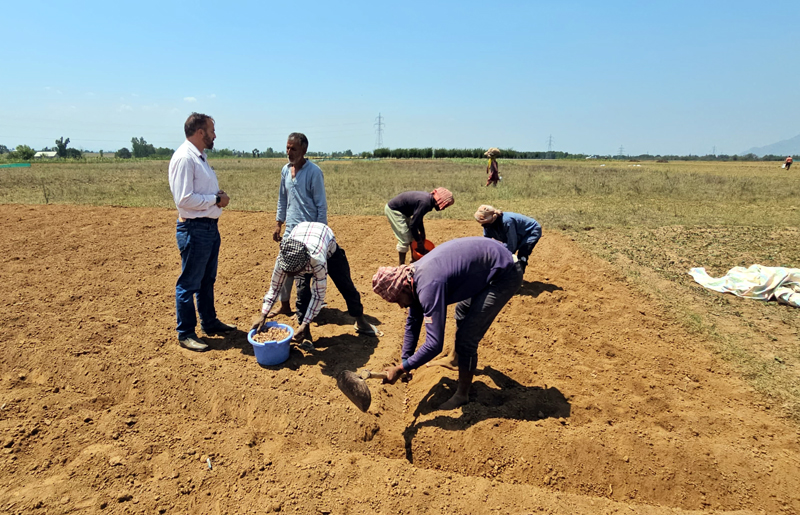
The Department of Agriculture’s Pampore Zone has set up a special squad to check the practice and maintain detailed records of corm extraction and sowing.
Officials told ‘Excelsior’ that the primary aim is to prevent unauthorized movement of corms and protect the interests of local growers, as illegal export has become a growing concern in recent years.
The squad, officials informed, is maintaining records of every extraction – noting where corms are pulled and where they are replanted – to track the process and curb illegal export.
Details being recorded include growers’ names, Aadhaar numbers, sources of extraction, and the fields where corms are sown, they said.
As per officials, the process and monitoring will allow them to verify how much seed each farmer extracts, replants, and where it is sown.
“The monitoring exercise will remain in force throughout the peak sowing season,” they said.
Agriculture Extension Officer Pampore, Ishtiyaq Ahmad Bhat, said saffron corm extraction and sowing began on August 15, after which the department intensified its monitoring efforts.
“Export has been going on for several years and remains a major challenge. We have held awareness drives in Pampore, Samboora, Chandhara, Lethpora, Androosa, Dusoo and adjoining areas to ensure people follow the directions and avoid corm export,” he said.
He added that raids have already been conducted at several locations, leading to the seizure of about 1.5 quintals of corms from non-residents in Awantipora who were attempting to smuggle them out.
“This is exactly why awareness campaigns and raids are necessary. The focus is on preserving saffron seed so that it stays here and multiplies locally,” Bhat stressed.
Authorities have also cautioned that illegal export or transportation of saffron corms is punishable under the Seed Act, 1966, and the Saffron Act, 2007, with provisions for imprisonment, heavy fines, and confiscation of the material.
“Anyone found involved, directly or indirectly, in the practice will face strict action including fine,” officials warned.
At the same time, farmers have been urged to cooperate with the department and support the campaign to safeguard the germplasm of world-famous Kashmiri saffron.
On the other hand, to incentivize compliance, officials noted that under HADP, farmers engaged in extraction and sowing will receive Rs 27,000 per kanal, directly credited to their bank accounts.
 Follow our WhatsApp channel
