

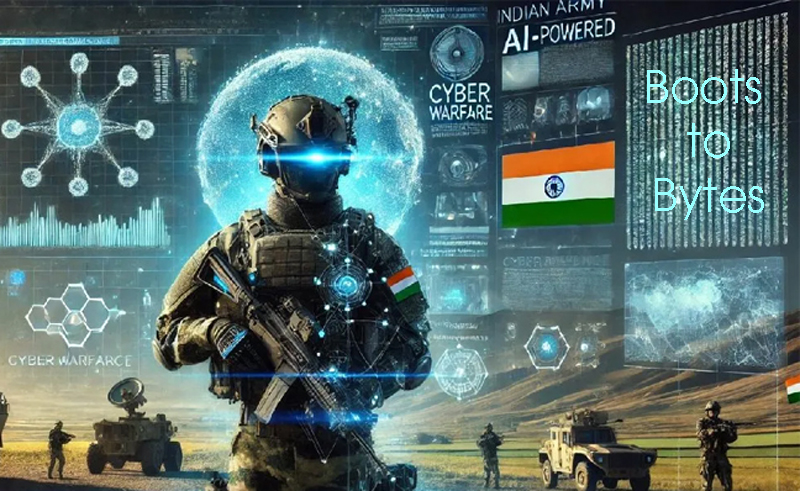
The Army’s newly unveiled ‘Boots to Bytes’ transformation plan marks one of the most consequential shifts in India’s military thinking in recent decades. At its heart lies a simple truth: the character of warfare has changed irreversibly. The dominance of infantry formations, conventional firepower and linear battlefields is now overshadowed by a new triad-drones, digital systems and data-driven decision-making. In this context, the Army’s Digitisation-3 programme and its suite of 100 indigenous digital and AI applications represent not just a technological upgrade but an existential necessity. Modern warfare has become defined by speed, precision and cognition. Conflicts across the world-from Ukraine to the Middle East-underscore a new reality where drones strike with pinpoint accuracy, cyber weapons disrupt the nation behind the frontline, and battlefield decisions must be taken in fractions of a second. India can neither afford to ignore this shift nor rely solely on the strengths that gave it victory in previous eras. The ‘Boots to Bytes’ initiative recognises exactly that.
The Operation Sindoor provided a striking illustration of the changing battlefield. Pakistan’s use of Turkish and Chinese armed drones, many flown in coordinated swarms, signalled a deliberate attempt to alter the operational balance. Yet, India’s preparedness-built on proactive surveillance, electronic warfare and counter-drone capabilities-ensured the nation suffered almost no damage. The retaliation, meanwhile, exposed Pakistan’s vulnerabilities. But this must not breed complacency. Against a technologically sophisticated adversary like China, which has already integrated AI, robotics, cyber warfare and hypersonic capabilities into its war doctrine, India must continuously anticipate and prepare for the next generation of threats.
This is where the Army’s new digital overhaul becomes crucial. The Digital Sena mission, with 40 applications focusing on logistics, automation and efficiency, and the larger set of 60 AI-powered tools, shows a force ready to embrace transformational thinking. The introduction of tethered UAVs equipped with jammer systems represents a proactive shift-not merely reacting to enemy drones but denying them access altogether. Similarly, the indigenous GIS platform transforms decision-making by giving commanders a unified, real-time operating picture of terrain, assets and troop movement. Even more significant is the Ekam AI platform, designed specifically to align with military doctrines and handle classified data. With capabilities ranging from document analysis to automated military correspondence, and eventually an Indian Army-specific large language model, Ekam represents a paradigm shift. The Army will have a secure, indigenous AI system capable of pattern recognition, predictive analysis and decision support-without relying on foreign technologies or vulnerable networks.
AI-assisted warfare is no longer a futuristic theory. In the digital age, there is little time for extended war-room discussions when an enemy missile, swarm drone or cyber strike can be launched within seconds. The imperative now is to feed AI systems with all possible scenarios well in advance-allowing them to recommend or even initiate defensive responses at machine speed. Human oversight will remain essential, but human limitations can no longer be the central driver of battlefield response times.
The Army’s new climatology tool, built on two decades of geospatial data, is further proof that modernisation is not restricted to weapons and sensors. This predictive system, capable of forecasting landslides and avalanches, is a lifesaving tool in some of the world’s most treacherous operational terrains. It exemplifies the broader approach: modern warfare requires modern logistics, modern planning, modern communications and modern situational awareness.
The Defence Ministry’s nod to this extensive technological modernisation is timely and necessary. What stands out is the breadth of the reform, encompassing more than 100 projects. This demonstrates the determination to incorporate every conceivable technological advancement into its operational ecosystem. It is a recognition that there is no upper limit to improvement, and no final stage to modernisation. As AI evolves, so will India’s military capabilities.
‘Boots to Bytes’ is not just a slogan-it is a shift in military culture. Every soldier, regardless of rank or role, must now understand the intricacies of digital systems, drones, cyber defence and AI-driven operations. Modern wars will be fought by humans, but won by those who best leverage technologies.
 Follow our WhatsApp channel
