

Harsha Kakar
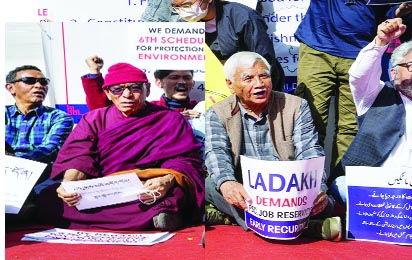
Ladakh recently witnessed a three-day hunger strike organized by the Leh Apex Body and Kargil Democratic Alliance. On the last day of the strike was a protest rally where known climate activist Sonam Wangchuk and Ladakh MP Mohmad Haneefa Jan participated. The strikers demanded statehood for the UT (Ladakh was converted into a UT post abrogation of article 370), inclusion in the sixth schedule of the constitution for additional autonomy, a Ladakh specific Public Service Commission and separate Lok Sabha seats for Leh and Kargil.
The protests and hunger strikes were thinly attended compelling the organizers to resort to an immediate ‘bandh’ to swell numbers. It conveyed that the intent of the organizers was political rather than welfare and the public was satisfied with the current state of development as also governance.
The sixth schedule of the constitution focuses on autonomy and self-governance accorded to tribal areas in Assam, Meghalaya, Tripura and Mizoram. Under the schedule, autonomous districts and regions are created, governed by respective councils, largely comprising of elected members, with few representatives. They have powers to make laws on land, forests, agriculture and village administration. The intended aim is to protect tribal land from exploitation by non-tribals.
The bodies would also be responsible for providing environmental clearance for Government projects. In a security sensitive region like Ladakh, blocking or stalling defence projects for environmental reasons can impact national security. It is possibly to ensure that major projects are not stalled that the Government hesitates to accept this demand.
It is not that leaders of the protests are unaware of this, however, see it as an opportunity to cause anger, unrest and gain political prominence.The game brewing in Ladakh is political activism. It is almost a copybook of the Anna Hazare movement which led to the emergence of Arvind Kejriwal and AAP (Aam Aadmi Party). Interestingly, both Arvind Kejriwal and Sonam Wangchuk have been awarded the Ramon Magsaysay Award, known as a geopolitical tool for projecting political leaders of choice.
Prior to arriving for the protest Sonam Wangchuk questioned the Government’s decision to allocate 40,000 acres for a solar plant endeavour. Soman admitted that ‘this installation will produce 13,000 megawatts, which is three times larger than the largest in the world.’ However, his criticism is that the project would ‘likely’ be implemented by Adani. Stalling a project which could benefit the region as also J and K and be climate friendly should have been praised rather than criticized by any accepted climate activist.
Partially meeting the demands of Ladakhis, the Government announced a 15-year domicile policy, which Wangchuk claims is not enough. A couple of months ago, Wangchuk released a video encouraging self-immolation and an Arab spring like scenario in Ladakh over the domicile issue. He also sought venue suggestions for self-immolation, suggesting the Home Minister’s residence, Parliament and the UN office in Delhi as options.
Wangchuk also threatened to bring 30,000 protestors to the famous Ladakh polo ground as a warning to the Central Government as also display his power base. However, the attendance in his recent rallies and protests indicate that Wangchuk is losing his grip over the region and these threats are a sign of desperation to regain political ground.
The fact that someone is preaching overthrowing a Government in an Arab Spring type revolution as also adopting Tibetan style of protests (self-immolation) in a sensitive region is music to India’s adversaries. Ladakh borders both, Pakistan and China, and has seen maximum conflict in recent times.The Kargil conflict of 1999 and Galwan clashes have both occurred in this UT.
It is known that both inimical nations have been attempting to cause internal unrest in Ladakh and here they are being presented with an opportunity. Pakistan and China would definitely exploit the unrest. China would announce to its Tibetan population that their brethren in India are unhappy as would Pakistan to its disgruntled populace in Gilgit-Baltistan.
Interestingly, the video encouraging self-immolation and a localized Arab Spring emerged months after Wangchuk attended a climate conference in Pakistan where he also met the Bangladesh interim head of state, Mohamad Yunus. Questions are being raised on whether external sources are pushing disturbances in Ladakh.
Post the abrogation of Article 370, there was happiness in Ladakh, as the population expected an acceleration in development. Admitting development Wangchuk mentioned, ‘People in Ladakh say they can see a difference in terms of development, roads have been built.’ At the same time, he mentions that people cannot be happy ‘only with development.’ He compares Ladakh to Tibet, claiming that even Tibet has witnessed development but unhappiness persists amongst Tibetans.
The difference is that in India there is religious and every other form of freedom as compared to suppression in communist China. The reason for placing Ladakh directly under the centre were largely national security concerns. Discontentment in Ladakhis being pushed by political aspirants rather than activists.
In Jan 2023, Wangchuk launched his first high-profile hunger strike seeking the sixth amendment. This gave him publicity and recognition. Since then, Ladakh has witnessed a few protests, led by Wangchuk, however most are not backed by the masses.
There is also a possibility that Wangchuk is aggrieved because his institution, Himalayan Institute of Alternatives, Ladakh, was deprived of two major projects. Wangchuk claimed these were cancelled on Government orders, a claim never substantiated. These projects were a Rs 10-crore one by GAIL (Gas Authority of India Limited) and another Rs 4-crore one by Coal India.
August and September are likely to see protests prior to the holding of council elections. All major players, including Wangchuk, will participate, aiming to enhance their political base. None have best interests of Ladakh and the nation in mind.
Ladakh is amongst India’s most sensitive regions. Every decision taken by the Government would be keeping national security interests paramount. Hence, some local demands may not be fully accepted and this is exactly what Wangchuk and his allies are attempting to exploit.
While political activity is acceptable, pushing for actions including self-immolation and violence, would be playing into hands of our inimical neighbours. The region must continue remaining one of peace and tranquillity, sending a firm message across the borders, rather than being instigated into violence and unrest.
The author is Major General (Retd)
 Follow our WhatsApp channel
