

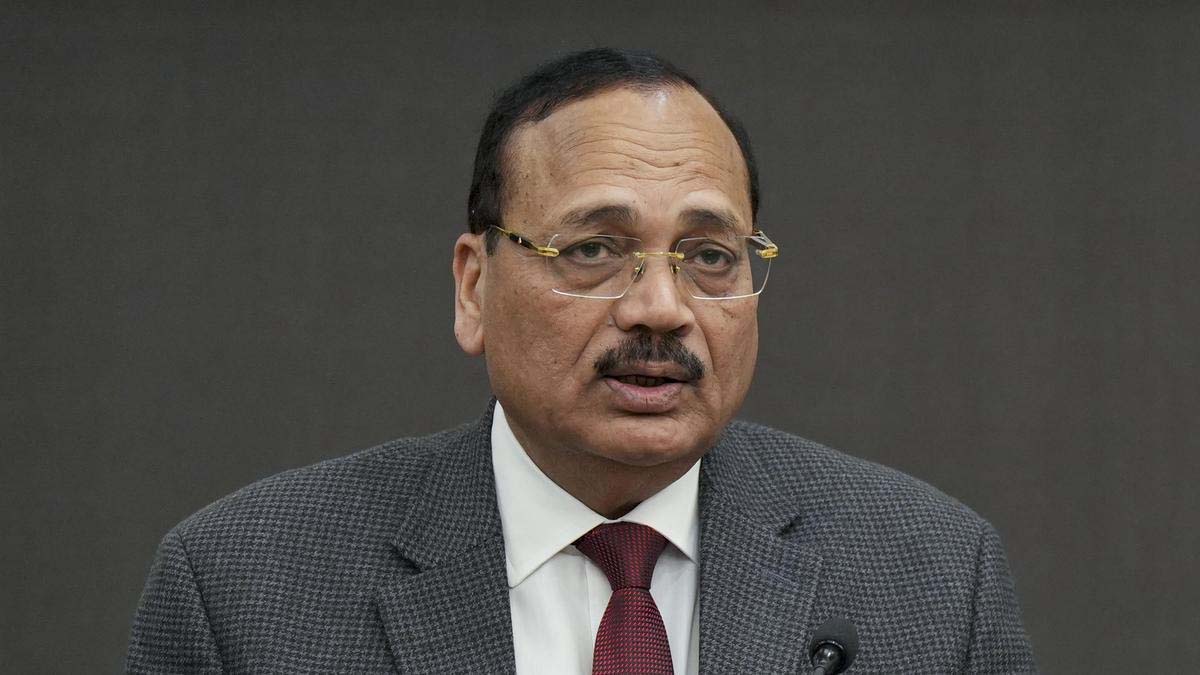
Ahmedabad, Feb 28: Chief Justice of India Surya Kant on Saturday said that while India’s arbitration framework has matured considerably, significant challenges remain in building trust, strengthening institutional capacity, and developing a coherent pipeline of qualified arbitral professionals.
Speaking after laying the foundation stone for the Gujarat High Court Arbitration Centre (GHAC) in Ahmedabad, the CJI said India must measure itself against the standards of leading arbitral seats across the world and the legitimate expectations of parties who choose arbitration in the hope of something better and faster than litigation.
He referred to Gujarat Chief Minister Bhupendra Patel’s address at the same event, wherein the CM highlighted the growing importance of institutional arbitration within India’s legal and jurisdictional framework, particularly for a state like Gujarat, which leads the nation in industrial development and technological advancement.
“I must acknowledge that India’s arbitration framework has by now matured considerably. Legislative reforms to the Arbitration Act have emphasised minimal judicial intervention, time-bound proceedings, and neutrality in appointments. Parallelly, judicial pronouncements have reinforced party autonomy and clarified doctrinal uncertainties,” the CJI said.
However, the CJI noted that progress does not eliminate existing challenges. Institutional arbitration, he observed, still occupies a smaller space than it ought to, with a substantial volume of disputes continuing through ad hoc mechanisms. Moreover, many institutional arbitration disputes still prefer destinations outside India.
“The question we must confront is not whether arbitration is viable, the question is whether our institutional arbitration and our institutions meant for that inspire sufficient trust to become the most preferred choice and destination,” he said, pointing to challenges including building trust, capacity and availability of trained professionals.
Addressing the first challenge — trust — CJI Surya Kant said institutional arbitration fulfils its promise only when users genuinely trust it.
“Trust in the neutrality of arbitrator appointments, trust in procedural integrity, trust in the enforcement of awards- that trust is not built by rules on paper. It is built through consistent, transparent, and demonstrably fair practice over time,” he said.
The CJI added that we must ask honestly whether our institutions have earned that trust in full, and what more they must do to earn it.
The second challenge, he said, is capacity.
“The number of institutional arbitrations in India remains disproportionately small relative to the volume of commercial disputes generated in the country. Too many parties still default to ad hoc arbitration or courts because institutions have not sufficiently demonstrated the value they add,” the CJI added.
Utilising institutional capacity in terms of infrastructure, internal panels of arbitrators, case management systems, and administrative competence “is not a question of prestige; it is a question of relevance,” he said.
According to the CJI, the third challenge is the “challenge of professionalisation”, which appears to be the most challenging and consequential.
“Arbitration at its finest is a specialised discipline. It demands not only legal equity, but case management skills, sensitivity to commercial realities, and an understanding of what is genuinely is at stakes for the parties.
“India must invest seriously in training arbitrators, and in developing a coherent pipeline of qualified arbitral professionals,” he added.
Without that investment, growth in the number of institutions will outpace growth in the quality of the process, he said.
The CJI said the way forward lies in institutional honesty — not in measuring ourselves against where we begin, but against where it needs to be: the standards of leading arbitral seats globally and the legitimate expectations of parties seeking an efficient alternative to litigation.
The state-of-the-art building of Gujarat High Court Arbitration Centre (GHAC) consists of 16 arbitration conference rooms, seven mediation rooms and an online dispute resolution system catering for the needs of international and domestic alternative dispute resolution.
The GHAC also organised a two-day conference on the theme: Institutional Arbitration at Crossroads : Challenges and the Way Forward, which brings together arbitrators, advocates, and all other stakeholders to deliberate on key aspects of institutional arbitration. (Agencies)
 Follow our WhatsApp channel
