

By Tirthankar Mitra
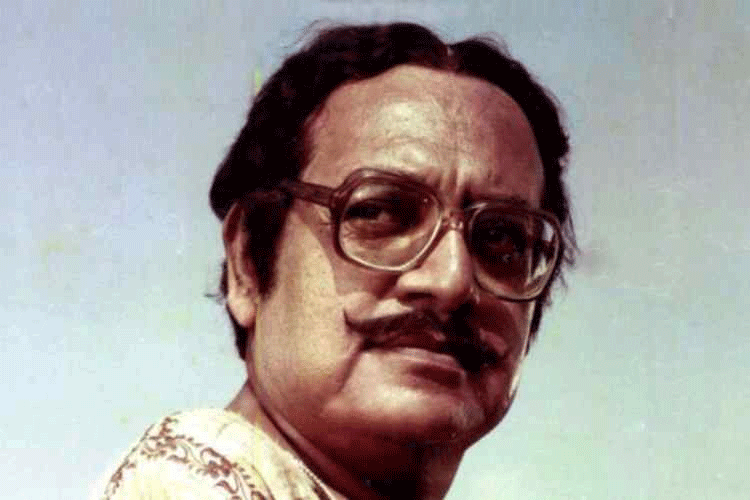
Think of an actor equally at home on stage and screen, and Utpal Dutt whose birth anniversary was on March 29, comes to mind first. With an English accent which would have made even an Englishman envious, coupled with mannerisms to match, Dutt would have been welcome in any blue-chip firm that were many in what was then known as Calcutta; yet he chose the uncertain career of an actor.
Arguably, it was Dutt’s lifelong devotion to Communism that helped him make his choice. He felt it was his performance as an actor would be an ideal mode to give vent to his ideological adherence and help him address the gaping class inequality that he saw all around in his country.
His choice was perfect. For he fitted into the stage and the silver screen like a glove. Dutt’s performance on stage is now the stuff of legends. It was mostly Shakespeare’s plays that found him in his elements in his early youth. The path to the silver screen was in a way facilitated by his stage performances. Among his early audience was the noted filmmaker, Madhu Bose.
Bose had earmarked Dutt in the role of the dramatist Michael Madhusudan Dutt for the screen adaptation of Michael. The iconoclast playwright who sought to be an Englishman penned some of the most memorable dramas in Bengali, including Meghnadbadh Kabya in blank verse.
It eulogised Ravan’s son Meghnad instead of Ram, the hero of the epic Ramayana. One wonders what would have been Michael’s fate and the book he had penned, had it been authored in these times, but it can easily be called a 19th century bestseller.
Yet, Madhu Bose had difficulties with the producer of the film who opted for Sisir Bhaduri. He was a thespian and had essayed Michael’s role on stage.
Finally, Bose had his way. And Dutt after the release of the film was in much in demand in the role of an Anglicised Indian, be it as a barrister in Sesh Anka, or theatre-loving maharaja in Shakespearewalla to name a few. Dutt first answered to the call of the stage. The grease paint, arc lights and the dark faces of the audience beckoned him.
.
Dutt, a dramatist and a scholar, was in his element. The first product of his literary genius was Kallol. Staged in Minerva theatre in north Kolkata, it attained a cult stature. And so did Dutt. It was during the turbulent mid ’60s when Kallol was staged. It rubbed the powers that be the wrong way.
Goons were sent to break up the show. There were more manifestations of government disapproval. But Kallol and its maker held the flag high. Dutt was arrested and none other than Satyajit Ray was one of the signatories in the letter seeking his release.
The following period marked Dutt placing himself on a firm footing in Hindi filmdom. The ease with which he spoke Hindi came a pleasant surprise to the filmmakers in what was still known as Bombay.
Bhuban Shome, directed by Mrinal Sen and Great Gambler which starred Amitabh Bachchan in double roles, were as different from each other as chalk and cheese. Dutt portrayed Shome, an incorruptible railway official who learns more of life on a duck-hunting trip.
In Great Gambler, he is a typical villain who sings while sending his opponents to death. Both are pointers to his range of acting. But Dutt never said farewell to the stage or Bengali films. His career reached a new high owing to his portrayal of characters of suave villains.
Ferari Fauj, Darao Pathikbor, Baniker Mandanda, Mirkasim, Tiner Talwar, Chayanot are all plays of Dutt which drew full houses. It also made the audience think aloud of the state of affairs around them.
More than holding his own when cast together with Suchitra Sen in Fariad, Dutt’s character became an object of hate of the audience. His acting while pitted against Uttam Kumar and Sharmila Tagore in Amanush can be stated to be the icing on the cake of his histrionic career.
This was the just before his association in films of Satyajit Ray. Moving away from all other of his previous screen performances, Dutt is “Bishuda” in Jana Aranya, who introduces the principal protagonist Somnath to the twists and turns of Kolkata’s business world, till then a no-go area for the middle-class Bengali youth, even when they were jobless.
Dutt in the portrayal of his role of his maiden Ray film is a guide to the Bengali youth in the forbidden territory where the law of the jungle often prevails. It was a slap in the face of the establishment and another milestone for both the actor and the director.
Dutt next appeared as Maganlal Meghraj, the bilingual villain in Ray’s second Feluda film, Joy Baba Felunath. Dutt as Maganlal is cast as a smuggler of antiques who is not loath to offer a bribe to Pradosh C. Mitter aka Feluda, a sleuth who depends most on his “magajastra” or brain weapon.
Not does this villain have second thoughts about intimidating Feluda by asking his friend Lalmohan Ganguli to be the target of knife-throwing game. A chill goes down the spine at the thought of the scene, where Ganguly stands almost on the point of losing his consciousness surrounded by knives stuck all around him on a throw-board.
Good prevails over evil in the end. But Dutt’s performance displays the arrival of both money and muscle power in the middle-class Bengali imagination. Dutt is the King of diamond kingdom or Hirak Raja in Ray’s next film Hirak Rajar Deshe. People work for the king’s benefits in diamond mines and asking even for a pittance invited punishment.
Apparently, a children’s film, it is a take on the dark sides of capitalism. Dutt’s character is a forerunner of present war mongers who seek to sell weapons and embattle other nations in their endless quest for profit.
Agantuk was the last venture between the maestro and the thespian. Dutt as Manmohan Mitra, a globe-trotter, creates a stir when he comes to his niece’s household after years of being out of touch with his own family.
His words are labelled as tall talk by adults except his niece, a role which fitted Mamata Shankar, to a tee. The children are, however, all ears for Mitra.
Mitra asks them not to be frogs in the well but to set out and see the wide world outside and judge it. Ray could not have a better medium to spread his own thoughts on screen.
It was a meeting of the brilliant minds of two cosmopolitan citizens of the world. Small wonder, the appeal of the films along with the actor and the director, has survived the test of time. (IPA Service)
 Follow our WhatsApp channel
