

BD Sharma
bds.jmu@gmail.com
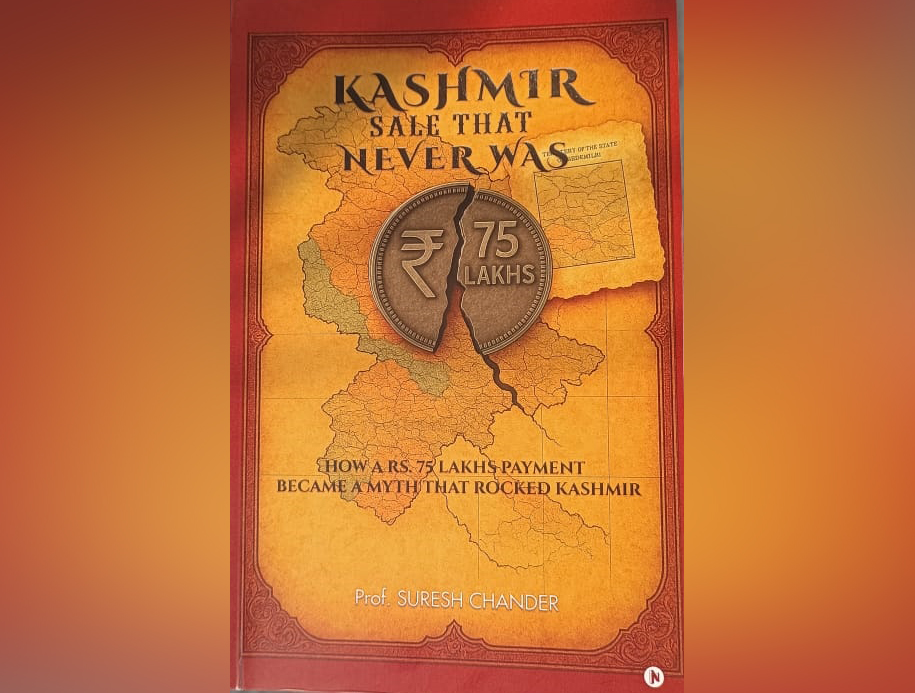
Our UT has two distinct regions, the Jammu division and the Kashmir division. Whereas a large number of books have been written on the Kashmir valley, the Jammu region has remained under the shadow and there are not many books written on Jammu. Recently a book has come in the market which has explored the distinct cultural, social and political landscape of Jammu region. Strangely enough the title of this book has also been ascribed to Kashmir. The book, “Kashmir -Sale that Never Was” has been penned by Prof. Suresh Chander. The author has given many small but fascinating details of Jammu region in general and Mirpur/POJK area in particular in this book. The author himself was born at Mirpur town and though he was barely six years of age at that time yet he has vivid memories of those turbulent days of partition. One gets painful experience on reading the gruesome events of that turmoil, as to how his father was got separated from his family and his death could be inferred by the family on seeing one of the killers roaming in the Camp while bearing his father’s clothes. The sordid tales at Alibeg Gurdwara Camp and how the self proclaimed President Ibrahim Khan got his fellow advocate colleagues killed in cold blood are all chilling tales. Glimpses of the history and geography of Mirpur and it’s adjoining areas, rule of the Lohara dynasty, the Abhisara kindom of hills, introduction to Salt Range and Tilla Jogian in Jhelum district provide interesting reads.
Though the author has worked as professor of Electrical and Computer engineering yet he seems to have taken keen interest in the public affairs since his youth. He wrote to PM Shastri ji as to why he has expressed his gratitude to the Punjabis only for the role played by them in the war efforts in 1965. Shastriji sent his response under his own signature to the author acknowledging the role of Jammu people also.
One feature of the book is that the author has taken up some controversial issues head on which many people try to avoid. One issue is with regard to Amritsar Treaty under which Maharaja Gulab Singh got State of Jammu and Kashmir. Many people started interpreting it as a sale deed when poet Iqbal asserted in his inimitable style that: peasant peasantry, streams & gardens were sliced; a nation was sold & how cheap was it priced! Author has debunked the Sale narrative and exposed this myth of Kashmir’s Rs 75 lakh sale. Maharaja Gulab Singh’s acquisition of Jammu and Kashmir was not a commercial transaction but a political realignment – part of the redistribution of territories ceded by the defeated Lahore Durbar to the English following the first Anglo-Sikh war. The treaty of Amritsar must, therefore be viewed not as a sale deed of land and people but as a strategic outcome of imperial negotiations. The treaty needs to be seen in the backdrop of the practices and percepts prevailing at that time and not in the light of bounties of present day democracy where the voice of the people reigns supreme.
The second controversial issue taken up by the author is with regard to the alleged killing of two lakh Muslims in Jammu during the upheavals of partition. In the unfortunate matter of human killing number doesn’t count because the loss of even one innocent human life is a matter of concern. Since it harms intercommunal relations so it was hardly discussed in Jammu. However, after the migration/ killings of Hindus in Kashmir valley some journalists and public men started making comparisons between the two events. One senior journalist from Jammu was in the forefront to project and propagate this exaggerated figure and other columnists like Karan Thapar, Swaminathan Aiyer and others took the thread out of it. The author has demolished this line of thinking by quoting a dependable source, the book ‘Kashmiris Fight for Freedom’ written by the retired Chief Justice of POJK, Justice MY Saraf. Justice Saraf has been quoted as stating that ” The claim that 70,000 to 2 lakh Muslims were killed in 1947 in Jammu is not only outrageous but is inflammatory”. The Justice estimates that the number must be between 20,000 and 30,000. The author being a professor of engineering subjects has himself applied statistical tools by taking into consideration the community wise census population of different parts of Jammu region before and after independence and come to the conclusion that a figure of 10,000 to 15,000 is the most likely. As already observed occurrence of any number of deaths is unfortunate but to quote the exaggerated figure smacks of a design to defame the Jammu non-Muslims of causing something like ethnic cleansing. A lady professor, a self styled type of intellectual had the audacity to quote this figure of 2 lakh in her address in IIPA some time back. She had to cut a sorry figure when another participant Col JP Singh confronted her on her assumption of 2 lakh figure.
Gen Goverdhan Singh Jamwal in the foreword of the book has given some useful details of the events of 1947 when the State was saved from the marauders sent by Pakistan.
Another interesting feature of the book is in taking up the lives of important public figures both from the folklore like Baba Jitto, Mian Dido and some others of recent times like Lala Hansraj, Mahatma Buddh Singh, Om Saraf etc. It would have been very appropriate if the author had thrown some light on the lives of two distinguished personalities of Rajouri Poonch. One is the legendary brave Sikh general Banda Bahadur born in a Manhas Rajput family of Rajouri/Reasi and the other is the famous Pahari-Pothwari poet Mian Mohammad Bakhash who was born in Mendhar tehsil of the then principality of Poonch.
The impression one gets from the book is that Jammu had come to lot of political activities during 1950s/1960s. Praja Parshid and later Jan Sangh had become a political force to reckon with. It had lead a powerful agitation at the time. The ruling party under Bakshi and Sadiq was of course in the forefront. Some socialists like Om Saraf, DD Thakur, Dhan Raj Bargotra etc. had also added a strain of colour to the political spectrum. The author has however missed to highlight the role that some communists played in the political awakening of Jammu. Though their stalwart Dhanwantari had died in early 1950s, his successors KD Sethi and Ram Piara Saraf groomed many people politically particularly in the field of trade union activities. Leftists remained significant factor in Jammu. We used to come across many professors particularly of English department like Apurab Somnath Bhakhri, Ishwar Sharma,Dushant Rampal Mohinder Sharma etc. who nursed and showed leftist leanings.
The book tells us of some interesting anecdotes also. In one of them Maharaja Hari Singh has been shown exhibiting his large heartedness when he granted permission to Ram Nath Shastri to file a suit against the Maharaja in the capacity of his person. In order to file a case against the Maharaja his permission had to be got. Shastriji filed and won the case and his family was not shifted from Karan Nagar location to Rehari.
The book is priced at Rs 575 in paperback edition and is available in Kindle format also. It is available in both the formats from the Amazon.
 Follow our WhatsApp channel
