

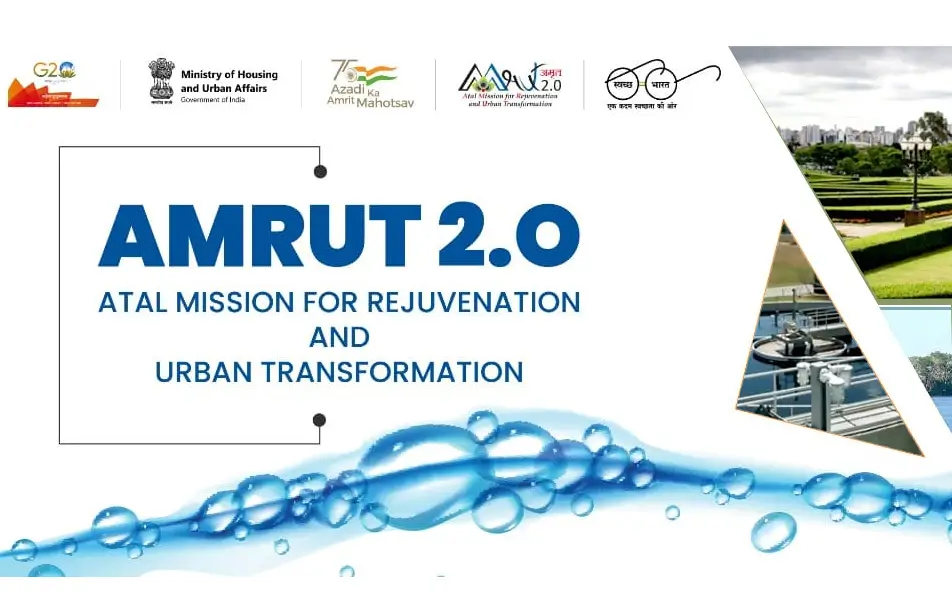
Despite the Union Government’s determined push to strengthen urban infrastructure through AMRUT 2.0, the UTs of J&K and Ladakh have recorded shockingly poor progress. The latest figures tabled in the Lok Sabha paint a grim picture: J&K has 153 projects worth Rs1,665.11 crore approved, yet work has been allotted in only 81 cases. Worse, actual expenditure stands at a paltry Rs 11.02 crore-barely 0.66percent of the sanctioned amount. Ladakh’s case is even more alarming-seven projects worth Rs908.90 crore have been sanctioned, but not a single contract has been awarded, meaning implementation has not even begun.
This is not merely a bureaucratic delay; it is a systemic failure with severe implications for urban life, public health, and environmental safety. AMRUT 2.0 is designed to ensure universal water supply, modern sewerage systems, rejuvenation of water bodies, and the reuse of treated water-objectives that are critical for the rapidly growing towns and cities of both UTs. Yet, despite repeated reviews, capacity-building programmes, and technical support mechanisms, these projects are languishing in files instead of taking shape on the ground.
The most disturbing aspect is that this inertia persists even after explicit warnings in a highest-level review meeting. When a flagship programme of national importance, backed by substantial grants, fails to take off despite the involvement of the highest political and administrative leadership, the problem lies not in resources but in accountability-or the lack of it.
The situation is particularly dire in J&K, many of which lack functional sewage treatment plants despite repeated reprimands from the NGT. The result is predictable yet devastating: untreated sewage flows directly into rivers and lakes, contaminating water bodies and, in many cases, re-entering the public supply system. This is nothing short of a public health hazard. In parallel, water scarcity-already acute in several urban and rural pockets-is being exacerbated by delays in augmentation projects.
The tragedy is that while these problems are well known and have been the subject of repeated judicial and administrative interventions, there has been no sense of urgency at the execution level. The Government often cites capacity issues, but that excuse rings hollow. The Union Ministry has provided regular training sessions, GIS-based master planning support, and institutional frameworks such as the State High Powered Steering Committee and State Level Technical Committee. Yet, the engineering and planning wings have failed to prepare projects in time, float tenders, and award contracts.
Ladakh’s position is even more concerning. Given its challenging terrain, harsh climate, and dispersed population, infrastructure projects require far longer lead times and meticulous planning. The Centre has sanctioned an amount large enough to transform urban water and sanitation infrastructure in the region. Yet, with no contracts awarded, not even the first steps toward execution have been taken. If the excuse is a shortage of technical manpower, the Central Government must step in immediately to provide expertise and project management support.
If the current lethargy continues, both UTs may face the ignominy of surrendering unspent central funds at the end of the financial year. Such a surrender is not just a bureaucratic embarrassment; it is a criminal waste in regions already financially constrained. The cascading effect will be equally damaging-future allocations will be slashed on account of poor utilisation, creating a vicious cycle of underdevelopment. Contractors, too, may suffer as partial or delayed projects block payment releases, further discouraging private sector participation.
The solution is not in announcing new schemes or holding more review meetings, but in decisive action. Since the Housing and Urban Development Department is under the CM’s charge, the responsibility for reversing this trend rests squarely on his office. Heads must roll where clear negligence is established-whether it be project directors, chief engineers, or senior municipal officers. At the same time, posts must be assigned to officers with proven records of execution, not merely those with seniority or political proximity. If not, a golden opportunity will slip away-leaving behind the same old story of grand announcements and ground-level inaction.
 Follow our WhatsApp channel
