

Dr. Vishal Sharma
vishal.sharma@fulbrightmail.org
Not long ago, the word “Artificial Intelligence (AI)” would bring to mind images of sci-fi robots, self-aware machines, or futuristic cities powered by sentient computers. Fast forward to 2025, AI doesn’t just live in science labs or high-tech companies, it is woven into the everyday lives of billions of people often without them realizing it. From the moment we wake-up until we retire to bed, we encounter various AI tools that cater to our day-to-day requirements. From virtual assistants like Siri and Alexa aiding daily tasks to recommendation algorithms on Netflix, personalized product suggestions on Amazon, predictive text on smartphones, AI-driven navigation with Google Maps, fitness monitoring, fraud detection in banking, drone-assisted agriculture, personalized education platforms and AI chatbots like ChatGPT, AI permeates every aspect of our lives. These aren’t sci-fi dreams rather they are everyday realities powered by AI in 2025, raising a fundamental question how Artificial Intelligence (AI) quietly became part of our daily lives and why it now feels more normal than futuristic.
What Exactly Is Artificial Intelligence?
Artificial Intelligence (AI) refers to the ability of machines to perform tasks that normally require human intelligence. These tasks include learning from experience, understanding language, recognizing images, solving problems, making decisions, and even creating content. Unlike traditional computer programs that follow fixed instructions, AI systems are designed to adapt, improve, and respond intelligently to new information. At its core, AI works by analysing large amounts of data at lightning speed and identifying patterns within it. Using techniques such as machine learning, deep learning, and neural networks, AI systems learn from examples rather than being explicitly programmed for every situation. For instance, a spam filter learns to distinguish unwanted emails by studying thousands of previous messages, while a navigation app learns traffic patterns to suggest faster routes.
AI is commonly classified into three types based on its level of capability: Artificial Narrow Intelligence (ANI), Artificial General Intelligence (AGI), and Artificial Super Intelligence (ASI). ANI, also known as weak AI, is designed to perform a specific task or a narrow range of tasks and operates strictly within predefined boundaries. Examples include voice assistants, recommendation systems, facial recognition software, and navigation apps. Although ANI systems can be highly efficient and accurate, they do not possess understanding or consciousness, and nearly all AI applications in vogue today fall into this category. AGI, or strong AI, refers to a another form of intelligence that can understand, learn, and apply knowledge across multiple domains in a manner similar to human intelligence. An AGI system would be capable of reasoning, problem-solving, and adapting to new situations without being retrained for each task. Although AGI has not yet been achieved, its realization no longer seems like a distant dream. ASI, or Artificial Super Intelligence, represents a hypothetical future stage in which AI surpasses human intelligence in all aspects, including creativity, emotional understanding, and decision-making. While ASI is largely speculative and often discussed in futuristic and ethical debates, it raises important questions about control, safety, and the future relationship between humans and intelligent machines.
2025 as the Tipping Point
For many years, AI created a lot of excitement, but often failed to meet expectations. In the 1980s, early AI systems were expected to think and decide like humans, but they worked only on fixed rules and failed in real-life situations. In the 2010s, Deep Learning (DL) again raised hopes because of big data and powerful computers. Still, AI could handle only specific tasks and struggled to truly understand meaning or context. In the early 2020s, Generative AI tools like chatbots and image creators caught global attention by talking naturally and creating art, leading many to believe human-level AI was close. When generative AI tools such as ChatGPT first entered in public domain, artists feared replacement, writers worried about originality, and musicians questioned the future of human expression. By 2025, that panic has largely subsided. AI generates drafts, ideas, visuals, and music but humans curate, contextualize, and give meaning. Creativity has not vanished rather it has expanded. New forms of storytelling, design, and expression have emerged, blending human imagination with machine assistance. Year 2025 feels different because AI has quietly but significantly improved, with new models able to understand text, images, audio, and video together, making them more context-aware. The key lesson of 2025 is simple: creativity is not about producing content, but about expressing intent.
Applications of AI
Artificial Intelligence (AI) is no longer just a futuristic idea; it is now a part of everyday life. It works by handling routine tasks, analyzing large amounts of data, and supporting better decision-making. As a result, AI is changing how work is done across different fields and making systems faster, smarter, and more efficient.
- AI in Education
AI is revolutionizing education by enabling personalized learning, automating administrative tasks, and providing intelligent tutoring. As an example, real-time adaptive platforms like “Khan Academy’s Khanmigo” and “Duolingo Max” serve as prime examples, utilizing Large Language Models (LLMs) such as GPT-4 to provide 24/7 personalized tutoring that scales beyond the reach of a single human instructor. In India, the Kerala Government’s AI-based platform “Samagra Plus AI” helps teachers assess student performance while offering chatbots, quizzes, and language games to support personalized learning.
Research indicates that these AI-driven environments can improve student performance by up to 30% by tailoring lesson difficulty and pacing to individual needs in real-time. Furthermore, global bodies like UNESCO have recently updated their AI Competency Framework for Teachers to address the ethical use and pedagogical integration of these tools, while Organisation for Economic Co-operation and Development (OECD) reports highlight that AI-powered early warning systems have successfully reduced student dropout rates by 15% through predictive analytics of engagement patterns. Beyond personalization, AI enhances inclusivity through tools like Microsoft Immersive Reader, which provides real-time translation and voice-to-text features for students with visual or hearing impairments, ensuring that the digital-first classroom remains accessible to all learners.
- AI in Healthcare
AI is rapidly transforming healthcare by strengthening diagnostics, widening access, and improving clinical outcomes in India and across the world. As an example, in India, the Armed Forces Medical Services have deployed AI-based diabetic eye screening through the ‘MadhuNetrAI’ platform, enabling early detection of retinal disorders in cities such as Pune and Mumbai while extending critical services to rural and underserved populations. AI is also playing a decisive role in closing long-standing gaps in rural healthcare delivery. Platforms like ‘Niramai Thermalytix’ offer non-invasive, affordable breast cancer screening in remote areas, while ‘Qure.ai’ employs deep-learning algorithms to interpret chest X-rays for tuberculosis within seconds – an invaluable capability in a country with one of the world’s highest TB burdens.
At the policy level, India’s NITI Aayog roadmap for “AI for All” highlights how AI-driven predictive analytics can forecast malaria outbreaks with accuracy exceeding 94 per cent, enabling health authorities to plan interventions proactively. Telemedicine has witnessed an equally dramatic shift: the AI-enabled ‘eSanjeevani’ platform has facilitated over 430 million remote consultations by late 2025, connecting rural citizens with more than 230,000 doctors nationwide under the Ayushman Bharat Digital Mission (ABDM). By integrating Azure OpenAI, the platform now supports multilingual prescriptions and automated clinical transcriptions, reducing language barriers and improving medical accuracy.
- AI in Governance and Public Services
Artificial Intelligence is reshaping governance and public services, enhancing efficiency, citizen engagement, and evidence-based decision-making through predictive analytics and automation. Governments in India are increasingly deploying AI tools to streamline administration and improve service delivery across sectors. At the policy level, the Delhi government’s forthcoming ‘DARPAN 2.0 dashboard’ will integrate real-time, cross-departmental data to help policymakers monitor welfare schemes, identify implementation bottlenecks, and take faster, data-driven decisions using predictive insights. At the municipal scale, Surat’s AI-enabled system leverages video analytics to detect potholes and waterlogging, automatically alerting field teams for rapid response and improving urban infrastructure management. Similarly, Tamil Nadu’s AI-powered monitoring centre addresses human–wildlife conflict by providing real-time alerts to officials and communities, enhancing safety while protecting wildlife. Citizen engagement has also improved through AI chatbots and virtual assistants, which simplify interactions with government portals, offer instant multilingual responses, and strengthen grievance redressal mechanisms. Complementing these applications, India’s ‘AI Governance Guidelines’ launched in November 2025 introduced the “Seven Sutras”, emphasizing fairness, accountability, and human-in-the-loop oversight for high-risk uses such as law enforcement and public benefits. Notable implementations include ‘Bhashini’, which enables real-time multilingual AI translation across Indian Railways platforms in more than 22 languages, and the AI-based Recruitment Tool unveiled on “Good Governance Day 2025” to enhance transparency in civil service appointments. Integrated with the existing Recruitment Rules Formulation, Amendment and Monitoring System (RRFAMS) portal, this tool is part of a broader digital reform agenda. In parallel, the iGOT AI platform supports continuous, real-time capacity building for millions of civil servants. Together, these initiatives demonstrate that AI is no longer a futuristic concept in governance but a practical, scalable instrument transforming how governments operate and offering the dual promise of greater efficiency and stronger public accountability.
- AI in Agriculture and Rural Development
Artificial Intelligence (AI) has emerged as a powerful driver of rural empowerment, reshaping agriculture from a labor-intensive practice into a data-driven science. By enabling precision farming, informed decision making, and efficient resource management, AI is steadily transforming agriculture and rural development, delivering tangible benefits to farmers in India and across the world.
In India, the NITI Aayog “AI for All” roadmap has become a strategic catalyst for integrating AI into agriculture and rural development, pushing beyond research toward large-scale, real-world impact. The roadmap highlights the importance of AI and machine learning in delivering precision advisories for weather, crop health, pest risks, and yield forecasting, promoting tailored strategies for farmers at various stages of adoption. One prominent example is Google’s Agricultural Landscape Understanding (ALU) API, which leverages satellite imagery and machine learning to identify individual field boundaries, vegetation, water bodies and other landscape features at high resolution. At the state level, Maharashtra is piloting AI-powered agricultural initiatives under its broader ‘MahaAgri AI’ strategy, aimed at modernizing farming through data-driven tools that enhance crop monitoring, weather outlooks, pest control and decision support. Complementing these initiatives, “Satnavari” village in Maharashtra has been inaugurated as India’s first AI-driven “Smart & Intelligent” rural community. The project equips farmers with mobile apps that deliver soil health data, weather alerts and fertilizer recommendations, while community drones assist with agricultural tasks and risk management. This holistic model also integrates internet connectivity, digital health services and education tools, demonstrating how AI can strengthen multiple facets of rural life.
- AI in Industry and the Workplace
By 2025, Artificial Intelligence (AI) is no longer an experiment or a future idea, it has become a normal part of how industries work in India and around the world. Companies are now using AI in their daily operations, decision-making, and production systems. According to the EY–CII Outlook 2026 report, nearly half of Indian companies already use generative AI in real business tasks. Many are moving toward Agentic AI, which can plan, decide, and act on its own to complete complex tasks such as scheduling work, handling customer queries, writing software, or managing operations.
This transition is clearly visible on the ground. In India, companies like Cipla use AI to reduce machine changeover times by 22% using AI-driven scheduling systems and thereby speed up the production, while Johnson & Johnson India uses AI to predict equipment failures before they happen. AI is also improving how offices and factories run. In India’s IT sector, companies like TCS and Infosys use AI to write code faster, support customers better, and reduce costs. In manufacturing companies like BMW, AI helps check product quality, improve production planning, and reduce mistakes. AI-powered robots now perform repetitive and risky tasks on factory floors, allowing round-the-clock work while keeping people safer. Some companies even use AI drones to monitor workplace safety in real time. On the enterprise side, Indian firms such as ‘Ramco Systems’ are offering AI-enabled HR and payroll platforms, including virtual assistants like ‘CHIA’, which automate routine workforce queries and streamline internal processes. On the factory floor, AI-powered robotic arms now handle repetitive and high-precision tasks with speed and accuracy, enabling continuous 24/7 operations while reducing human exposure to risk. Workplace safety has also improved through AI: Hindustan Coca-Cola Beverages (HCCB), for example, uses self-learning AI drones to monitor safety compliance and detect hazards in real time. Beyond factories and offices, AI helps manage supply chains, predict IT system failures, and plan workforce skills for the future.
- AI in Policing and Internal Security
By 2025, Artificial Intelligence (AI) has become a powerful support tool for policing and internal security, helping law enforcement move from reacting to crimes after they happen to preventing them before they occur. Across India, AI is being used at national, state, and local levels to improve efficiency, awareness, and coordination with citizens while also raising important questions about privacy and ethics.
At the national level, the Bureau of Police Research & Development (BPR&D) has integrated AI-based analysis into the Crime and Criminal Tracking Network & Systems (CCTNS). This allows police forces in states like Delhi and Maharashtra to identify crime hotspots more accurately. In February 2025, for example, Delhi Police solved an ₹80-lakh robbery in Chandni Chowk within 24 hours by using AI-powered video analysis that linked CCTV footage with criminal databases. Tools like Bhashini now help officers file FIRs using voice-to-text in 22 Indian languages, making reporting faster and easier. In Uttar Pradesh, AI-enabled drones are used during large religious festivals to monitor crowd density and prevent stampedes.
At the state and city level, initiatives such as Maharashtra Police’s MARVEL system and Smart Policing platforms in cities like Ghazipur help track crime patterns, manage investigations, and digitize records. Bengaluru Police use AI to monitor CCTV footage during major public events, allowing faster response to suspicious activity. In Hyderabad, the Telangana Integrated Command and Control Centre connects over one lakh cameras with AI analytics to manage emergencies, traffic, and law-and-order situations. At the community level, tools like the ‘Police Satark Mitra WhatsApp bot’ allow citizens to report crimes anonymously, helping police identify trends and problem areas.
Future of Jobs in the era of AI
In 2025, Artificial Intelligence is no longer just changing old jobs, it is creating many new types of careers that combine technical skills with human creativity, judgment, and understanding. According to NITI Aayog’s report on ‘2025 Roadmap for Job Creation’, AI is projected to generate up to 4 million new jobs in India by 2030, particularly in “human-AI augmentation” i.e. roles where humans and AI work together. In India, a new local-first job market is emerging, with roles such as Indic language experts who adapt AI models to regional languages and dialects, and vernacular UX designers who create apps and platforms for the next billion internet users. Globally, the rise of Agentic AI has created new jobs like AI agent designers and managers, who build and supervise teams of AI systems working together. The World Economic Forum’s Future of Jobs Report 2025 also shows that while routine office jobs are decreasing, there is a sharp rise in demand for roles such as AI ethics specialists and AI product managers.
Based on the above discussion, the future of jobs in the AI era will be broad, inclusive, and multidisciplinary, extending far beyond science and engineering alone. In the coming years, AI-driven careers will not be limited to computer science or electronics graduates. Students from arts, humanities, social sciences, commerce, law, psychology, design, and languages will play equally important roles. As AI systems increasingly interact with people, culture, society, and governance, skills such as critical thinking, ethics, communication, creativity, domain knowledge, and cultural understanding will become as valuable as coding. Writers, linguists, and historians will help AI understand language, context, and culture; psychologists and sociologists will guide human-AI interaction and behavior; lawyers and policy experts will shape AI governance and digital rights; designers and artists will create intuitive, human-friendly AI interfaces; and business graduates will manage AI products, strategy, and innovation. Teachers, healthcare workers, journalists, and public administrators will increasingly work with AI as a partner, not a replacement.
The future of jobs is therefore not about “man versus machine” but about “human plus machine.” Those who combine domain knowledge with AI awareness regardless of their academic background will shape the workforce of tomorrow. In the AI age, every discipline has a role, and every young mind has an opportunity.
The Final Thought
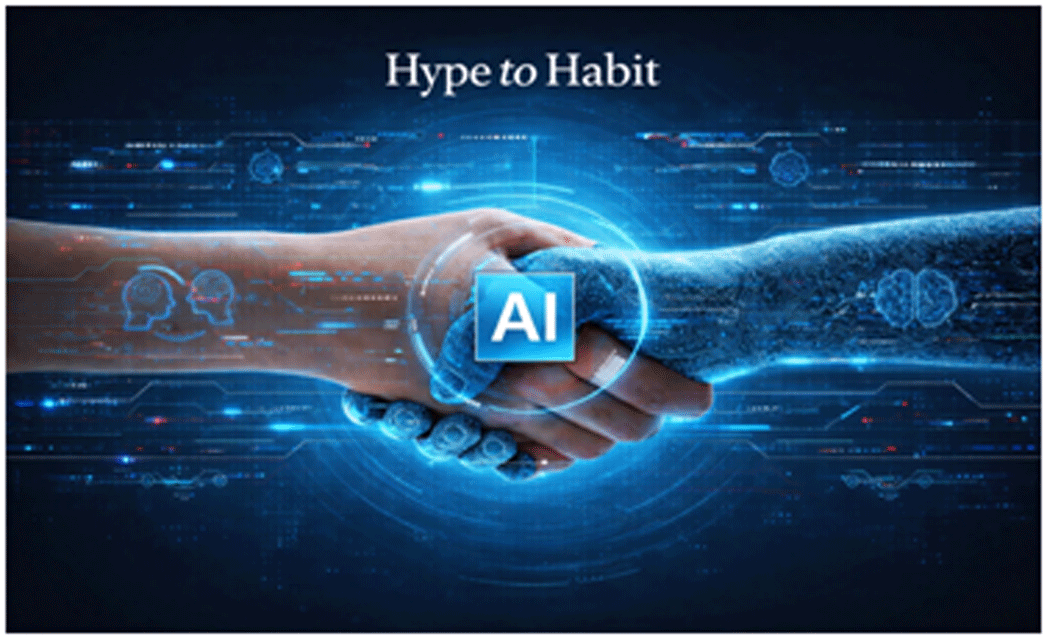
The true achievement of AI in 2025 is not intelligence, it is normalcy. AI has moved from headlines to habits, from fascination to function. Like electricity or the internet, it has become invisible, essential, and deeply woven into modern life. The question is no longer whether AI will shape our future, but how responsibly we choose to live with it. In simple terms, Artificial Intelligence is not about replacing humans; it is about augmenting human capabilities, helping people make better decisions, automate routine work, and solve complex problems more efficiently. What 2025 represents is not the arrival of “Superintelligent Machines,” but the maturation of AI into something far more practical and far more impactful. Looking to 2026 and beyond, the future of AI will be defined not by how powerful it becomes, but by how wisely, ethically, and inclusively we use it.
 Follow our WhatsApp channel
