

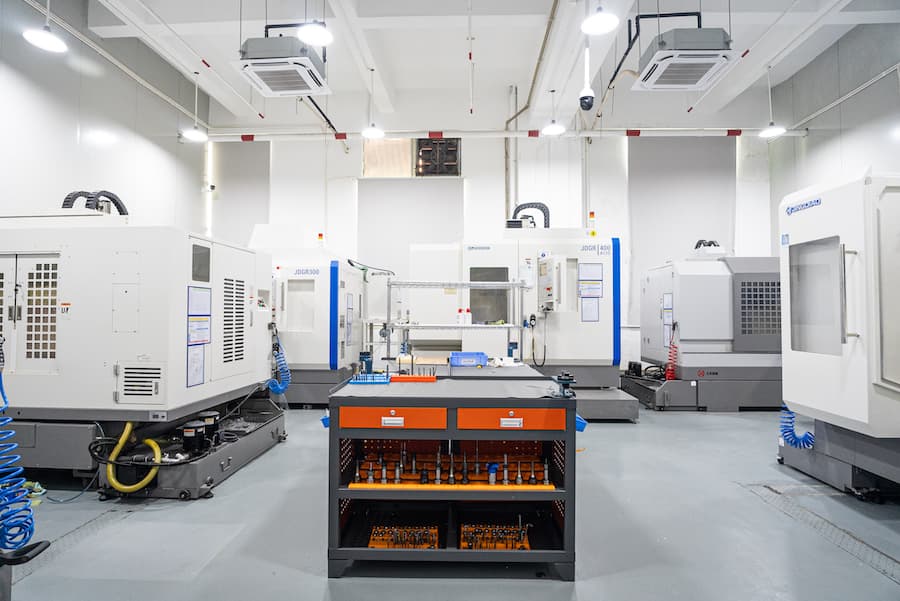
Speed is of essence in the final stages of electric car design. One project recently was a concept EV going straight to a rolling prototype in a four-week cycle by taking advantage of a complete digital model built to finalization. This quick turnaround meant more than simply putting more hours on a machine; it was the culmination of years of development of AI-guided toolpath development that meets the demands of production-injection grade machining completed through multi-axis machining. Workflow linked generative CAD with adaptive machining approaches to machine multielement drivetrain and chassis parts with zero significant remake periods.
This is a watershed moment in automotive prototyping. The traditional methods use several physical models in between, which are also sources of delays and accumulative tolerances. To overcome the bottleneck of iterative decisions in the geometry analysis, tool selection and path generation, the team chose the route of utilizing AI to achieve geometric fidelity between the digital twin and the physical part without iteration.
Bottlenecks in Traditional Prototyping
Conventional automotive prototyping has to face a number of repeated limitations. Manual CAM programming has difficulty keeping tool engagement in the undercuts, blended or pocket areas of high curvature. In the absence of algorithm optimization, conservative feed rates and excessive reorientation tend to be used by the programmer, bloating cycle times.
Surface fidelity also comes to be a limiting factor. In thin-walled or otherwise cantilevered CNC machining parts, tolerances may be affected by vibration and deflection during machining. This is further exacerbated by long exposure time, due to thermal distortion when machining heat sensitive alloys which are utilized in lightweight chassis parts.
When real-time correction is not available, deviations may be realized after inspection, where reconfiguration or discarding costly parts may be necessary. Delay is further compounded by tooling cost as they would have to get specialized cutters to fit special geometries. This was when the engineering teams began exploring AI’s role in collapsing the design-to-production gap.
AI in the CAD-to-CNC Workflow
The use of AI changes the means of converting CAD models to instructions to compute machining. Algorithms conduct automatic recognition of features, wherein the part is broken down into machinable areas that will be ideal when using 4- and 5-axis techniques. In the case of CNC machining parts, the segmentation takes into consideration the surface curvature, possible deflection of the cutter and tools reach constraints and then specific cutting tools are chosen.
Predictive feed control stabilizes cutting forces over variable geometry by use of AI. In the case of thin-walled housings, it minimizes radial engagement but keeps an axial depth in order to prevent chatter. Volumetric simulation forecasts the behavior of chip evacuation, causing alterations to the toolpaths to avoid recutting.
Thermal load modelling is also built in and can be used to preemptively change spindle speeds or coolant direction in order to prevent localized heat accumulation. This particularly helps in complicated automotive prototyping where the tolerance requirement has to be adhered to throughout the various machining processes.

Case Study: Adaptive AI Machining of a Drivetrain Component
An 8-kg weight drivetrain-housing was identified with asymmetric bearing seats, oil channels, and interlocked flange to be manufactured using AI-assistance. This component was needing tolerances of less than ±8 μm to the bearing bores and less than 0.01 mm to parallelism between mounting faces. Usually, this will require three different setups to access internal and external features.
CAM with AI integrated a single fixture orientation, based on the use of 5-axis interpolation and swarf cutting of angles on the surfaces. Adaptive clearing toolpaths reduced engagements with tools to spikes, and rest machining routines eliminated the remaining stock with excessive passes. The cutters that were chosen incorporated a neck-relieved carbide end mill used in deep bores and a high-helix 2-flute used in the slotting activities to evacuate the chips. On-tool tool life was also checked in-process to avoid formation of micro-burr.
The 22 % improvement in cycle time was noted over a manually programmed run and the surface deviation reduced by 37 %. These advances directly reflected to decreased automotive prototyping readiness, including low post-machining corrections. In the case, AI has been able to verify that it can be used to integrate geometrical complexity with precision output in CNC machining parts production.
The Feedback Loop: AI Learning from Machining Errors
An AI-driven workflow does not remain the same, it learns. In each machining cycle, data sets on spindle power, vibration spectrum, cutting forces and thermal gradients are released. Force dynamometers embedded into sensors are used to gauge modifications of loads in real time, accelerometers embedded to identify the onset of chatter, and infrared systems embedded to survey temperature increase.
Such streams are fed back into the model to refine AI prediction. When particular CNC machining parts repeatedly display tooling wear at small radii, then the AI can autonomously adjust the toolpath curvature beforehand or even suggest other cutter geometries.
When the lightweight housings exhibited minimal warping of the housings following heavy roughing, the AI changed the removal order to balance the thermal load. After many iterations, the error rate decreases and the predictability of the process also improves. Such a mutually reinforced feedback loop can guarantee that automotive prototyping environments have shorter lead times and improved first-pass yield.
Future Outlook: AI Predicting Performance Before Prototypes Exist
The next stage of integrating is the prediction functional validation prior to machining. The ability to integrate finite element crash analysis and NVH simulation directly with the AI machining planner allows teams to analyze whether CNC machining parts will be able to reach performance levels under incoming stress before they are cut in the stock.
The resulting geometry will not only be structural performance-optimized, but also manufacturable with multiple axis machining under consideration. AI will control the toolpath strategies, material selection and even cutting fluid deployment as a whole.
It is in this race field of automotive prototyping that the convergence of digital performance projection with actual manufacturing will dominate the next development cycles. The outcome will include not only cheaper price and minimized usage of material but also almost zeroing unplanned iteration stages.
 Follow our WhatsApp channel
