

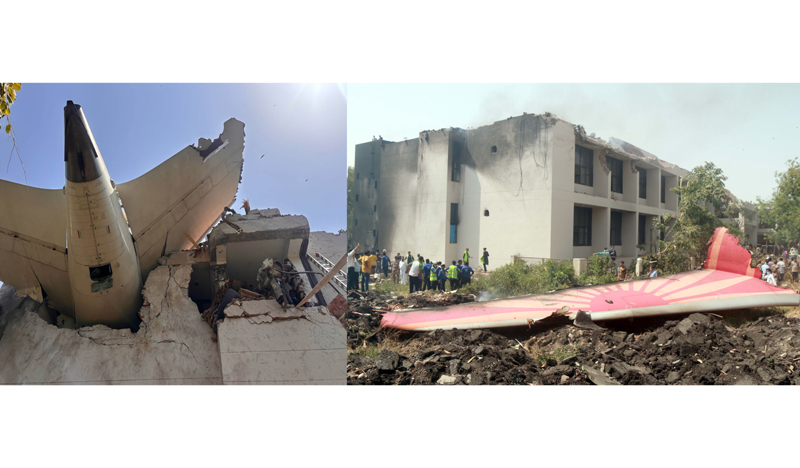
The catastrophic crash of Air India flight AI171, moments after take-off from Ahmedabad, has sent shockwaves across the nation and beyond. With 265 bodies recovered so far and the death toll feared to rise further, this tragedy ranks among the worst in India’s aviation history. The crash, involving a Boeing 787 Dreamliner en route to London with 242 people onboard, including 53 foreign nationals and a prominent Indian political figure, underscores not just the scale of human loss but also the urgent need to re-examine the state of aviation safety and regulation in the country.
This incident raises troubling questions. The Dreamliner, considered among Boeing’s most advanced and safest aircraft models, had logged only 11 years in service-well within the expected aircraft lifespan of 30 to 50 years. Thus, the airframe’s age or design is unlikely to be the cause of isolation. Yet, reports hinting at a possible dual engine failure, bird hit, or lack of thrust during takeoff cannot be ignored. A “Mayday” call was issued shortly after departure, indicating severe technical distress. Visuals of the aircraft flying low with landing gear still extended and its fiery plunge into residential quarters add to the gravity.
What makes this tragedy more painful is its compounded impact. The aircraft crashed into the residential quarters of BJ Medical College and Civil Hospital, resulting in additional civilian casualties, including medical students, healthcare workers’ families, and residents. Such devastation points toward a larger systemic issue: the unchecked urban sprawl around airports. With commercial and residential structures mushrooming dangerously close to airport perimeters, the inherent risks of take-off and landing-already the most accident-prone phases of flight-are significantly amplified. Authorities must revisit urban planning norms near airports and enforce strict safety buffers to prevent such collateral tragedies.
India, which now boasts one of the world’s fastest-growing aviation markets, must acknowledge the rising number of passenger complaints and operational issues reported to the Directorate General of Civil Aviation. While the duopoly of Tata-owned Air India and IndiGo dominates the skies, it also has limited competitive pressure to uphold consistent service and safety standards. In such a scenario, complacency can be fatal. The regulator must proactively ensure that safety audits, crew training, technical checks, and complaint redressal mechanisms are strictly monitored and transparently executed.
Equally important is the investigation. As this was an international flight with citizens from several countries onboard, India is under international scrutiny. The cause of the accident must be determined by a thorough, impartial, and time-bound investigation. Boeing, along with the U.S. National Transportation Safety Board, has offered assistance-this offer must be accepted in full spirit to bring international credibility to the probe. The black box data, once retrieved, must be shared with all stakeholders and the final report placed in the public domain. Accountability must not stop at a technical error-if there are regulatory, human, or managerial lapses, those responsible must be held to account.
The magnitude of the crash is horrifying not just for the number of lives lost but also for the manner in which many of the bodies were charred beyond recognition. DNA testing is now the only tool for identification, adding trauma for families already torn by grief. As rescue teams, hospitals, and forensic agencies work round the clock, the Government must ensure full logistical, emotional, and financial support to the victims’ families.
This is a dark day for Indian aviation. But tragedies, however devastating, must lead to reform. India cannot afford to treat the incident as just another freak accident. Structural issues-ranging from urban planning to aviation oversight and airline competition to infrastructure readiness-must all come under the lens. The DGCA’s role must evolve from a reactive body to a proactive enforcer. India owes it to the 265 lives lost and the countless dreams shattered that day to ensure that the answers are found, lessons are learnt, and such horror never repeats. The nation mourns with the bereaved, but mourning alone is not enough. Action must follow.
 Follow our WhatsApp channel
