

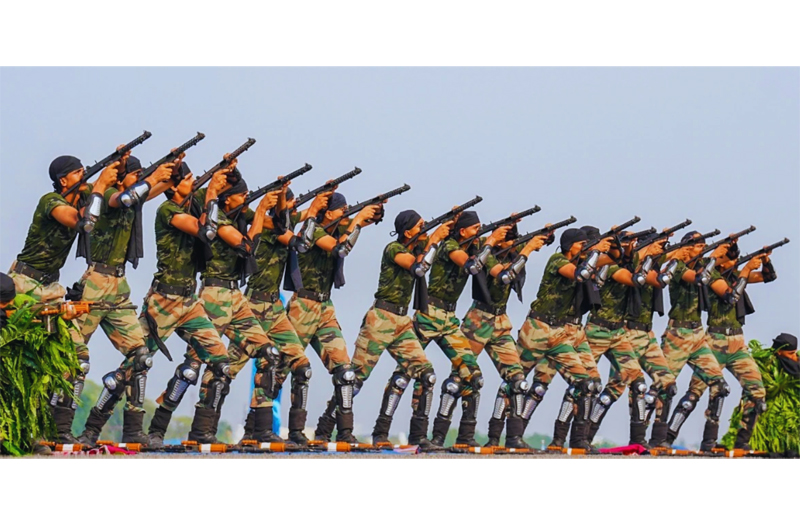
The four-day military confrontation between India and Pakistan, code-named Operation Sindoor, has not only reaffirmed India’s military prowess but has also served as a compelling validation of the Agnipath recruitment model. More than 3,000 Agniveers, many barely out of their teens, played a central role in safeguarding Indian airspace from a relentless barrage of Pakistani missile and drone attacks. Their performance during this high-stakes operation underscores how the modern battlefield demands youthful dynamism, adaptability, and technological fluency-qualities that the Agnipath scheme appears to cultivate effectively. Introduced in June 2022 amid intense political debate and public skepticism, the Agnipath scheme sought to revolutionize the recruitment process by enlisting soldiers for four years, with only the top-performing 25 percent being retained for longer-term service. Critics feared it would create a disposable class of undertrained soldiers with uncertain futures. However, the baptism by fire during Operation Sindoor suggests that this model might not only be sustainable but also better aligned with the evolving nature of warfare, especially in the age of automation, drones, AI-assisted targeting, and real-time battlefield data analytics.
At the heart of India’s defensive success in Operation Sindoor was the Akashteer air defence control and reporting system, an indigenous digital command network that integrated a wide array of sensors, weapons, and communication systems. Agniveers-many with only a year or two of service-were instrumental in operating Akashteer. Their ability to man radars, fire control systems, and advanced air defence weaponry such as L-70s, Zu-23-2Bs, Strela, Tunguska, and Akash SAM launchers was not just impressive-it was decisive. Technology is second nature to this new generation of soldiers. Growing up in a digital environment, they are not only more comfortable handling complex interfaces and electronic systems but are also more adaptable to rapidly evolving military technologies. The older legacy recruitment system, while time-tested, often struggled to keep pace with such swift technological shifts. The Agnipath scheme, by contrast, appears to be a forward-looking strategy tailored to the age of digital warfare.
What further strengthens the case for Agnipath is the internal competitive dynamic it fosters. With only 25 percent of Agniveers being retained for permanent roles, there is a clear and strong incentive for young recruits to excel in training, operations, and leadership. This meritocratic structure fosters an environment of discipline, motivation, and continuous self-improvement-qualities that any modern military must cultivate. Operation Sindoor showed that Agniveers rose to this challenge, performing shoulder-to-shoulder with regular troops and gaining accolades from senior defence officials. Moreover, the strategic deployment of Agniveers in four key roles-gunners, operator fire control, operator radio, and logistics/drivers of weapon-bearing vehicles-ensures they are not just supplementary manpower, but core enablers in combat operations. Their training has proven sufficient, their resolve unflinching, and their tactical understanding mature far beyond their years. For a program that is barely three years old, such outcomes are remarkable.
That said, concerns about post-service rehabilitation for the 75% of Agniveers not absorbed into permanent roles must not be ignored. The Government has taken commendable steps, including reservations in CAPFs and PSUs, as well as incentives from private enterprises like BrahMos Aerospace. These measures must be expanded and formalized further to ensure the long-term success and acceptance of the Agnipath model.
Far from being underprepared, these young soldiers delivered under the most demanding of conditions. As warfare becomes increasingly reliant on speed, precision, and data-driven decisions, India’s military must stay agile and technologically adept. Agniveers, as demonstrated during this conflict, are not just meeting these challenges-they are excelling at them. In them, India may have found the ideal soldier for the 21st-century battlefield: young, bold, tech-savvy, and motivated by the prospect of proving their mettle. Operation Sindoor has thus not only marked a military victory but also a strategic turning point in India’s defence recruitment philosophy. The Agnipath scheme, once controversial, now appears visionary. It deserves to be refined, supported and expanded for future-ready armed forces.
 Follow our WhatsApp channel
