

Arun Kumar Gupta
Environmental pollution today stands as one of the most significant challenges faced by humanity. Its effects are visible everywhere-air quality has deteriorated, water bodies have become contaminated, and ecosystems are struggling to maintain balance. Despite remarkable advances in modern science and technology, the ability to fully reverse environmental damage remains elusive. Preventative measures have become widespread, but the power to purify an already polluted environment is still limited. Interestingly, ancient traditions offer valuable insights that are both relevant and practical today. One such remarkable tradition is Agnihotra, an ancient Vedic practice that holds profound significance even in the modern era.
Agnihotra is often mistaken as merely a religious ritual. However, a deeper understanding reveals it to be a carefully designed environmental purification technique, rooted in the profound wisdom of early civilizations. This practice combines natural elements in a precise process to achieve complex chemical transformations that benefit not just individuals but the surrounding environment as a whole.
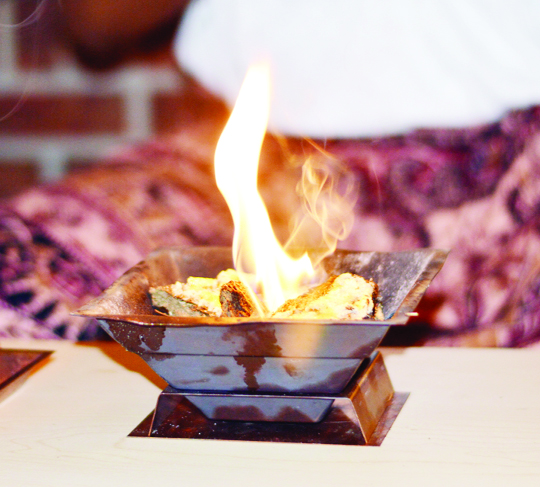
Agnihotra involves offering specific substances like clarified butter (ghee), medicinal herbs, cow dung, and natural resins into a specially prepared fire at sunrise and sunset while chanting specific mantras. Some modern perspectives have questioned whether this combustion process could contribute to air pollution by increasing carbon dioxide or other emissions. However, scientific research suggests otherwise. Agnihotra’s structure is such that the emissions produced carry purifying and therapeutic properties rather than harmful pollutants. The practice relies on controlled combustion that releases medicinal aerosols into the environment, aiding in the purification of air and surroundings.
Scientific principles provide a deeper appreciation of Agnihotra’s environmental impact. It is a well-established scientific fact that matter cannot be created or destroyed; it only changes form. In Agnihotra, the solid offerings transform into gaseous forms through sublimation, a process where a substance transitions directly from a solid to a gas without becoming liquid. This transformation amplifies the healing properties of the substances used, and the resulting vapors spread widely, benefiting larger areas rather than a single space. These medicinal vapors not only cleanse the environment but also contribute to improving overall health.
Various studies conducted across reputed institutions have validated Agnihotra’s positive impact. During an Ashwamedha Yagya held in Gorakhpur, Uttar Pradesh, the Uttar Pradesh Pollution Control Board measured air quality levels before and after the event. The results were noteworthy, showing a 70 percent reduction in sulfur dioxide levels, an 11 percent decrease in nitrogen oxide, and a 6 percent improvement in nearby water quality. Another significant study conducted jointly by the National Botanical Research Institute, Lucknow, and the Asian Agri-History Foundation revealed that performing Agnihotra for just 60 minutes led to a 94 percent reduction in harmful airborne bacteria. The materials used were sourced from Gurukul Kangri Pharmacy, Haridwar, ensuring the authenticity and replicability of the findings.
Dr. Arvind D. Mondkar, an esteemed microbiologist, carried out experiments which demonstrated a 91.4 percent reduction in airborne bacterial counts following the performance of Agnihotra. His research adds strong scientific backing to the benefits of this ancient practice.
International observations have also underscored similar effects. Dr. Hafkine reported that the burning of ghee and sugar leads to the destruction of germs responsible for numerous illnesses. Professor Tilleard further observed that the smoke generated from burning ghee and sugar could destroy pathogens responsible for diseases like tuberculosis, measles, and smallpox. These findings, corroborated by multiple studies, illustrate the wide-reaching antimicrobial properties of substances used in Agnihotra.
Further expanding the horizon of its benefits, Dr. Sergei A. Shirokov, a Russian scientist, noted that the smoke produced by burning cow dung significantly reduces the harmful effects of nuclear radiation. Complementary research by Dr. L. Matela Antoninowska of Poland found that Agnihotra ash could play a crucial role in mitigating the effects of nuclear pollution. These findings demonstrate that Agnihotra’s effects are not limited to chemical or biological pollution but extend to radiological contamination as well.
The evidence presented through these diverse scientific studies showcases the comprehensive capability of Agnihotra to address different forms of pollution. This remarkable tradition, therefore, emerges as a potent environmental purification method, capable of offering solutions where modern science continues to search for effective alternatives.
The ancient scholars who devised Agnihotra exhibited profound understanding of natural laws. Their knowledge aligns closely with contemporary scientific principles, particularly the concept that matter can only change form but not be destroyed. They intuitively grasped the process of sublimation and the behavior of medicinal vapors in atmospheric dynamics. The sages recognized that the subtle forms of medicinal substances, when dispersed through fire, could travel over significant distances and exert beneficial effects on a wide area. They understood that the state of matter plays a vital role in determining its influence and that the penetrating power of fire-what today’s science refers to as aerodynamic behavior-could be harnessed for environmental purification.
This integration of science into daily life practices ensured that ecological balance was maintained in ancient times. Agnihotra was not a ceremonial formality but a methodical environmental intervention embedded within the cultural fabric of society. It reflected an innate understanding of sustainability long before the term entered the modern lexicon.
In contemporary times, this ancient wisdom holds greater relevance than ever before. Modern lifestyles often involve spending extended periods indoors, within closed spaces where air circulation is limited and pollutants can accumulate. From chemical emissions of synthetic materials to microbial contamination, indoor pollution poses significant health risks. In such a scenario, Agnihotra emerges as a natural, sustainable, and effective solution. Practicing Agnihotra regularly within homes and workplaces can significantly improve indoor air quality, eliminate harmful bacteria, and create a healthier living environment without reliance on artificial purifiers or chemicals.
Moreover, Agnihotra resonates with sustainable living principles. The materials involved are natural, biodegradable, and often locally sourced, resulting in minimal environmental footprint. The practice not only enhances personal well-being but also fosters environmental responsibility, bridging the gap between individual action and global ecological preservation.
In the broader perspective, while modern technology plays an essential role in addressing environmental challenges, there is immense value in reviving time-tested traditional practices. Agnihotra reminds us that harmony with nature is not a forgotten concept but an enduring necessity. Embracing such holistic approaches can complement contemporary scientific efforts, offering a path that is both sustainable and deeply rooted in ecological balance.
Agnihotra thus stands as a profound testament to the vision and foresight of ancient times. It encapsulates a deep respect for nature, a scientific understanding of matter and energy, and a practical method for ensuring environmental purity. Its efficacy, validated through modern research and supported by scientific evidence, makes it highly relevant for today’s world, where the quest for sustainable solutions is more urgent than ever.
(The author is President of Arya Samaj Dayanand Marg, City Chowk, Jammu )
 Follow our WhatsApp channel
