

SKIMS to submit white paper on food safety
Irfan Tramboo
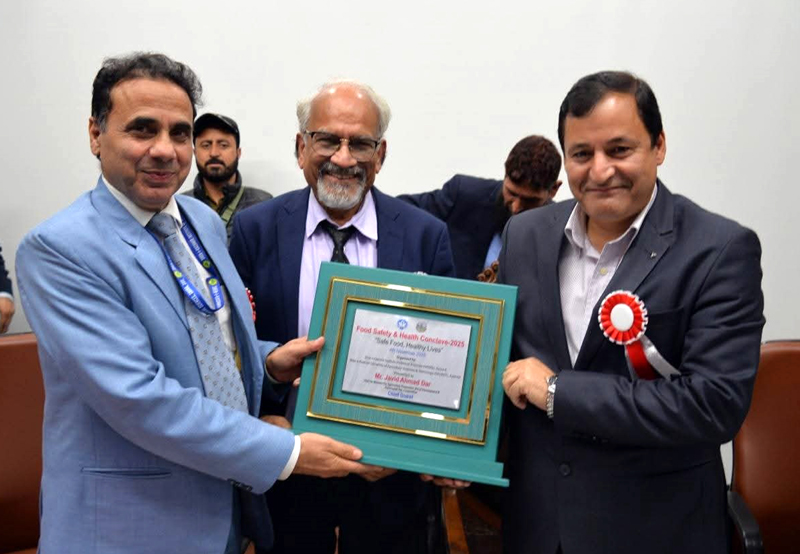
SRINAGAR, Nov 4: Minister for Agriculture Production, Rural Development & Panchayati Raj Javid Ahmad Dar today said that tackling adulteration and unsafe food practices requires more than just regulation, and calls for collective moral responsibility and heightened public awareness at the societal level.
He was speaking at the Food Safety and Health Conclave 2025 organised jointly by the Sher-i-Kashmir Institute of Medical Sciences (SKIMS) and Sher-e-Kashmir University of Agricultural Sciences and Technology (SKUAST-K) here.
The day-long conclave brought together experts, public health specialists, administrators, and researchers to deliberate on strategies for strengthening food safety mechanisms in J&K
Dar said that 7,500 hectares have been identified in J&K for natural farming to promote sustainable agriculture and reduce pesticide use.
He added that flagship horticulture programs were already being implemented to support farmers and enhance productivity.
Reflecting on recent food safety concerns, the Minister said the Government and its enforcement agencies acted “promptly and diligently” to restore public confidence.
“Checks and balances have been considerably strengthened to safeguard public interest,” he said, while emphasising that scientists remain the “real intellectual and ethical assets” of the country, guiding evidence-based policymaking and public health protection.
Dr. Shahid Iqbal Choudhary, Secretary, Science & Technology, said the newly framed food policy was a welcome step, but its success depended on being “technically robust, administratively implementable, and politically supported.”
He underscored the role of religious scholars in shaping public awareness and stressed that “food safety cannot be compromised at any level.”
Choudhary further highlighted the need for research in food safety and urged premier institutions like SKIMS and SKUAST to leverage funding opportunities and promote innovative studies.
Prof. M. Ashraf Ganie, Director SKIMS, said the conclave followed the recent rotten meat incident and subsequent high-level meetings chaired by the Chief Minister, Omar Abdullah.
He reaffirmed SKIMS’ commitment to leading scientific interventions on food safety in collaboration with SKUAST-K.
He stressed that food safety was a vital public health concern, requiring “rigorous scientific scrutiny” to study the effects of preservatives, pesticides, and genetically modified foods on human health.
Prof. Yoginder Kumar Gupta, President, AIIMS Kalyani, emphasised adopting effective, science-based awareness campaigns and providing institutional support for public health initiatives.
He cautioned that “low-dose, slow-residual pesticide exposure poses a greater long-term danger than acute toxicity,” particularly for children.
A central highlight of the event was a panel discussion on formulating food safety guidelines and drafting a white paper to be submitted to the Government.
The panel comprised key administrators, legal experts, scholars, and civil society representatives, including Akshay Labroo, District Commissioner, Srinagar; Prof. Riyaz Ahmad Shah, Dean FVSc & AH SKUAST; Dr. Abdul Lateef Alkindi; Prof. Farooq Ahmad Kaloo, former Director, Animal Husbandry Kashmir; Dr. Ruchita Gupta, WHO; and Yameen-ul-Nabi, Assistant Commissioner, J&K Food & Drug Administration.
Labroo said that while operational constraints existed, law enforcement was being “strictly implemented,” adding that community participation remains essential for ensuring safe food.
Legal experts called for strong deterrent action against violators, while religious scholars termed food purity both a civic duty and religious obligation.
Citizen groups urged greater administrative efficiency and vigilance to protect consumers.
The conclave also featured thematic sessions on Public Health and Regulatory Frameworks, Food Safety and Ethics in J&K, Nutraceutical and Drug-Food Interactions, Clinical Consequences of Unsafe Food Consumption, Agriculture and Production Systems, and Regulatory Architecture.
Prof. Ganie acknowledged Prof. Iftikhar Bashir and his team for organising a “substantive academic and policy-oriented platform,” noting that the deliberations would contribute significantly to strengthening food safety and public awareness in J&K.
 Follow our WhatsApp channel
