

Biju Dharmapalan
bijudharmapalan@gmail.com
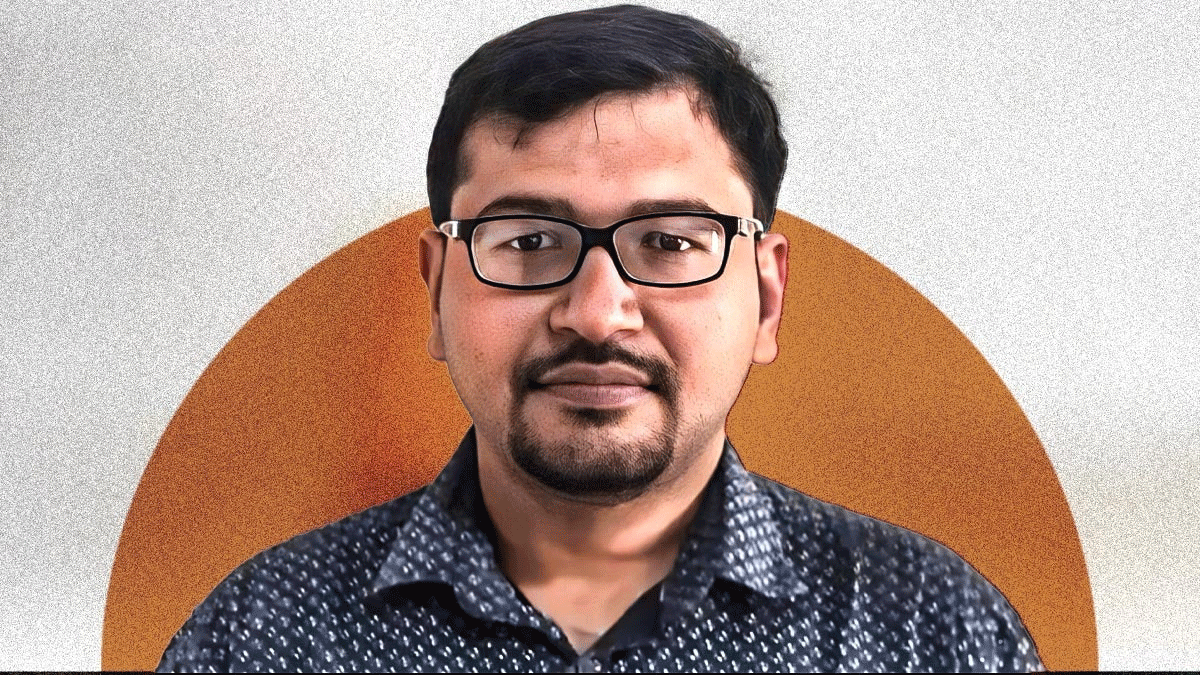
The story of science isn’t always written in labs or journals. Sometimes it’s written in quiet acts of resistance by people who won’t accept that doing wrong is the price of success. One such tale is that Achal Agrawal is in Nature’s 10 for 2025. It is not a celebration of a new discovery, a new device, or a new technology. It is a sign of conscience. Of a man who chose to be uncomfortable instead of complicit, to tell the truth instead of being safe, and to be credible instead of easy.
.
Agrawal’s turning point did not come in a boardroom or at a policy meeting. It arrived quietly, through a conversation with a young, enthusiastic student who wanted to do research. There was promise in that curiosity—until the student casually admitted to using software to paraphrase already published work. When Agrawal explained that this was plagiarism, the student did not retreat in shame. Instead, he defended himself, saying the work had cleared the university’s plagiarism checks. That moment pierced something deeper than academic protocol. It revealed how dangerously normalised misconduct had become. The system, meant to protect integrity, was being gamed—and the next generation was learning to do it with confidence.
For many, that encounter might have ended as a private disappointment. For Achal Agrawal, it became a point of no return. In 2022, he resigned from his university post and stepped into uncertainty, choosing to pursue an unpaid, risky mission: to confront research misconduct in India openly and relentlessly. It was not an emotional reaction. It was a carefully considered moral decision. He had seen colleagues abandon classrooms to chase publication numbers. He had watched quantity eclipse quality. And he had understood that silence was no longer neutral—it was enabling the decay.
From that resolve emerged India Research Watch (IRW)—not as an institution with power, but as a collective conscience with data. Agrawal began doing what few were willing to do: tracking retractions, dissecting publication patterns, exposing plagiarism networks, and drawing public attention to paper mills and unethical authorship. He took this work to social media, particularly LinkedIn, where his analytical posts slowly gathered momentum. What began as scattered observations turned into a nationwide conversation. Today, IRW’s platform has grown into a space with more than 77,000 followers and an anonymous reporting system for whistle-blowers. Every day, Agrawal receives multiple tips—each one a quiet confession of a system struggling with itself.
One of his most unsettling contributions was the visualisation of global retraction data using international databases. The picture that emerged was uncomfortable: India ranked third in the world for retracted papers, after China and the United States—and most of these retractions cited direct research-integrity concerns. This was not about isolated misconduct. It was about a pattern. A culture shaped by incentives that rewarded speed and volume over scrutiny and responsibility.
Agrawal’s most lasting impact, however, has not been digital visibility—it has been structural reform. For years, Indian universities have lived under the shadow of rankings, especially the National Institutional Ranking Framework (NIRF). These rankings influence grants, reputations, student admissions, and institutional survival. Yet, until now, they largely rewarded publication volume without asking hard questions about quality. Through sustained data-backed critique, Agrawal and his collaborators helped trigger a historic policy shift: institutions will now face penalties if a significant proportion of their published papers are retracted. It is a fundamental redefinition of merit—from how much is produced to how honestly it is produced.
His work also uncovered how some private institutions rapidly climbed ranking ladders by massively increasing publication and citation counts—often without sufficient internal checks on quality and ethical standards. These findings did not accuse lightly; they demonstrated, methodically, how metrics themselves were being weaponised. In doing so, Agrawal forced the academic community to confront an uncomfortable truth: when evaluation systems are flawed, misconduct doesn’t just survive—it thrives.
But revolutions in integrity are never free of consequence. Agrawal’s work has cost him professional stability. He remains unemployed, not because of a lack of ability, but because of the discomfort his findings generate. A lawsuit filed by a private university against members of IRW stands as a sobering reminder that truth-telling in academia can exact a heavy personal toll. There are days, he admits, when the strain becomes overwhelming—when the thought of stepping away feels tempting. And yet, he continues. This year, he has begun conducting workshops across universities, training faculty and students in research ethics, plagiarism awareness, and publication responsibility. The fight has shifted from exposure to education.
What makes Achal Agrawal’s contribution historically significant is not just that he exposed misconduct—it is that he reframed what success in science should mean. At a time when careers are increasingly built on citation scores, H-indices, and rapid outputs, he has reminded the nation that credibility cannot be automated. That trust cannot be outsourced to software. That science, at its core, is a moral enterprise.
Indian science today stands at a crossroads. The country’s ambition to lead in innovation, artificial intelligence, biotechnology, space science, and health research is undeniable. But ambition without integrity is fragile. Global credibility is not earned through numbers alone; it is earned through systems that punish wrongdoing and protect honesty. In that slow, difficult recalibration, Achal Agrawal’s role is foundational.
He does not speak the language of slogans. He works with datasets, retraction notices, and institutional patterns. Yet beneath that analytical surface beats a deeply human concern—for students who are being misled, for teachers who are being pressured, and for a nation whose scientific reputation is being shaped every day by choices big and small.
Agrawal compares his work to filling a pot, drop by drop, without knowing when it will overflow. That metaphor captures both the patience and the pain of reform. Structural corruption does not collapse in one dramatic moment. It weakens slowly, under sustained pressure from inconvenient truths. And those truths, quietly and persistently, are what Achal Agrawal continues to provide.
His place in Nature’s 10 is not merely a personal honour. It is a signal to Indian academia—and to the world—that the future of science will not be judged only by how fast it grows, but by how honestly it stands.
Biju Dharmapalan
(Dr.Biju Dharmapalan is the Dean -Academic Affairs, Garden City University, Bangalore and an adjunct faculty at the National Institute of Advanced Studies, Bangalore, E-mail: bijudharmapalan@gmail.com)
 Follow our WhatsApp channel
