

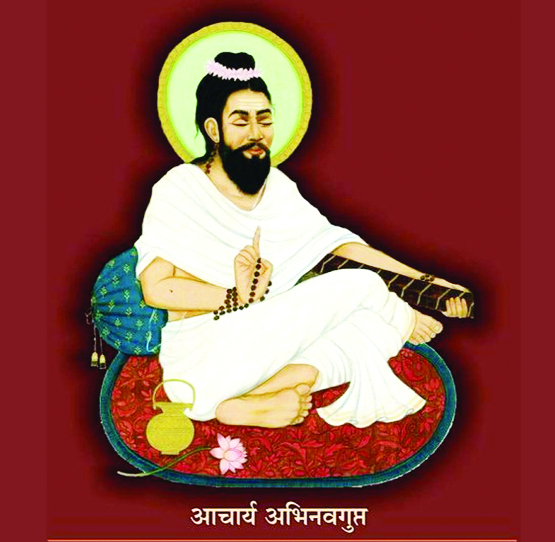
Avtar Bhat
A philosopher, mystic, aesthetician and polymath, Acharya Abhinav Gupta was born in Kashmir during tenth century in a Kanyakubja Brahmin family of scholars and mystics. His forefathers it is said, were brought by Lalitaditya Muktapida a great King of Kashmir from somewhere in Kanuj an ancient town in undivided Uttar Pradesh to Kashmir for dissemination of knowledge of Shastras.
Though the exact date of birth of this legendary Shivacharya is not known but historians reveal it is in between 9th and 10 th century. A great scholar and a Shaivite, Acharya Abhinav Gupta is said to be the incarnation of Lord Shiva himself and he had attained the form of Bhairava.
It is said that Atri Gupta, a great scholar and Shivachariya and one of his ancestors was brought by Lalitaditya to Kashmir and allotted a big estate of land on bank of river Jhelum (Vitasta) in Srinagar as a part of his grand strategy to expand Kashmiri’s intellectual and cultural influence. Lalitaditya, who despite being a Vaishnavite himself was deeply influenced by Atri Gupta’s scholarly knowledge so he invited him to Kashmir.
Atri Gupta after settling in Kashmir was instrumental in establishing the Kashmir School of Shaivism or Kashmir Tantra which was later followed by his son Varah Gupta and great grand son Narasimha Gupta also a great Shivacharya who was the father of Acharya Abhinav Gupta.
Abhinav Gupta gives great credit to his parents father Narsimha Gupta and mother Vimal Kala for his intellectualism which he had himself mentioned in Tantraloka one of his great works. Making its mention in the very first Shaloka– of Tantraloka he says “My essence of being, which is filled with nectar of God consciousness, which has come forth by the union of my mother and father, let that essence of my being vibrate in this whole universe”.
He further says “ My mother was named Vimla because she was residing in the purity of God consciousness and her only festival was my birth in her life., My father who was full bodied had no desires at all for sensual pleasures was named Paficamukhagupta means Narasimha Gupta. The Union of these two great souls was the cause of existence of Abhinav. And let the heart and the essence of my being vibrate in the whole of this universe”.
Giving credit to his father of being his first teacher “Abhinav Gupta says “My father was also my master of spirituality because he was resting in complete and universal Ananda (peace) and he had mastery of all the Shastras and had full information about them. , Let my great master (my father) bestow to me whatever I desire in my spiritual world”.
Abhinav Gupta likewise takes his Guru (teacher) Sambhu Natha in high esteem. In one of the Shalokas in Tantra Loka, he bows before his Master Sambhu Natha who he says was capable of lifting whole universe and not only one or two students. “He could uplift the whole universe in one minute, let him be glorified because he was only master of mine”, says Abhinav Gupta about his illustrious teacher.
Abhinav Gupta is known for his profound contribution to Indian culture, in particular within the sphere of Kashmir Shaivism. He was a great proponent of Trika Philosophy of Kashmir. He was a polymath, and was proficient in various disciplines including music, poetry and drama. His life was marked by a profound spiritual journey during which he studied with multiple teachers and developed a comprehensive understanding of various philosophical and religious traditions.
Among his teachers Lakshman Gupta was also one but Abhivnav Gupta keeps Sambhu Natha in high esteem among all of them. However, he does not remain without giving due credit to Lakshman Gupta also.
“ In Tantra Loka one of his masterpieces, Abhinav Gupta while referring to his Gurus says “I bow to the black bee of the intellect, of Lakshman Gupta” who was one among his other masters. “Lakshman Gupta’s intellect was just like a black bee which was captivating every one’s heart by its sound”.
He also says that not only Sambhu natha but his every disciple was his guru. While explaining this Abhivgupta says that as a bee goes from one branch of flower to another branch to get nectar same was the case with him.
Abhinav Gupta described as a gem and a valuable asset among his peers who was on the highest pedestal of spirituality during his life time has 35 works to his credit but the Tantraloka is described his masterpiece. He has made a commentary on Bharat Muni’s Natishastra which is considered a great critical appreciation by art critics. It is said that no one has surpassed this great philosopher as an art critic so far.
Abhinav Gupta’s commentary on Shrimad Bhagwat Geeta is also considered a masterpiece by the scholars. One of the most imoprortant works of Abhinav Gupta is Isvarapratyabhijna Vimarsini (commentary to the verses on the recognition of Lord) and Isvarapratyabhijna Vikriti-Vimarsini (Commentary on the explanation of Isvarapratyabhijna. This treatise is fundamental in the transmission of Pratyabhijna School (the branch of Kashmiri Shaivism based on direct recognition of the Lord). His another commentary on a Pratyabhjna work Sivadrstya Lohana (light on Sivadrsti) is now lost.
Padarthapravesa Niranjatika and Parkirnkavivarana( comment on notebook) referring to the third chapter of Vakyapadya of Bhatriha his other Commentaries are also lost . Two more philosophical texts of this great Shivacharya are Kathamukha -tilak ( Ornament of the Face of discourses) and Bhedavada Vidarana (Confrontation of Dualist thesis).
His other poetic verses include Ghata Karpara Kelaka Vivrti, a commentary on Ghata karpara of Kalidasa, Kavyakautukavivarana a commentary to the ‘wonder of poetry’ a work of Bhatta Tuta now lost. The Dhanyalokalocana illustration of Dhavanyaloka is also one of the famous works of Abhinav Gupta.
Abhinav Gupta’s mother left the world during his childhood and soon after some time his father renounced the world. This led to a great impact on his life and he was completely wedded to spiritualism. He led a celibate life and it is said that one day when he was at the peak of his spiritual ecstacy he left for Beerawh Gufa (cave) known as Abhinav cave reciting Shivsutra and entered the cave and then did not return from there.
This cave still exists in Beerav tehsil of Budgam’s Central Kashmir district and devotees visit there to pay obeisance to this great master of Kashmir Shaivism every year.
 Follow our WhatsApp channel
