

Maj Gen Sanjeev Dogra (Retd)
sanjeev662006@gmail.com
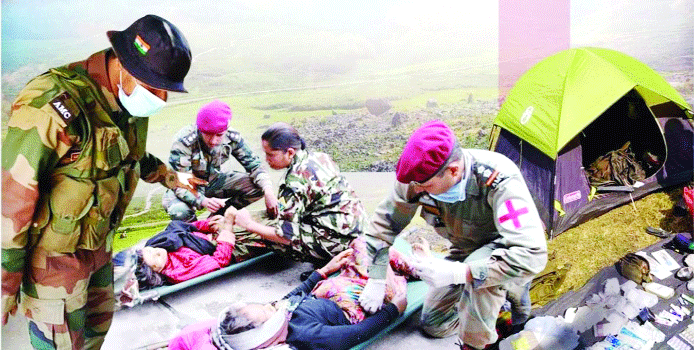
In the armed forces, courage is usually seen at the point of contact: on the icy ridge, in the trench, in the patrol moving silently through the night. But there is another kind of courage, quieter in bearing yet no less profound. It does not announce itself with the crack of gunfire. It bends over the wounded, steadies panic, restores hope and, many times, snatches life back from the edge. That courage wears the same olive green. It belongs to the Army Medical Corps.
Army Medical Corps Raising Day
As the Corps marks its Raising Day on 3 April, this is not merely a date on the calendar. It is a moment to acknowledge an institution whose history stretches back to 1764, and whose service has, for generations, sustained the fighting spirit of the Indian Army in war and peace alike. True to its motto, Sarve Santu Niramaya, let all be free from illness, the Corps has stood as healer, guardian and silent force multiplier of military effectiveness.
My own memories of the AMC are spread across the varied landscapes of a soldier’s life: the disciplined hardship of cadet days, the white desolation of Siachen, the tense uncertainty of insurgency operations, and moments abroad where India’s military medical tradition was remembered with gratitude. At every stage, the Army Medical Corps was present not merely as a service, but as reassurance itself.
My earliest memories go back to the National Defence Academy. Beneath its grand symmetry and inspiring architecture lies a regime of relentless training. Sudan Block may stir the imagination, the parade grounds may fill a young cadet with pride, but cadet life is built on effort, repetition and exhaustion. Young men arrive from civil life carrying soft edges. The Academy begins reshaping them almost immediately, and so does its medical establishment.
The day starts early and demands something at every turn: drill, PT, classes, outdoor training, cross-country, inspections, punishments. A cadet adjusts, but the body and mind still quietly long for one thing: a break. That is where the famous practice of “report sick” came in. Attend C, meaning bed rest, was the category every exhausted cadet secretly hoped for. To a tired cadet, it was not just medical relief. It was temporary liberation.
One incident from my fourth term remains vivid. We had returned from a grueling week-long camp that ended with a 30-kilometre march. Everyone was spent. Predictably, many of us reported sick. The Duty Medical Officer surveyed this parade of suffering faces and, with a wisdom that was simultaneously military and medical, devised his own test. He ordered us all to run 400 meters around the Military Hospital, declaring that the first five to finish would get Attend C. At once, mysterious illnesses began to recover. We ran.
When the run ended, the first five were awarded Attend C. Then came the masterstroke: the doctor also granted Attend C to the last five. The first five, he said, had clearly exerted themselves and deserved rest; the last five truly could not run and therefore deserved rest equally. It was a moment of humour, but also of insight. He healed many of us that day, not with medicine, but with wit.
From the light-heartedness of cadet life, my thoughts travel to a wholly different world. If NDA is about being forged, Siachen is about being tested against nature at its most merciless. There, the battle is not only against an adversary. It is against altitude, cold and the fragile limits of the human body.
Siachen is not just snow. It is endless white, broken only by rock, ice, wind and danger. At 17,000 to 18,000 feet, oxygen thins, movement becomes labored and ordinary tasks demand will. Temperatures plunge to minus 30 and below. Weather turns without warning. Avalanches threaten. Crevasses hide beneath deceptive surfaces. Helicopter evacuation, the lifeline of such terrain, is often impossible for days when the sky closes in.
In such an environment, the role of the AMC acquires an almost sacred dimension. For the soldier in those heights, the medical officer is far more than a doctor. He is confidence. He is survival made visible. High altitude illnesses including pulmonary oedema, cerebral oedema, hypothermia and frostbite can strike with frightening speed. The man standing between a soldier and death may well be the AMC officer posted with him under the same hostile sky.
I have seen these doctors in super high-altitude areas, living amidst the same snow, the same uncertainty and the same long isolation as the troops. They were not observers from comfort. They shared the hardship completely. In those forbidding regions, where the silence of snow can feel heavier than sound, the presence of the AMC was the soldier’s saving grace.
Later, in insurgency-affected areas, the setting changed but the trust remained. Here the enemy was not altitude but sudden violence: ambushes, IED blasts, gunfights in forests and villages. Men go into contact more confidently when they know that if they are hit, a competent medical chain stands ready. In Jammu and Kashmir, one heard again and again the belief among soldiers: if a man reached 92 Base Hospital, he would be saved. That confidence was not about buildings alone. It was professional reputation earned in blood, the soldier’s faith in the Army Medical Corps.
One memory deepened that faith and moved it to a different register entirely. It came not from Indian soil but from South Korea. In a war museum there, I came upon a special acknowledgment of India’s contribution during the Korean War. A newly independent India had sent 60 Parachute Field Ambulance, and its work left such an impression that decades later it was still remembered with warmth. That display stopped me.
Nations may remember you for the force you project. They remember you even longer for the humanity you bring. In Korea, India’s military doctors carried not conquest but compassion. The work of 60 Parachute Field Ambulance remains one of the proud chapters of India’s military-medical heritage, proof that healing, too, is a form of honour.
The Army fights because it is trained, equipped and led well. But it also fights because it knows it will be cared for. Morale in battle does not depend only on weapons and orders. It depends on faith: faith that one will not be abandoned, that life will be fought for, that behind the combat soldier stands a committed medical fraternity ready to act under any circumstance.
Today, I carry this conviction with particular warmth because my own son has joined the Army Medical Corps. That has made my admiration more personal than I anticipated. A father sees not only the uniform but the calling behind it: the long hours, the intellectual discipline, the emotional resilience and the selflessness that military medicine demands. In the AMC, medicine is not practised apart from national duty. It is woven directly into it.
The soldier at the front may be the visible face of national defence. But behind him stands the doctor in olive green, steady-handed, clear-headed, carrying his own kind of battlefield resolve. The Army Medical Corps heals bodies, certainly. But more enduringly, it strengthens morale, sustains confidence and gives the soldier one of the greatest gifts in war and hardship: the assurance that if he falls, someone will fight for him too.
As the Army Medical Corps marks another Raising Day, the nation and the armed forces stand together in saluting this extraordinary institution. May the Corps continue to grow from strength to strength, uphold its splendid traditions with unwavering distinction, and remain always what it has long been for the Indian soldier: not merely a medical service, but hope in uniform.
 Follow our WhatsApp channel
